In ten days’ time, somewhere in the rolling hills of Liguria, Ferrari’s most loyal clients will gather at the Cavalcade, the annual invitation-only grand tour that exists primarily so that 70 wealthy people can drive supercars at each other through medieval villages while drinking very good wine. This year, the brand is bringing something extraordinary: the first “manual” V12 Ferrari in 19 years. There is just one small detail Maranello would prefer you didn’t dwell on. There is no manual gearbox in it.
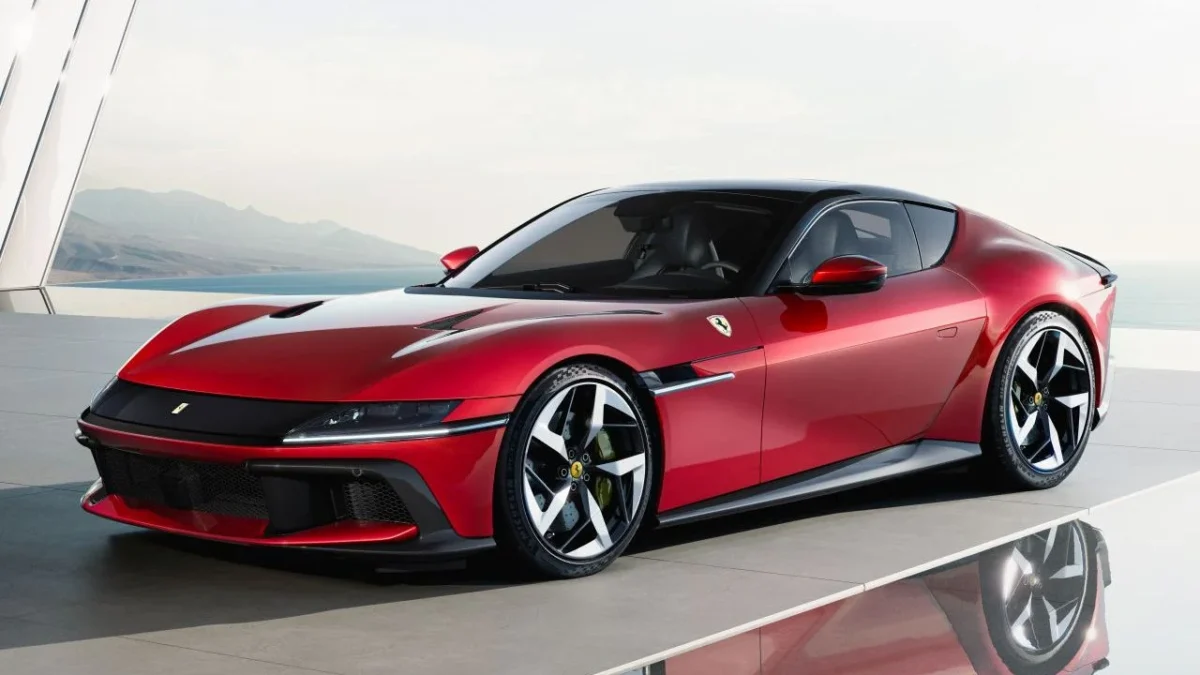
Meet the 12Cilindri MM, a limited-edition version of Ferrari’s last remaining V12 grand tourer, which trademark filings, patent documents and four hours’ worth of fresh leaks confirm will be revealed to clients on 29 June and to the world on 4 July. The MM badge, freshly registered with the Italian Patent and Trademark Office, stands for Mille Miglia. The styling is mildly differentiated. The 6.5-litre naturally-aspirated V12, producing 819 horsepower at a vertiginous 9,250 rpm and 500 lb-ft of torque at 7,250 rpm, is identical to the standard car’s. What changes, and what every petrolhead on Earth is currently arguing about, is the transmission interface. Where the regular 12Cilindri has a row of buttons and paddles, the MM has a beautifully machined, six-speed, H-pattern gated shifter. The kind you used to find in a 599 GTB. The kind Ferrari’s chief marketing officer, Enrico Galliera, told Evo last year customers should look to “classic cars” if they wanted.
Except it isn’t really a manual. Patent US 2026/0160329 A1, which an alert eye spotted earlier this month, lays out the architecture. The shifter is a ball mounted inside a slotted gate reading 1 through 6. Underneath, however, is not a real H-pattern manual gearbox but a shift-by-wire interface providing programmed mechanical resistance designed to mimic the feel of one. Reverse is selected via a button, not the lever. The system can electronically block certain gates at high speeds, presumably to stop a Ferrari client doing something tedious like dropping into second at 130 mph and lunching the engine. The actual transmission, the rear-mounted Magna dual-clutch transaxle that all 12Cilindris share, remains. It just spends its working life being told what to do by a beautifully-engineered theatre prop, sitting beneath the driver’s right hand, that gives the impression of a 1990s Maranello cockpit. It is, frankly, brilliant.
The historical context makes this an entertaining moment. Ferrari built its last factory-fitted manual gearbox in 2012, by which point only 30 of the front-engined V12 599 GTB Fioranos had been ordered with one (out of more than 3,000 examples produced). The economics of double-clutches had won so emphatically that even Ferrari’s most analogue customers had stopped ticking the box. Since then, manual transmissions have been quietly disappearing from every premium segment. The Volkswagen Jetta GLI, the last properly affordable manual sport sedan on the American market, was discontinued for the 2027 model year due to insufficient demand. Less than 1% of new vehicles sold in America still offer a stick shift. And yet, in roughly the same window, manual-equipped older Ferraris, Porsches and Aston Martins have been changing hands at auction for two to three times the price of their automatic siblings. The market has spoken with both wallets at once.
What Ferrari has done with the MM is, in commercial terms, very clever. The dual-clutch transaxle is faster, smoother, less mechanically fragile and substantially cheaper to engineer than a true manual. By keeping it and pairing it with a simulated H-pattern interface, Ferrari gets the visual theatre of analogue driving — the polished aluminium knob, the satisfying click into gear, the slight retro snobbery — without the expense, warranty risk, or development time of a real manual gearbox. The customer can also have what would otherwise be an entirely irreconcilable combination: 9,250 rpm of unmolested V12 against an engine architecture that is rapidly going extinct elsewhere and the romance of a gated shifter, on a single car. Koenigsegg pioneered the trick with its Engage Shift System. Ferrari, as ever, is finishing the homework with a flourish.
The forward-looking takeaway is that the 12Cilindri MM will be expensive, gloriously irrational, and almost certainly sold out before the press embargo lifts. Estimated production is fewer than 100 units. Estimated pricing is north of $700,000. Estimated proportion of buyers who will actually drive it: roughly 12%. The rest will go straight to climate-controlled garages alongside their F40s and Enzos, where they will appreciate at the predictable Ferrari rate of about 8% per year. The naturally-aspirated V12 is on official borrowed time — Euro 7 will not be kind to it — and the gated shifter, real or simulated, is a lovely fingers-crossed gesture of remembrance from a brand that has otherwise sprinted toward an electric future. The manual isn’t back. It is being commemorated. And honestly, given the state of the world, that may be the most Ferrari thing imaginable.