Porsche has spent its entire existence making cars that reward driver engagement. The flat-six in the 911, the naturally aspirated howl at 8,000rpm, the mechanical intimacy of a well-chosen gear change — these are not incidental features. They are the product. So when Porsche adds a simulated eight-speed gearbox to its fully electric Taycan, complete with artificial shift jerks, a virtual rev counter, and a software-generated redline at 7,500rpm, it is doing one of two things. Either it has found a genuinely clever way to preserve the emotional connection that makes a sports car worth the money, or it has quietly admitted that electric cars, as currently constituted, are missing something important.
Both things can be true simultaneously. That is rather the point.
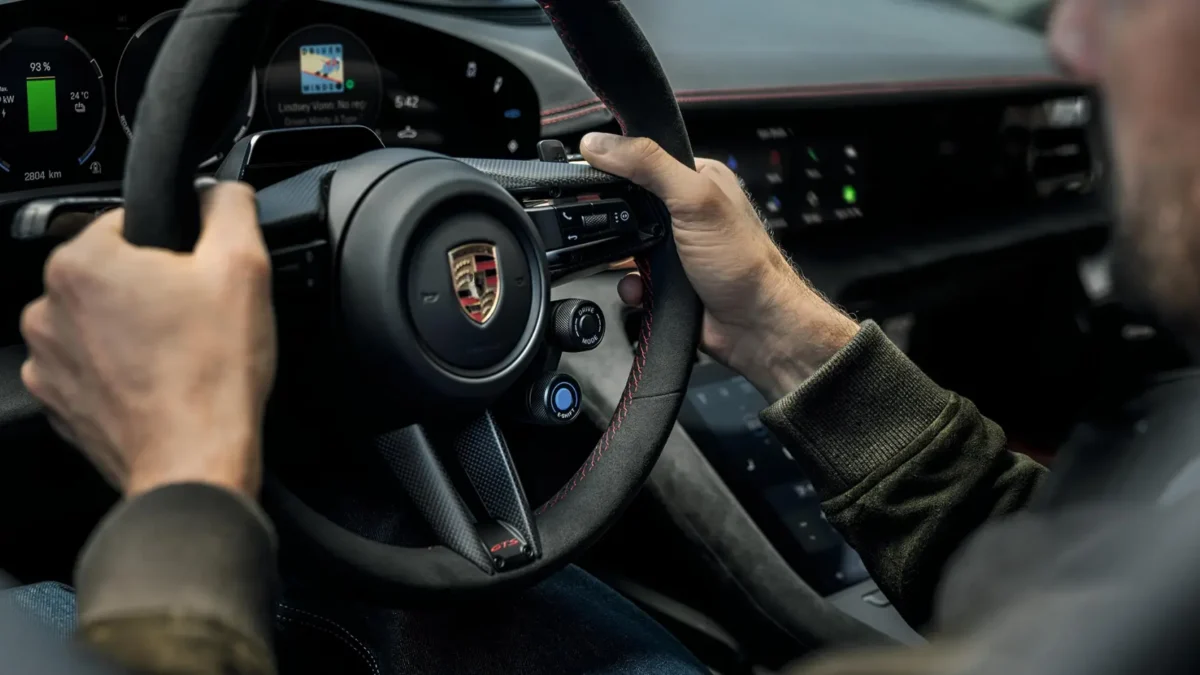
The 2027 Porsche Taycan introduces E-Shift across all model variants — an optional system that simulates an eight-speed sequential gearbox via steering-wheel-mounted paddles, complete with noticeable shift jerks, gear-specific drag torque comparable to engine braking in a combustion car, and a virtual rev limiter. The irony that the Taycan already has a real two-speed transmission on its rear axle — which continues shifting on its own in the background — while the eight simulated gears are pure software is not lost on anyone who has been paying attention. Porsche has, in essence, added fake gears to a car that already has real ones and doesn’t tell you about them.
Porsche previously said it wouldn’t do fake shifts. Then it was spotted testing the Hyundai Ioniq 5 N in Germany. Then Frank Moser, VP of the 718 and 911 model lines, said the Ioniq 5 N was “eye-opening” and had even converted Andreas Preuninger — the man in charge of Porsche’s GT cars — from sceptic to convert. There is something genuinely entertaining about the narrative of Porsche’s most serious GT car engineers being won over by a Hyundai. It is, however, an accurate account of what happened, and Hyundai deserves full credit for demonstrating, with its N e-Shift system, that simulated engagement in an EV is not automatically contemptible.
Porsche sold just 16,339 Taycans in 2025 — down more than half from its 2021 high of 41,296 units. That is the context within which E-Shift arrives. The Taycan is a genuinely brilliant technical achievement — one of the finest electric cars ever built — that has struggled commercially in a market where Chinese competitors are offering comparable or superior technology at significantly lower prices, and Ferrari has gone in the opposite direction with amplified natural vibrations and “power levels” rather than simulated gears. The 2027 update is an attempt to address the emotional engagement gap that has been, alongside price, the most consistent criticism of the electric sports car category.
Beyond the headline feature, the broader updates are substantive. The 105-kWh Performance Battery Plus pack becomes standard across all Taycans, enabling a higher maximum charge rate of 320 kW. Over-the-air infotainment updates are now possible for the first time, and the new Porsche Digital Interaction suite offers up to five times the computing power of the previous system with an AI-supported Voice Pilot. A NACS fast-charging port joins the driver’s side J1772 AC port on all models except the Turbo GT Weissach — meaning American Taycan owners can now use Tesla Superchargers natively, which is arguably a more practically significant update than eight virtual gears. The Sport Turismo and Cross Turismo wagon variants have been quietly discontinued, which will disappoint the small but vocal contingent who believed the Taycan wagon was the most sensible performance car Porsche had ever made.
The pressure from Chinese premium EV brands — the six-seat SUVs at BMW prices that debuted at Beijing in April — makes all of this feel urgent in a way that earlier Taycan updates did not. Porsche’s counter is not to compete on specification alone. It is to argue that a Porsche should feel different from everything else, including its own engineering. E-Shift is that argument made tangible: you can drive the Taycan as a conventional EV, or you can engage eight gears that don’t exist and feel, at least according to the software, like they do.
Whether that argument persuades enough buyers to reverse the sales trajectory is the question the EV category will be watching. Porsche starts deliveries in autumn 2026, priced from $111,900 in the United States. The fake gears are optional. The sales pressure is not.