The Porsche Carrera GT was a $440,000 car when it went on sale in 2004. That was considered a great deal of money for a road car and a slightly alarming amount for something that could, if you misjudged a corner on a damp circuit, snap sideways with enough speed and aggression to end the conversation permanently. 1,270 examples were built. The engine was a 5.7-litre naturally aspirated V10, producing 605 horsepower and revving to 8,400rpm. The clutch was carbon. The chassis was carbon. The driving experience was extraordinary and terrifying in roughly equal measure.
In January 2026, a Seal Grey example sold at RM Sotheby’s Arizona auction for $3.085 million. Six weeks later, at Broad Arrow’s Amelia Island sale, a paint-to-sample Gulf Blue Carrera GT sold for $6.715 million, more than tripling the auction record set just months earlier. Four of the six Carrera GTs sold at auction in 2026 achieved over $3 million. The car that originally retailed for $440,000 has become one of the defining collector cars of the modern era, and 2026 appears to be the year the market decided to make that official.
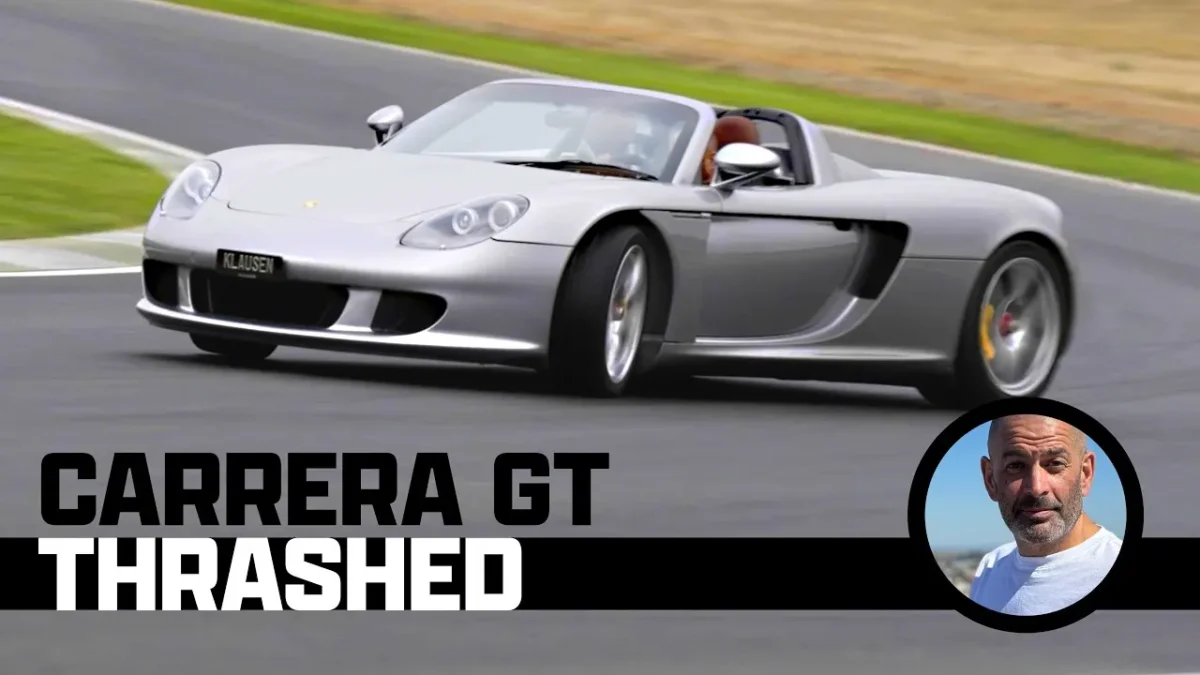
Chris Harris recently drove one at Ascari. He was, by his own admission, quite frightened.
Why the Carrera GT Still Demands Respect
This is not false modesty. Harris has driven essentially everything. His assessment of the Carrera GT on a damp morning is worth reading carefully, because it explains something important about why the car has become so valuable.
The Carrera GT has no ESP. It has a traction control system, and that is all. At speed on a damp surface, the car’s behaviour when the throttle is applied or lifted requires absolute precision: not how you get the slide going, Harris notes, but how you wind the lock off and come off the throttle. Unless you get it absolutely right, it snaps back. The traction control button is famously located in the exact spot your hand naturally travels during a downshift from fourth to third, raising the question of how many Carrera GT incidents have been caused not by driver error but by inadvertent TC deactivation at precisely the wrong moment.
The V10: An Engine Unlike Any Other
The contrast between the car’s demand for absolute commitment and the quality of the reward is what makes it special. The V10 engine is, Harris notes, amazing. It is a linear engine, pulling cleanly from low revs to its maximum, with a sound he describes as Audi-like in its sophistication inside the cabin, though considerably more theatrical from outside.
The naturally aspirated 5.7-litre V10 produces 605 horsepower and was originally conceived for the LMP2000 racing programme. By today’s standards, the power output is not exceptional. What it delivers cannot be quantified in power figures: it is the experience of driving something with no digital intermediaries between you and the machine, at a time when the industry has systematically removed every such sensation from its products.
The brakes are superb. The hydraulic steering provides feedback. It does not feel like carrying something large into a corner. It feels like carrying something extremely alive into a corner.
Why $6.7 Million Makes Sense
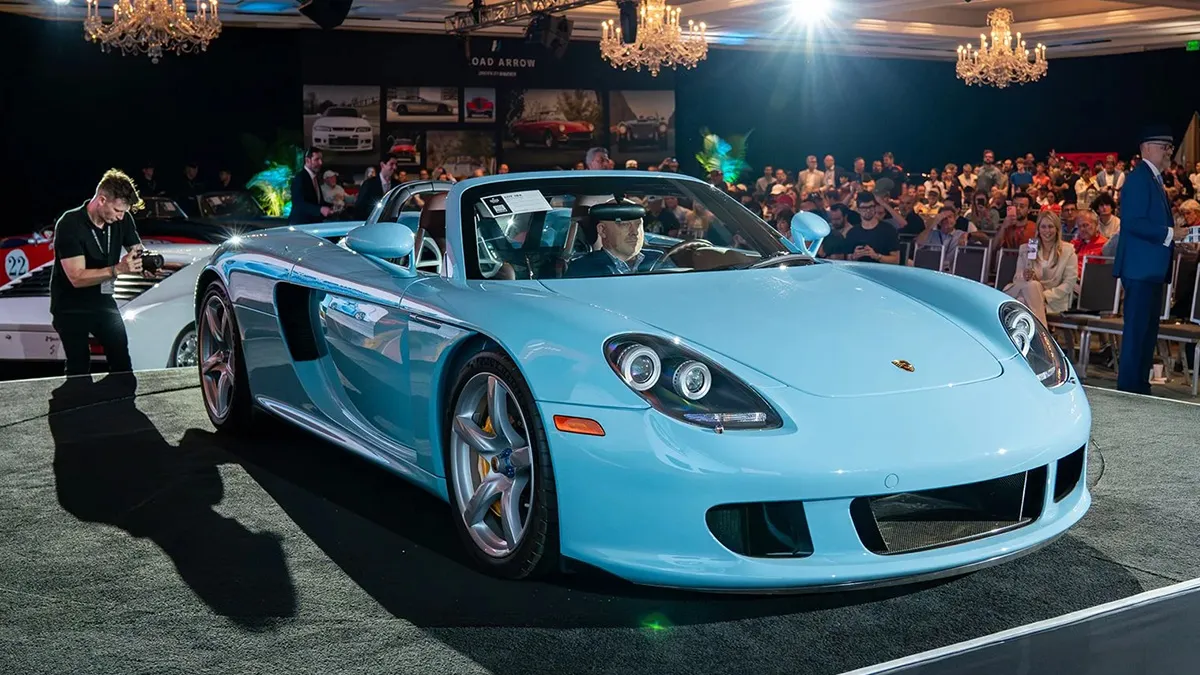
The Hagerty 2026 Bull Market List includes the Carrera GT, with production limited to 1,270 units and values having resumed an upward trajectory. The record sale at $6.715 million represents a paint-to-sample specification car, but the broader appreciation across the model is structural, not merely speculative.
Every significant road car launched in 2026 has adjustable driving modes, electrified assistance, and sophisticated stability systems. The current Porsche hypercar lineup is the 918 Spyder’s spiritual successor, which was itself a hybrid. What the Carrera GT offers is specific: a V10 derived from racing, in a car that requires you to drive it properly, with no assistance beyond your own competence.
As Harris puts it, arriving at the Boxster comparison that reviewers always make and dismissing it: the Boxster has an approachability that this doesn’t. You are aware this is a much bigger car and it responds to trading throttle and agitation in a way that requires you to behave.
This, in a market where analogue collector cars are appreciating systematically and where the broader EV market reality check has clarified the distance between what regulators wanted and what buyers actually chose, is the entire point. You cannot buy a new analogue supercar. The Carrera GT is one of the last things built before the industry collectively decided the driver’s job was to select a mode and stay in the lane.
The Conclusion
Harris finishes his damp morning at Ascari with the Carrera GT in his top ten. He is being tippy-toed, not really trying, conscious of the consequences of pushing harder on a slippery surface. Even in this state, the car is demanding, precise, and present in a way that modern performance cars with 800 horsepower and ten driving modes are not.
Someone paid $6.7 million for one in February. The car’s original MSRP was $440,000. That is not a coincidence. It is a collector car market expressing a preference with considerable clarity for the kind of car that cannot be made anymore.
On the evidence of what it offers and what it represents, they may have got a bargain.