The Honda Civic Hybrid is a genuinely excellent car. It is reliable, efficient, competitively priced at around $30,000, and will almost certainly never strand you on the side of a motorway with its head gaskets in a carrier bag. It is, in every measurable sense, the responsible choice. It is also, as Throttle House’s Thomas and James put it with admirable precision, the kind of car chosen by the kind of person who does 10,000 steps a day, calls their mother, and makes low-risk investments. Nothing wrong with that. But perhaps not why you’re reading this.
For approximately the same money, the used car market currently offers three of the most characterful naturally aspirated V8 sport sedans ever produced in the same generation: the Audi B7 RS4, the BMW E90 M3, and the Mercedes-Benz W204 C63 AMG. All three have engines that are either identical to or directly derived from the flagship sports cars of their respective brands at the time. All three are compact, four-door, capable of reasonable fuel economy when you can resist the temptation, and deeply, absurdly entertaining to drive. All three will, at some point and without much warning, require you to spend money you had planned to spend on something else.
This is the catch. It is not a small catch.
Start with the Audi. The B7 RS4, produced between 2006 and 2008, carries the same 4.2-litre naturally aspirated V8 that powered the original Audi R8 — the actual mid-engined supercar — tuned to produce 420 horsepower and an 8,250rpm redline, which was the highest of any cross-plane crank V8 ever produced at the time. It runs through a six-speed manual gearbox, which in this application shifts with a precision and weight that surprises people who have spent too long dismissing front-engined Audis as refrigerators with exhaust pipes. The steering actually communicates. The Quattro all-wheel-drive system provides confidence that its rear-wheel-drive rivals cannot in the wet. Current market medians for the B7 RS4 sit around $32,300, making it the most affordable of the three on the sticker. The owner in the Throttle House video paid around $40,000 Canadian and has since invested a further $40,000 in keeping it properly. Carbon buildup in the intake valves requires walnut blasting — an actual procedure using actual walnut shells — and the factory dynamic dampers are no longer supported by Audi, meaning everyone fits aftermarket units and calls them “period correct maintenance.”
The C63 AMG 507 Edition is, on the numbers, the most dramatic option. The 6.3-litre V8 — called a 6.3 for heritage reasons despite being slightly over 6.2 litres, which is the kind of historical revisionism only a German engineering department could deliver with a straight face — produces 507 horsepower in this specification. Market medians for the W204 C63 currently sit around $36,900. It sounds extraordinary. The chassis is taut, the seats are supportive, and the engine has a midrange torque delivery that makes you drive in ways you had not previously planned. The known problems are the kind that should give pause: head bolts that fail, causing head gasket failure, causing catastrophic overheating, causing an engine that is suddenly and completely not fixable without a great deal of money. The MCT automatic gearbox is the correct gearbox for this car’s character and is also, shift by shift, somewhat slower than the standard of a decade later. You learn to drive it, which becomes part of the ritual.
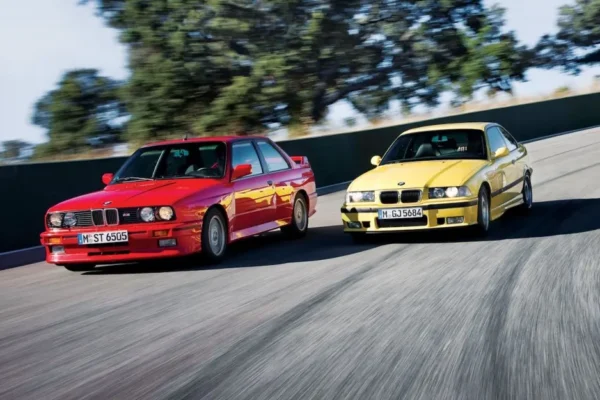
The E90 M3, produced from 2008, has the S65 V8 — a 4.0-litre, 420 horsepower, 8,400rpm engine that is derived from Formula racing technology in the way that gets mentioned every time anyone describes it, and which remains entirely and completely true. Available in manual or automated single-clutch, the manual version is the one everyone wants and the one this comparison uses. Values currently sit around $34,300 for clean examples. It is the lightest of the three by hundreds of pounds, and this is the most important single fact about it. It rides better than the C63, handles better than the RS4, and has a more sophisticated rear differential than either. The known problems are rod bearings and throttle actuators, both of which are well-documented and must simply be done.
The honest conclusion of all this, which Throttle House arrives at after forty minutes of entirely entertaining debate, is that the BMW M3 is the best car of the three by a margin wide enough that reasonable people agree on it even if they prefer the others. It is lighter, more capable, better balanced, and has a manual transmission that is actually satisfying to use. The RS4 is the most confidence-inspiring daily in adverse weather and has the best build quality of the three. The C63 is the most theatrical and lovable and has the worst gearbox, and these two things are probably related.
The uncomfortable truth is the maintenance bill. None of these cars costs $30,000 to own. They cost $30,000 to buy, and then they cost whatever it costs to keep a high-revving naturally aspirated V8 sport sedan from the late 2000s in the condition it deserves, which is more. As one period review noted about these cars’ collective rivals at the time, they were criticized for being “too complicated” — a verdict that now reads as a document of innocent optimism, given what German interiors look like today.
The European sport sedan category produced cars in this generation that will not be replaced by their direct successors. The current BMW M3 has a turbocharged inline-six and weighs more. The current Mercedes-AMG C63 has a four-cylinder hybrid producing 671 combined horsepower and sounds like what happens when you ask an engineer to simulate excitement without using a V8. The Audi RS 5 has just arrived with plug-in hybrid technology and 5,129 pounds of curb weight. What you are buying when you buy any of these three cars is something that does not exist in a showroom anymore and will not again — Toyota’s GRMN Corolla is the rare exception, a 300hp naturally aspirated manual track car landing in 2026 against every prevailing industry instinct, and the closest current parallel to what these German V8s represented when new.
The Civic Hybrid gets 47 miles per gallon combined and will require you to feel nothing. Make your choice accordingly.