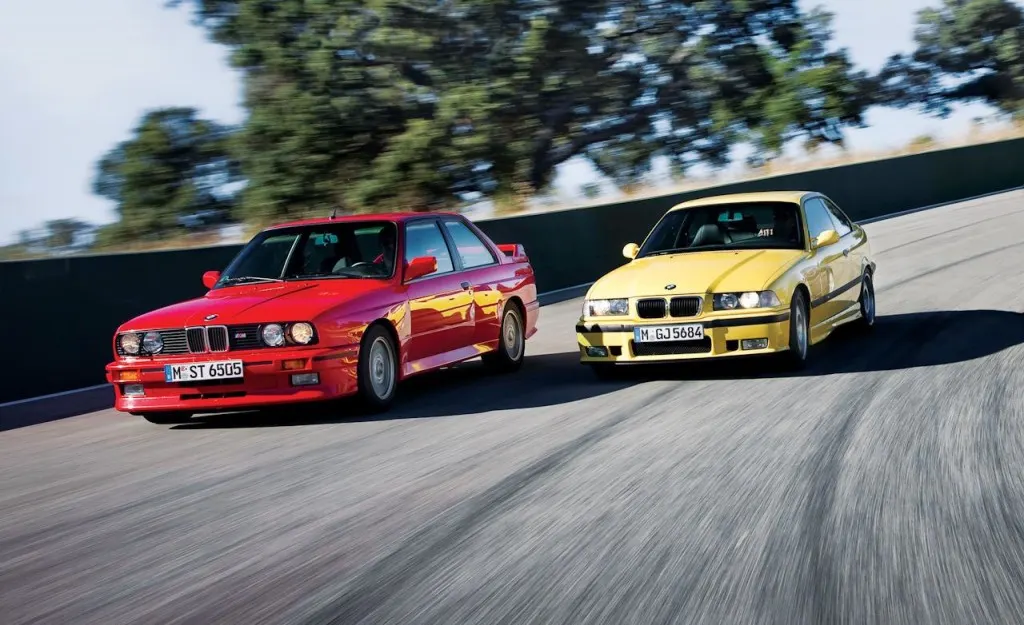
The BMW E30 M3 was not designed to be a great car. It was designed to be a legal racing car — specifically, to satisfy the FIA’s Group A homologation requirements, which mandated that 5,000 road-going examples of any car entering touring car competition had to be built and sold to the public. BMW needed a race car. The road car was the price of admission.
What they got, in trying to make that road car good enough to sell 5,000 times, was something considerably more than they had bargained for. The E30 M3 is now one of the most sought-after cars in the history of the brand — a homologation special whose purity of purpose translated into a driving experience so focused and communicative that thirty-five years of subsequent development have not produced a successor that matches it on those specific terms.
The decision that guaranteed its legendary status was not the one that created it. It was the one made in the late 1980s, when BMW looked at what the E30 M3 was and decided, deliberately and with full awareness of what they were doing, to replace it with something different.
What the E30 M3 Actually Was
To understand why the E36 M3 disappointed people who cared about the E30, you need to understand what the E30 had been built to do.
The Group A touring car regulations that the E30 M3 had been built specifically to satisfy required a car that could be developed into a competitive touring car racer while remaining recognisably related to its road-going form. This meant the M3 needed the right architecture from the start — a four-cylinder engine that could be tuned without limit, a body structure that could be stiffened without fundamental redesign, and aerodynamic provisions that made sense in competition.
Mazda had made the rotary their identity. BMW made the racing brief their constraint. The S14 engine — a 2.3-litre four-cylinder with a twin-cam sixteen-valve head, derived from BMW’s Formula Two programme — produced 200 horsepower in road specification. In competition tune, it produced considerably more. The car was built with wide arches to accommodate racing slicks, a boot lid spoiler that was functional rather than decorative, and a suspension setup calibrated for the track with the road car as a secondary consideration.
The result weighed under 1,200 kilograms and steered with a directness that larger, heavier cars with more power could not replicate at everyday speeds. It was not the fastest M3 in history by any objective measure. It remains, in the view of most serious drivers who have owned several generations, the most rewarding to drive at eight-tenths — the speed at which the vast majority of enthusiasts actually use their cars.
The Decision BMW Made
The E30’s production run ended in 1991. The E36 chassis — a significantly larger, more refined, more sophisticated platform — was already in development as the new 3 Series. BMW M had to decide what the next M3 would be.
The options, broadly, were two. They could build another homologation special — a car defined by racing requirements, focused and uncompromising, with the commercial viability of the road car as a secondary concern. Or they could build a proper sports saloon — a car designed primarily to be desirable and liveable for the customer who would pay M prices for it, with the racing programme as a secondary consideration.
By the late 1980s, BMW’s touring car programme was evolving. The DTM — the Deutsche Tourenwagen Meisterschaft — had replaced Group A as the primary competitive arena for manufacturers. The DTM’s technical regulations were more open than Group A had been, which meant the strict homologation relationship between road car and race car was looser. BMW didn’t need the road car to dictate the race car in the same way.
Without the racing brief imposing its requirements, the product planners’ priorities took over. The E36 M3 customer, as BMW’s market research defined them, wanted more power, more refinement, more space, and more of the things that made a car feel expensive rather than purposeful. The E36 could deliver all of those things. The question was whether delivering them required sacrificing what had made the E30 special.
BMW concluded that it did, and decided the trade was worth making.
What the E36 M3 Was
The E36 M3, launched in 1992, was a genuinely excellent car. The S50 straight-six produced 286 horsepower in European specification — significantly more than the E30 — and delivered it with the smoothness and linearity that six-cylinder engines provide and four-cylinders cannot. The interior was a generation ahead of the E30’s in terms of refinement and equipment. The chassis was more sophisticated. The car was quieter, faster in a straight line, and considerably more comfortable on a motorway.
It was also heavier by approximately 200 kilograms, larger in every dimension, and calibrated for a buyer who wanted to use it as a daily driver rather than as an occasional track weapon. The steering was less direct. The throttle response was less immediate. The sense of the car communicating the road surface through every contact point — the quality that E30 drivers described as the thing they would miss most — was present but attenuated. The E36 M3 told you things. The E30 M3 told you everything.
Road testers of the period were broadly positive about the E36. They praised its performance, its refinement, its value relative to competitors. What some of them noted, with varying degrees of directness, was that it felt less like a driver’s car in the specific sense that the E30 had defined — that the edge which had made the E30 memorable had been smoothed away in the service of broader appeal.
BMW’s sales figures suggested the broader appeal was real. The E36 M3 sold in considerably larger numbers than the E30 had managed. The customer BMW had designed it for existed and was buying it.
The Long Argument
The enthusiast community’s dissatisfaction with the E36 M3 did not fully crystallise until the E30 had been off sale long enough for its qualities to be properly missed. By the mid-1990s, the gap between what the E30 had been and what the E36 was had become a recurring topic in motoring press that, in retrospect, reads almost as a collective grieving process.
The E46 M3, launched in 2000, was widely received as a return to form — a car that recovered much of the focus the E36 had traded away while retaining the power and refinement gains. It is now considered one of the finest M3s ever made and commands significant premiums on the used market. But it arrived a generation late for the people who had followed the E30 to the showroom and been disappointed.
The subsequent M3 generations have each provoked their own arguments about focus versus breadth, purity versus capability. A pattern of M division being overruled by product planners that didn’t end with the E36 — the V8 controversy, the turbocharged straight-six controversy — suggests that the tension between what M’s engineers want to build and what the market is deemed to require is structural rather than episodic. The E36 was not an aberration. It was the first clear expression of a recurring argument.
Were BMW Wrong?
The honest answer is: probably not, and that is the most uncomfortable conclusion the E36 story offers.
BMW built a car that sold well, that customers liked, that was by almost any objective measure better than its predecessor on criteria that matter to most buyers. The people who were disappointed were a specific subset of enthusiasts whose priorities were not shared by the majority of M3 customers. BMW made a decision to serve the majority. That is, normally, what companies do.
The E30 M3’s current values — examples in good condition regularly achieve six figures, with exceptional cars selling for considerably more — are partly a consequence of that decision. A car that was replaced by something more broadly appealing became, by contrast, something special. Its successor’s compromises defined its predecessor’s purity. The E30 M3 is as legendary as it is partly because BMW chose not to continue what it had started.
The decision to soften the M3 for the E36 generation preserved the E30’s reputation more effectively than any continuation of its formula could have. Which is either an irony or a lesson, depending on how generously you’re feeling.
What It Tells Us
The E36 M3 decision is a case study in the difference between what a product means to its most devoted customers and what it means to the market that actually funds its development. BMW’s engineers understood what the E30 was. BMW’s product planners understood what the next generation of customers wanted. Both understandings were correct. They pointed in different directions.
The choice to follow the product planners rather than the engineers produced a very good car that disappointed the people who cared most, sold well to the people who didn’t know what they were missing, and inadvertently canonised its predecessor by refusing to match it.
The E30 M3 is irreplaceable because BMW decided, in 1988 or thereabouts, not to replace it. That may be the most accidental act of brand building in the history of the company.