The year is 1980. You are a World Rally Championship competitor. You have spent years developing your rear-wheel drive car to a fine edge. You have learned its limits, managed its weaknesses, extracted everything the regulations allow. You arrive at a stage in Sweden and discover, idling at the start line, a large German saloon with an engine in the front, driven wheels at all four corners, and the aerodynamic subtlety of a wardrobe.
You probably laughed.
You should not have laughed.
The Audi Quattro’s arrival in the World Rally Championship is one of those hinge moments in motorsport history where almost everything that came before it was immediately obsolete. Not gradually superseded, not incrementally improved upon — obsolete, within a season or two, in the same way that a letter becomes obsolete the moment email exists. The decision that put it there was not obvious, was not universally supported, and was made possible by a regulatory loophole that Audi’s engineers spotted before anyone else thought to look.
The Rule Nobody Had Noticed
Four-wheel drive was not new in 1980. It existed in military vehicles, agricultural machinery, and the occasional experimental road car. In motorsport, it had been tried and largely abandoned — the additional mechanical complexity and weight penalty were considered to outweigh the traction benefits, particularly on the mixed-surface stages of international rallying.
The FIA’s Group 4 regulations, under which the Quattro would initially compete, did not prohibit four-wheel drive. It had simply never occurred to anyone to try it seriously, because the received wisdom said it wouldn’t work at the level required.
Audi’s chief engineer Ferdinand Piëch — the same Piëch who had clashed with Ferry Porsche over the 911’s future and who would later turn Volkswagen Group into a global superpower — disagreed with the received wisdom. Piëch had been developing a four-wheel drive system for a military vehicle project at Audi and noticed, studying the rally regulations, that nothing in the rulebook prevented him from using it in competition.
The observation was straightforward. The implication was seismic.
What They Built
The Quattro road car, launched in 1980, was the platform from which the rally programme was developed. It used a turbocharged five-cylinder engine — itself an unusual configuration, chosen partly for packaging reasons and partly because five cylinders in a line produced a power delivery characteristic that Audi’s engineers found usefully progressive — producing around 200 horsepower in road specification.
The four-wheel drive system used a centre differential to distribute power between the front and rear axles, with the driver able to lock both the centre and rear differentials manually when conditions demanded it. On loose surfaces — gravel, snow, mud — the ability to put power through all four wheels rather than two transformed the car’s behaviour at the limit. Where a rear-wheel drive car required a driver to manage oversteer through throttle and steering inputs, the Quattro simply drove. Not easily — it was heavy, and its turbo had the on-off power delivery characteristic of the era — but consistently, in conditions where consistency was the difference between winning and sliding into a ditch.
For rallying, where stages routinely mixed tarmac, gravel, ice, and mud within a single run, this was not a marginal advantage. It was a categorical one.
The First Season
The Quattro made its WRC debut at the 1981 Monte Carlo Rally, driven by Hannu Mikkola. It did not win. The car was heavy, the crew were learning, and Monte Carlo’s particular combination of dry tarmac and treacherous ice-over-tarmac did not immediately play to the four-wheel drive system’s strengths.
By the end of the season, the picture was considerably clearer. On loose surfaces — Sweden, Portugal, the Acropolis — the Quattro was not merely competitive. It was in a different race from the two-wheel drive cars. Mikkola won in Sweden. Michèle Mouton — the most successful female driver in WRC history, and a figure whose talent Audi had the wisdom to recognise before most of the paddock had caught up — won in Portugal and San Remo. In just its first full season, the Quattro had won four rounds of the world championship.
The competition noticed. Urgently.
The Arms Race
What followed the Quattro’s arrival was the most concentrated period of technical development in rally history, compressed into barely half a decade before the consequences became too severe to ignore.
Lancia developed the Rally 037 — rear-wheel drive, supercharged, aerodynamically sophisticated — as a direct counter to the Quattro and won the 1983 Manufacturers’ Championship with it. It was the last rear-wheel drive car ever to win a WRC Manufacturers’ title. Peugeot produced the 205 T16, mid-engined and four-wheel drive, which was quick enough to beat the Quattro at its own game. Ford, MG, Renault and others poured resources into their own Group B programmes.
Everyone, eventually, built a four-wheel drive car. Audi had made the alternative unthinkable.
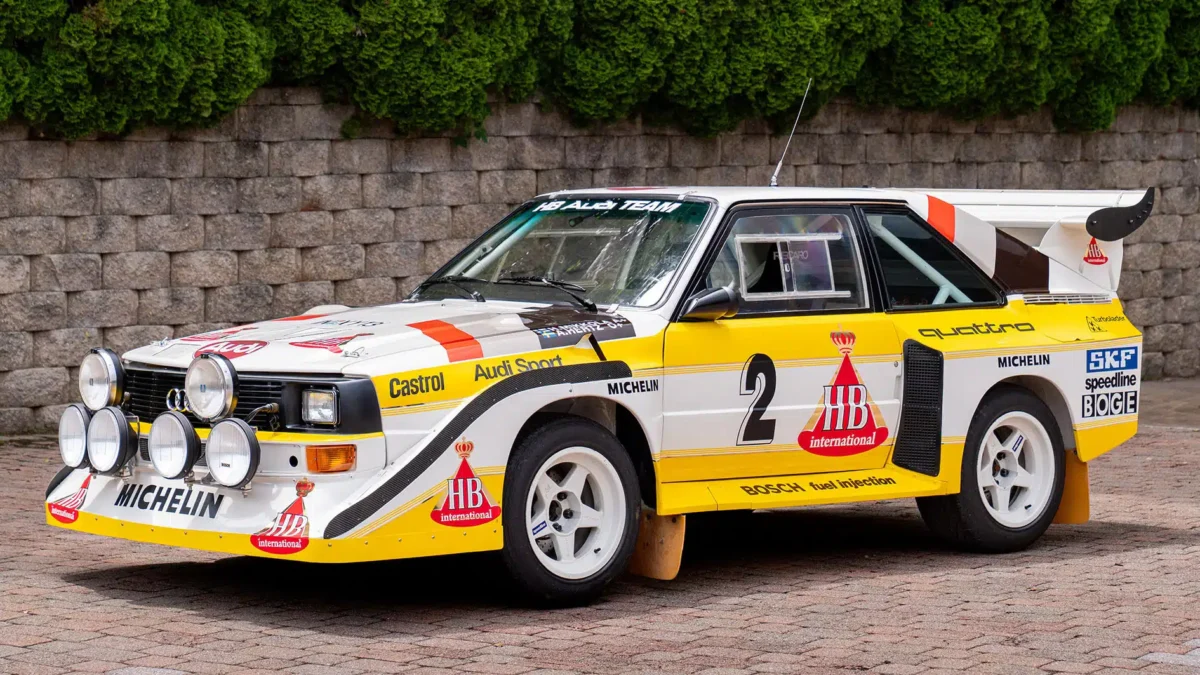
Audi’s own response to the escalating competition was the Group B arms race they had started — progressively more extreme versions of the Quattro culminating in the Sport Quattro S1, a shorter, wider, more powerful machine producing somewhere between 450 and 600 horsepower depending on the stage and the tune. The S1 was, by common consensus, one of the most spectacular and terrifying competition cars ever built. Its power, delivered through a narrow, twisting forest stage to a crowd standing three deep at the apex, was genuinely dangerous — to spectators, to drivers, to the sport’s relationship with safety.
Group B was banned after the 1986 season, following a series of fatal accidents. A tradition of German engineers doing things on a racetrack that nobody thought made sense had, in this instance, produced something so fast it couldn’t be allowed to continue.
What It Left Behind
The Quattro’s legacy is not limited to rally trophies and banned regulations. It is present in every performance car made in the decades since, and in a great many ordinary ones.
Audi built the Quattro name into a brand architecture that persists across their entire range today. The technology that Piëch developed for a military vehicle and adapted for rallying became, progressively, a mainstream option on road cars, then a standard feature on premium models, then an expected specification on anything asked to deploy serious power. When Porsche introduced all-wheel drive on the 964 in 1989, they were following a path Audi had cleared. When Mitsubishi and Subaru built four-wheel drive into the Evo and Impreza to create the greatest touring car rivalry in motorsport history, they were extending a logic that the Quattro had established.
The list of high-performance cars that use some variant of the insight Piëch had in 1977 — that four driven wheels are better than two on a surface with imperfect grip — now includes almost every serious performance car built anywhere in the world.
What It Tells Us
The Quattro story is, at its core, a story about reading the rules more carefully than your competitors. Piëch did not invent four-wheel drive. He noticed that the regulations did not prohibit it, concluded that the received wisdom about its unsuitability was wrong, and committed Audi’s resources to proving the point before anyone else had worked out what he was doing.
By the time the competition understood what was happening, Audi had a full season of development, a set of race results that couldn’t be argued with, and a head start that took the entire field three years to close.
The lesson is not that four-wheel drive was obviously right. The lesson is that obvious is often just another word for what everyone already assumes. Piëch, characteristically, didn’t assume. He looked.
The rally car that everyone laughed at in 1980 spent the next six years making the entire world rally field obsolete, inspired a generation of four-wheel drive road and racing cars, and ended by going so fast that the sport had to stop it.
Not bad for something that was too heavy.