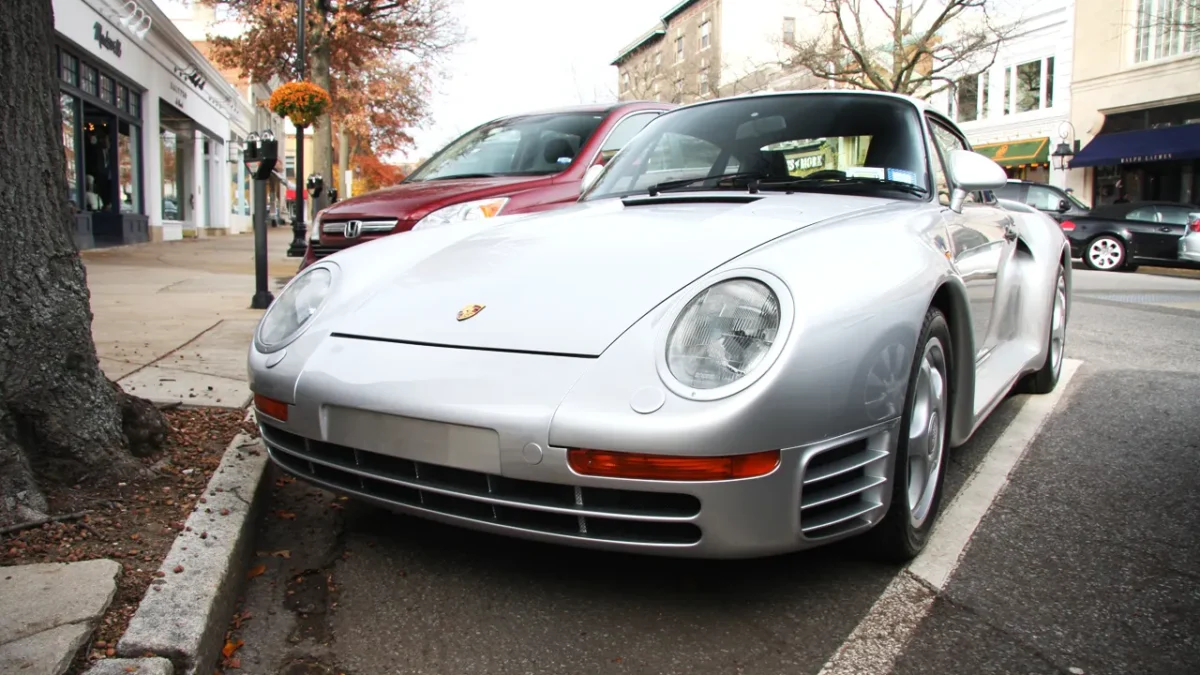
In 1986, Porsche unveiled a car that looked like the future. Low, wide, and aerodynamically sculpted, the 959 shared the general silhouette of the 911 but shared almost nothing else. It had a twin-turbocharged flat-six producing 450 horsepower, a sophisticated all-wheel drive system controlled by an onboard computer, adjustable ride height, and a top speed of 317 km/h that made it the fastest production car in the world at the time of its launch.
What very few people knew was that by the time the 959 reached showrooms, the competition it had been built to win no longer existed.
Group B and the Brief It Created
In the early 1980s, the FIA introduced Group B — a category of motorsport that would prove to be one of the most extraordinary, and most dangerous, in the history of rallying. Group B had minimal technical regulations and required manufacturers to build just 200 road-going examples for homologation. The result was a generation of cars that pushed the limits of what was mechanically possible: the Audi Quattro S1, the Peugeot 205 T16, the Ford RS200, the Lancia Delta S4.
Porsche’s response to Group B was the 959. In company documents, the car was initially designated the 961. The plan was to build a four-wheel drive vehicle that would compete in the Paris-Dakar Rally and, eventually, in circuit-based Group B competition. The technical brief was essentially an invitation to build the most advanced car Porsche could conceive — a direct response to the Group B arms race that Audi had started with the original Quattro, which had spent the early 1980s dismantling every rear-wheel-drive rally car that turned up against it.
They accepted.
The Technology
The 959’s engineering represents a compression of concepts that would define high-performance cars for the following two decades into a single machine.
The all-wheel drive system was not a simple mechanical split. It used a computer-controlled Porsche-Steuer Kupplung (PSK) system that could apportion torque between the front and rear axles almost infinitely — from a 50/50 split in slippery conditions to as much as 80 per cent to the rear in dry, high-grip situations. The system read wheel speed, throttle position, and steering angle, then made adjustments in milliseconds. Nothing remotely like it existed in a road car in 1986.
The twin-turbo flat-six used sequential turbocharging — one smaller turbo operated at lower revs to eliminate lag, a larger one came online at higher speeds for maximum power. This was a direct response to the on/off power delivery that had made earlier turbocharged cars difficult to drive at the limit. Sequential turbocharging is now standard across the industry. The 959 was one of the first road cars to use it.
The hollow magnesium alloy wheels formed sealed chambers with the tyres and contained a built-in pressure monitoring system. Tyre pressure warning systems are now mandatory on production cars. The 959 had one in 1986.
Adjustable ride height. Anti-lock brakes. A six-speed gearbox. Kevlar bodywork panels. By any measure, the 959 was at minimum a decade ahead of its production contemporaries.
What Happened to Group B
Group B produced the fastest rally cars ever built. It also killed people. The power outputs of the cars, combined with the proximity of spectators to the stages and the limitations of safety infrastructure of the era, led to a series of accidents that culminated in catastrophic incidents at the 1986 Rally de Portugal and Tour de Corse.
The FIA banned Group B with immediate effect after the 1986 season. The category that the 959 had been developed to dominate ceased to exist before the 959 had a chance to compete in it at the level for which it was designed.
The Paris-Dakar-spec 961 did race — and won its class in 1986 — but the circuit-focused Group B ambitions were over before they began.
Building It Anyway
Porsche faced a decision. The 959 programme had consumed enormous development resources. The car was ready, or near enough to ready that completion was not the issue. Group B was gone. The commercial case for continuing was, by conventional reasoning, questionable.
Porsche built it anyway.
Of the 292 road-going 959s produced between 1987 and 1988, each was sold for approximately $225,000. Each reportedly cost approximately twice that to build. The loss per car was somewhere in the range of $225,000 — meaning Porsche lost, in aggregate, something in the region of $65 million on the programme.
This was, on one level, a financial disaster. On another, it was a deliberate decision by a company that understood what it had built. The 959 was not just a car; it was a demonstration of Porsche’s capabilities at a moment when those capabilities needed demonstrating. Audi had been winning rally championships. Ferrari was producing the Testarossa. Lamborghini had just launched the Countach in its final form.
Porsche needed to say something unambiguous about where they stood. The 959 said it. It is the kind of decision that was, in Porsche’s history, only ever made by a founder who trusted instinct over committees — Ferry Porsche had made the same call two decades earlier with the 911’s rear-engined layout, and the company’s willingness to build the 959 at a $65 million loss was the cultural inheritance of that earlier conviction.
The Influence
The 959’s technical legacy is difficult to overstate. The sequential turbo system became standard. Computer-controlled all-wheel drive became the foundation of every modern supercar AWD system. The tyre pressure monitoring concept eventually became law.
And the 959 directly influenced every Porsche turbocharged car that followed it. The decision that all future Porsche Turbo models would use all-wheel drive — a policy that persists to this day — was made because of what the 959’s engineers had learned about deploying high power through all four wheels.
Famous owners have included Bill Gates, Jerry Seinfeld, and a number of automotive engineers who bought them specifically to study the technology. Gates famously imported one to the United States years before it was federally legal to do so, eventually paying for the compliance process to make it road-legal. That level of desire from someone who understood exactly what the car contained says more about the 959 than any specification sheet.
What It Was Really For
The 959 was built for Group B. Group B died. Porsche built it anyway, at a loss, because they had created something that mattered regardless of whether the competition for which it had been designed still existed.
That decision — to finish what you started even when the original reason is gone — produced one of the most important cars of the twentieth century. It proved technologies that are now universal. It established a benchmark that competitors spent years trying to reach.
It also finished second in class at Paris-Dakar in 1984 and won outright in 1986. Which, given that it was designed as a rally car, seems like the right note to end on.