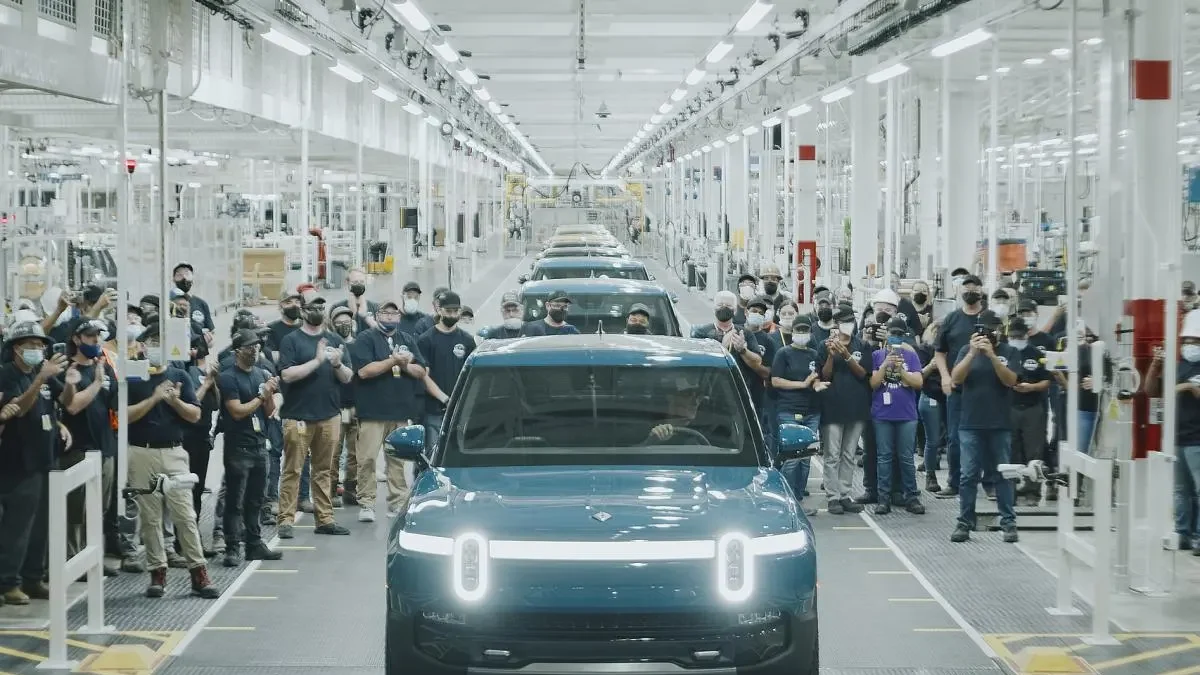
On April 18, an EF-1 tornado touched down in Normal, Illinois and caused significant structural damage to Rivian’s manufacturing plant. Four days later, Rivian started volume production of its most important vehicle. The R2 is, apparently, not a car that waits for convenient weather.
Rivian began volume and saleable production of the R2 electric SUV on April 22 at its Normal, Illinois facility — just days after the tornado struck — with first customer deliveries expected by the end of spring and broader configuration invitations rolling out in June. The launch edition rolling off the line first is the Performance Launch Edition, priced from $57,990, packing 656 horsepower from a dual-motor AWD setup, 330 miles of EPA-rated range, and a 3.6-second 0-60 time, with lifetime access to Rivian’s Autonomy+ driver assistance suite and a 4,400-pound tow rating.
That $57,990 figure will raise an eyebrow among the 1.2 million people who placed reservations after Rivian’s original R2 reveal in March 2024, when the company promoted a $45,000 base price with considerable enthusiasm. The $45,000 Standard trim — the model Rivian has been promoting as its volume play — is not expected until late 2027. Between here and there sit the $53,990 Premium, expected in late 2026, and whatever undisclosed variants CEO RJ Scaringe has been quietly developing. Which, as of Tuesday, turns out to be quite a few.
In an exclusive interview with Reuters, Scaringe confirmed that Rivian is developing undisclosed R2 variants, hinting at both a pickup truck version and an R2X performance model. “There are other variants of R2, which we haven’t shown,” he said, adding that the Georgia plant — Rivian’s second facility, currently under reconfiguration — is “built for different variations.” This is Rivian telling the market, in the most decorous terms possible, that the R2 platform is considerably larger in scope than anyone has been shown. Given that the company’s original R2 announcement generated the kind of reservation numbers that most automakers would accept in exchange for a reasonably sized internal organ, the news that there are more versions coming is not entirely surprising. The R2 pickup, if and when it arrives, will land in a segment that has suddenly become considerably more interesting — Slate Auto’s $25,000 electric truck is approaching production from the opposite end of the market, and the gap between those two price points is where most of the meaningful electric pickup competition is going to happen over the next three years.
The financial context matters here. Rivian has engineered dramatic cost reductions into the R2 platform: die casting reduces manufacturing costs by 32%, a new drive unit cuts 25%, and simplified suspension slashes costs by 72%. At full production volumes expected in 2027, Rivian says the R2 will cost less than half as much to build as the R1. That is a remarkable engineering achievement, and it is the number that explains why the R2 exists as a platform rather than simply a product. If you can build a vehicle at half the cost of your existing line at scale, you build as many versions of it as the market will absorb.
For 2026, analysts at BNP Paribas estimate the R2 will contribute roughly 22,000 to 23,000 units of Rivian’s 62,000 to 67,000 total delivery guidance — with a slow ramp: fewer than 400 in Q2, approximately 7,000 in Q3, and around 15,000 in Q4. Those numbers require things to go well. They require the Illinois plant to continue recovering from tornado damage, the Georgia facility to come online on schedule, the $57,990 launch price to not deter too many of those 1.2 million reservation holders, and the Uber autonomous partnership to develop without the usual complications that accompany autonomous driving partnerships. Lucid’s robotaxi ambitions with the same Uber partner — a 35,000-vehicle commitment — are a useful reminder that Uber is now hedging across multiple EV startups, which makes the Rivian deal more replaceable than the press releases let on.
The R2’s EPA range of up to 328 miles and 217 kW DC fast charging puts it solidly in competitive territory — not the longest range in the segment, not the fastest charging, but capable enough to be unremarkable in the best possible way. At $57,990, it sits above the Hyundai Ioniq 6 and below the Model Y Performance, in a price band that Rivian will need to demonstrate is justified by the product rather than simply by the badge.
The American EV market has spent 2026 absorbing retreats, cancellations, and factory shutdowns. Ford abandoned its electric truck. As GM idled Factory Zero again, sending 1,300 workers home for the second time in three months, the contrast became hard to ignore. Honda cancelled three models before they reached the road. Against that backdrop, a startup that started building a new vehicle four days after a tornado hit the plant carries a certain symbolic weight.
Whether the R2 can carry Rivian to profitability is a different question — and one the company has been working toward since it delivered its first R1T in 2021. The target is positive automotive gross margins by the end of 2026. The weather, as established, is not guaranteed to cooperate. But then, Rivian appears to have already decided that’s someone else’s problem.