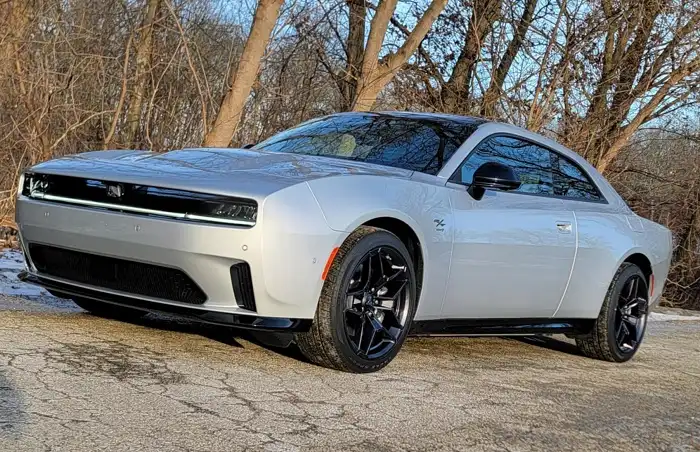
The Dodge Charger — both the electric Daytona and the twin-turbo Hurricane six-cylinder SIXPACK — has become America’s slowest-selling vehicle, and Stellantis is now paying customers $10 per horsepower to move the metal, which is essentially the automotive equivalent of a fire sale dressed up as a marketing programme.
Headline
Dodge Is Now Paying You $10 Per Horsepower to Buy a Charger. The Fine Print? It’s Because Nobody Actually Wants One.
Article
Six weeks ago, Dodge stood in front of the world’s automotive press and opened European orders for the eighth-generation Charger with the confident bearing of a company that knew exactly what it was doing. Today, it is essentially bribing Americans to take one home. The Dodge Power Dollars programme — dormant since 2020, when it was last deployed to prop up sales during the pandemic — has been quietly reactivated as of 9 July, offering $10 cash back per horsepower on gasoline SIXPACK Chargers. Buy the 420-hp R/T? Here’s $4,200. Buy the 550-hp Scat Pack? Have $5,500. Buy the 670-hp Daytona EV that Dodge called “the world’s most powerful muscle car”? Ah, no. That one, embarrassingly, is not eligible.
The reason for all this is depressingly numerical. According to Automotive News data reported this weekend, Dodge has sold 4,583 Chargers total in 2026 so far. Of that, 534 were the all-electric Daytona. The Charger is, by any sensible measure, currently America’s slowest-selling vehicle. That is a genuinely remarkable achievement for a nameplate celebrating its 60th anniversary this year with a $60 million marketing campaign, a bespoke “Purple Haze” limited-edition paint, a global manufacturing footprint at Windsor Assembly in Ontario, and — as we wrote in June — a bold European launch.
The maths, in unflattering detail
Let’s start with the ICE side of the ledger, which was meant to be the safe bet. The Charger SIXPACK R/T starts at $54,995 in the United States before destination. The Scat Pack, which adds the high-output Hurricane, starts around $60,000. For that money, an American shopper can currently choose from:
- A Ford Mustang GT, which starts around $34,000 and has a 5.0-litre V8.
- A Ford Mustang GTD, which starts around $325,000 and has an 815-horsepower supercharged V8.
- A Chevrolet Corvette Stingray, which starts around $69,000 and has a 495-hp naturally-aspirated V8.
- A BMW M3 Competition, which starts around $80,000, has a 523-hp turbocharged straight-six, and comes with a manual transmission.
- A Toyota GRMN Corolla, which starts under $50,000, has 300 hp, a proper manual, and demand exceeding supply by roughly 5 to 1.
The Charger sits awkwardly amid this lineup. Its Hurricane I6 is an interesting engine — low inertia, lots of torque, capable of clean-sheet Euro 7 compliance — but the specific proposition of “$60,000, 550 hp, four-cylinder-in-your-neighbour’s-garage exhaust note, no manual transmission, all-wheel drive as standard” is not what the traditional Charger buyer signed up for. Muscle car buyers, per every survey Dodge has commissioned in the past three years, want a V8. Preferably one you can hear from the next zip code. The Hurricane I6 is quieter, smoother, more expensive, and lacks the emotional punch of the 6.4-litre Apache V8 it replaced. From a pure engineering standpoint, it’s the better engine. From a pure marketing standpoint, it has landed with the emphatic thud of a Hemi being dropped from a first-floor window.
The Daytona is worse
The electric Charger Daytona, meanwhile, is having what marketing professionals delicately call a “repositioning moment.” The 670-hp Scat Pack version has sold 534 units in the first half of 2026. That works out to about 89 cars per month, which is not many cars, and represents a further decline from the already-disappointing 240 units it managed in Q1. Dodge originally forecast Daytona sales somewhere north of 20,000 units per year when the model debuted in December 2024. Actual run rate is closer to 1,000. That is a 95% miss against internal projections. The Power Dollars promotion, tellingly, does not apply to it. Dodge would rather move the ICE cars first and deal with the EV problem separately, which is a bit like a restaurant offering discounts on the mains while quietly pretending the starters were never on the menu.
Meanwhile, Ford is enjoying itself
The context makes this all sting a bit. The Ford Mustang won the American front-engine sports car segment in Q2 2026 outright — the Camaro is dead, the Challenger is dead, and the Charger is a niche muscle sedan the market has largely forgotten to notice. Ford is running two-year waiting lists on the Mustang GTD, can’t build enough Dark Horse variants, and is preparing a facelift for 2027. Stellantis, at Investor Day in May, promised a Copperhead halo car and a returning Hellcat Charger, presumably in the hope that supercharged V8s can rescue the nameplate that a twin-turbo six-cylinder has not. The problem, of course, is that both of those halo cars are still 18 months away from showrooms, and Dodge’s dealers have inventory to move now.
The wider hedge on Europe was a smart bet
Here is where the June story I wrote gains new relevance. Six weeks ago, Dodge opened European orders for the Charger at €66,000 with the observation that the American muscle car had a genuinely clean market run in Europe against hybridised BMW M3s and four-cylinder AMG C63s. That analysis, embarrassingly, may be the only piece of good news Stellantis has had about the Charger this month. First European deliveries begin in September. The pricing is roughly comparable to a base BMW M3. And the entire competitive landscape is, if not welcoming, at least underdefended. If Stellantis has a life raft for the Charger, it may be Munich, Barcelona, and Milan rather than Dallas, Detroit, and Miami.
The forward-looking takeaway
The Charger will not be discontinued. Stellantis is committed through 2030 and the platform underneath it — STLA Large — is genuinely good. But the current sales trajectory means Dodge is going to spend the next 18 months in a state of permanent promotional theatre: Power Dollars in July, some form of Loyalty Cash in September, likely a lease-specific programme in Q4, a Hellcat model reveal in early 2027 to change the conversation, and eventually the Copperhead halo car to remind everyone that Dodge still makes proper muscle cars.
The deeper lesson is that a brand cannot rebuild an emotional product with a rational engine. The Charger nameplate, sixty years old this year, was built on V8s that made noise, spilled fuel and lit up rear tyres. Selling it with a plug or a six-pot was always going to be a difficult ask. Stellantis knew this. Investors knew this. American muscle car buyers, at $54,995 base, are now voting with their feet. Dodge’s answer is $10 per horsepower and a slight smile. Presumably the next one will be $20.