Germany has a complicated relationship with modified cars. The country that invented the high-performance automobile, that gave the world the Nürburgring and the autobahn, runs one of the strictest vehicle modification regimes on the planet. Drive something sufficiently unusual on a German public road and you risk impoundment, a substantial fine, and the genuine possibility of being instructed to remove the car from the country. Enthusiasts from the UK, who understand that their own regulations are merely eccentric, routinely bring spare sets of number plates to Germany as insurance. This is the context in which car culture operates here.
Which makes what Ultrace’s organisers did in April 2026 considerably more interesting.
What Is Ultrace?
Ultrace is a Polish car festival — held annually in Wrocław, drawing over 50,000 visitors, and described by its organisers as the ultimate festival for the custom car scene in Europe. Ultrace Germany, held on 25–26 April at the Areal Böhler in Düsseldorf, was the festival’s first expansion beyond Poland, staged on a former industrial site that provided the appropriately serious backdrop for what unfolded inside.
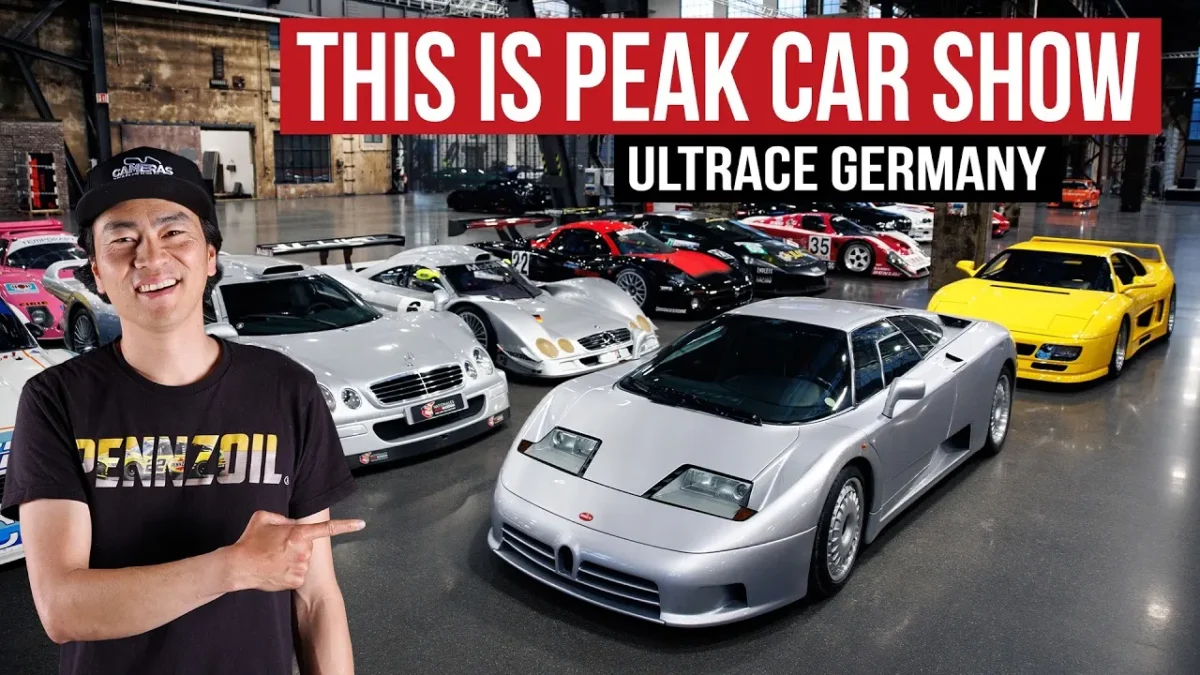
And what unfolded was, by any reasonable assessment, a world-class automotive event. Not a parking lot with expensive cars in it. Not a brand activation with a DJ. An actual, carefully curated, meticulously presented gathering of historically significant and culturally important vehicles that would individually justify a transatlantic flight and collectively boggled the comprehension of people who had seen rather a lot of car shows. Photographer Larry Chen — who arrived jet-lagged from the Forza Horizon 6 launch in Tokyo and spent the subsequent 24 hours in a state of documented disbelief — put it with characteristic precision: “There are car shows and there’s Ultrace.”
The Cars: GT1s, a Claimed Z-Tune, and All Six Generations of M3
The headline cars were extraordinary. The Porsche GT1 in Marlboro livery — which is technically orange, a period concession to television cameras on which true red washed out, so fluorescent orange was used to read as the correct Marlboro red on screen. It has since become so associated with the era that actual red now looks wrong. The Mercedes CLK GTR street car, one of 25 ever built, which exists only because homologation rules required a road-going version of the GT1-class race car and Mercedes was the kind of company that would simply build 25 of them rather than argue about it. The Nissan R390 GT1, a car that exists so far outside the normal parameters of automotive discourse that it still surprises people who know it exists to encounter it in person. And the Mercedes-Benz that flew at Le Mans in 1999, preserved in its post-accident condition — the kind of exhibition decision made by people confident enough in what they have to show it honestly.
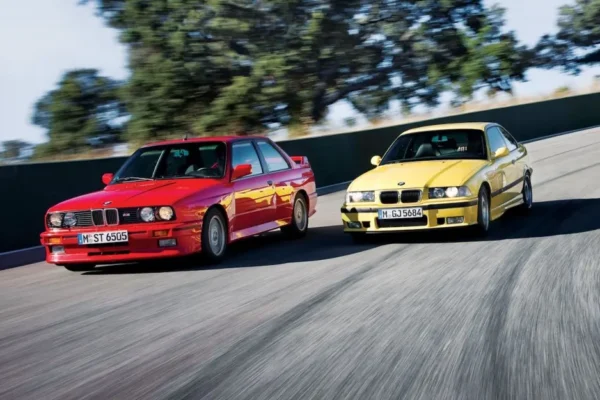
BMW M GmbH took exclusive use of the Halle am Wasserturm for the M3’s 40th anniversary: all six generations displayed in pairs — one road-legal and one racing version from each era — alongside special editions and a live livery painting by automotive artist Rae Roberts. Among them, the E36 M3 Compact: the one-off prototype BMW M built in 1996 by dropping the full M3 powertrain into the short-wheelbase TI body — one of those cars that sounds like a factory mistake and drives like a very good idea.
Then there was the Nissan R34 GT-R claiming to be a genuine Z-Tune, which would make it one of approximately 19 confirmed examples and worth somewhere in the region of £5 million. It sat without ropes, available for anyone to approach. This is either very brave or very confident or some combination.
A Show Built Like a Museum — Minus the Ropes
The venue treatment deserves separate mention. Ultrace did not put cars in a field. They built a show inside a series of industrial halls, using the existing architecture as part of the display and creating distinct rooms — a silver Mercedes room, a BMW hall, a separate space for the Jägermeister-liveried cars — that required genuine exploration to navigate. Individual cars sat within circular guard rail installations that kept crowds at the right distance while allowing full 360-degree visibility. Elevated viewing platforms let people look down at cars rather than up at them, which sounds like a small detail and changes the entire experience. The organisers describe the concept as built on “the latest technical solutions in the event industry,” which is event-industry language for: someone thought about this properly.
The no-rope policy is a philosophical position as much as a practical one. A car show with ropes everywhere is a car show protecting its reputation at the expense of the experience. A car show without ropes trusts its visitors and believes the proximity matters. When the display you are trusting visitors to respect includes a potentially £5 million R34 GT-R and several Le Mans prototype race cars, this represents a considerable degree of confidence in the automotive community.
Why Germany, of All Places?
Modified car culture in Germany has always operated in the margins — the regulations push the most creative builds toward events rather than roads, which means shows like Ultrace end up serving a function that car culture in less restrictive countries doesn’t need: they become the primary venue for the work, not a secondary celebration of it.
The European car show scene has been reconfiguring for several years, as traditional motor shows contract and specialist enthusiast events expand to fill the gap. Ultrace Germany represents that expansion at its most serious. The Japanese car culture connection was evident in the JGTC cars and the R34 claiming Z-Tune status — and the seriousness of presentation mirrors the preservation culture Japan has been modelling for a decade. Whatever its Polish origins, Ultrace functions as a genuinely international event. And the fact that the analogue racing car era is producing vehicles worth preserving to museum standard, then showing them without ropes at a car show, suggests the line between collector culture and enthusiast culture is blurring in ways that events like this are uniquely positioned to exploit.
When Is the Next Ultrace?
Ultrace Poland runs annually in Wrocław. Ultrace Germany is scheduled to return, and on the evidence of the first edition, the advice from everyone who attended is direct: go.
Bring spare number plates, just in case.