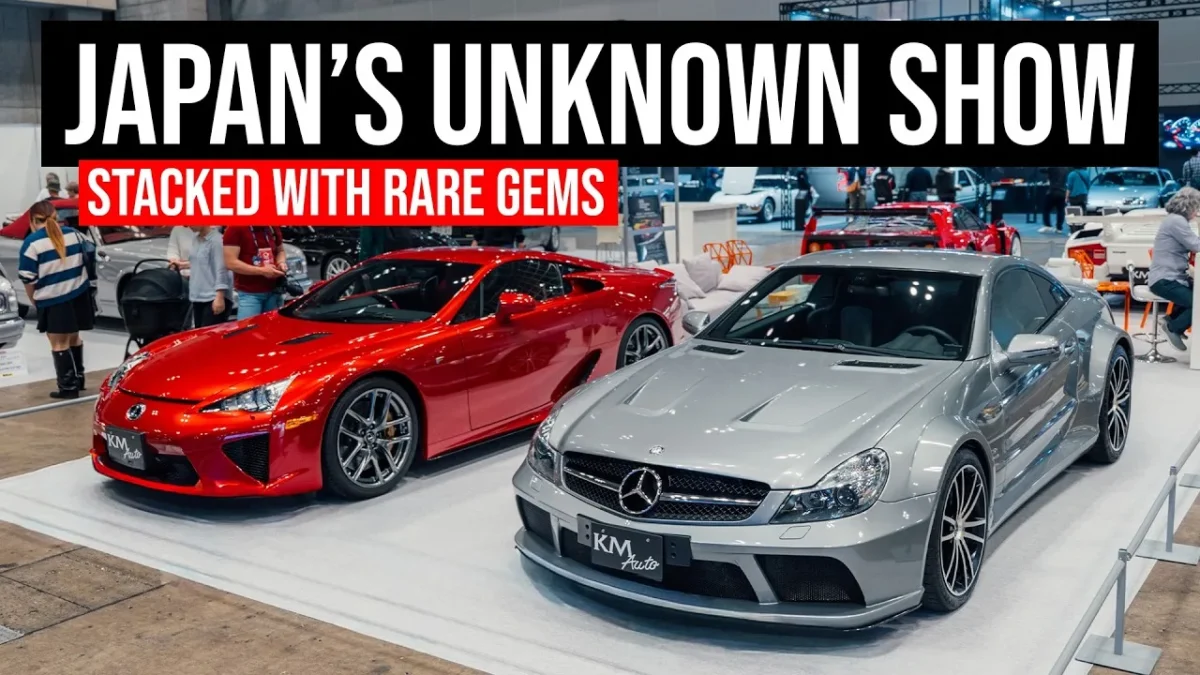
The Automobile Council in Tokyo, which celebrated its 10th year in 2026, operates on a different principle from most car shows. It exists to bring out the cars people actually care about — the rare ones, the ones that have been quietly living in collections, the ones that cost more than a house and have never been driven in the rain. Walking its halls at the Makuhari Messe is less a visit to a car show and more an unscheduled education in everything you thought you knew about automotive history.
The best tour of this year’s halls comes courtesy of Dino DC’s walk-through, which is worth an hour of anyone’s time.
The floors this year contained, among other things: a Ferrari 250 GT Short Wheelbase, possibly the most beautiful object Italy has ever exported; the Ferrari GTO from the 1980s, the original hypercar before anyone had invented the word; a Lancia Delta restomod built with rally world champion Miki Biasion; a Singer DLS; a Prodrive P25; a Gunther Werks 993; an F40 reskinned in LM specification; two Lexus LFAs; a Bugatti Chiron on California dealer plates; a 1929 Invicta four-and-a-half litre; and, with deeply satisfying incongruity, an outwardly ordinary Lancia Thema 8.32 — a boxy family saloon powered by a transversely-mounted Ferrari V8 — selling for 4.68 million yen, roughly $30,000. Your move, dealers of Europe.
But the most significant thing at the show was not the trophy cars or the record-breaking restorations. It was a collection of engine parts, dashboard assemblies, and rubber seals on a stand at the Toyota booth. And a similar display at Honda’s. Because what both companies were demonstrating, quietly and without fanfare, is something that should make every enthusiast feel slightly more optimistic about the future of the cars they love: Japan’s major manufacturers are, systematically and seriously, keeping their classics alive.
What Is Toyota GR Heritage Parts?
Toyota’s GR Heritage Parts programme, which began in 2020 and has expanded steadily since, now covers the AE86 Corolla, the A70 and A80 Supra, the 2000GT, and multiple generations of Land Cruiser. In 2025 alone, fourteen new parts rolled out for AE86 Corollas, A70 and A80 Supras, and Land Cruisers across the 40, 60, 70, and 80 series.
At the Automobile Council, Toyota showed reproduced cylinder heads, cylinder blocks for the 4A-GE engine, and a newly manufactured AE86 dashboard — a part particularly vulnerable to sun damage, cracking and shrinking over decades, and essentially unobtainable through conventional channels. Think about what that means for a moment: Toyota is casting brand-new engine blocks for a forty-year-old hatchback because enough people love it to justify the tooling.
What Is Honda Heritage Works?
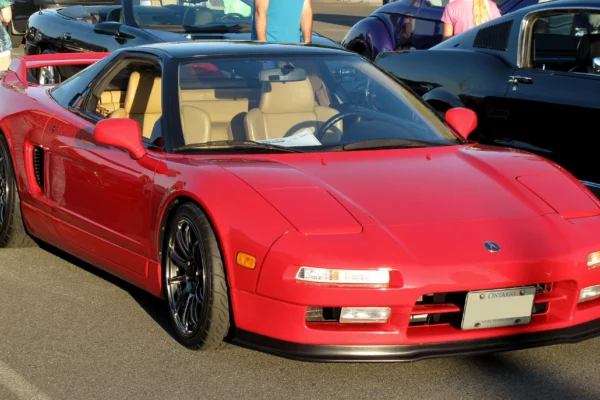
Honda, not to be outdone, launched Honda Heritage Works in April 2026 with rather more ambition. The programme offers reproduction parts on a global basis to replace discontinued components, as well as a full restoration service in Japan, starting with the first-generation NSX at its Takanezawa facility in Tochigi — the birthplace of the original car. Honda has form here: its NSX Refresh Plan quietly offered factory overhauls in Japan for years, but Heritage Works formalises and globalises the idea.
The restoration service offers two tiers: a targeted overhaul of drivetrain, suspension, or interior items, or a ground-up Total Restoration that uses Honda Heritage Parts to return the car to factory standard. The parts programme will eventually expand to other sporty models, with the S2000, Civic Type R, and Prelude among the likely candidates. It sits neatly alongside Honda’s celebration of 50 years of the Accord — a company that, for all its recent EV turbulence, clearly still understands the value of its own back catalogue.
Nissan, Mazda, and the Rest of the Movement
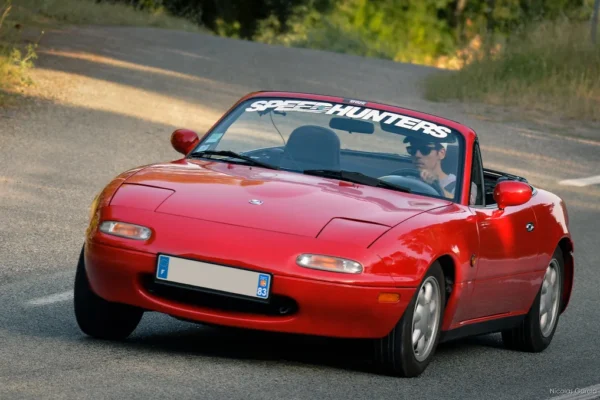
Nissan, through its NISMO Heritage programme, has been manufacturing new parts for the R32, R33 and R34 Skyline GT-R since 2017 — up to and including new engine blocks, which is not a small commitment for an engine as mythologised as the RB26. Mazda, for its part, started down this road earlier than most, with its factory restoration programme for the NA MX-5 and reproduction parts for the RX-7 — the natural final chapter of a company that spent five decades refusing to let the rotary engine die.
Taken together, this represents something genuinely new. It was once the exclusive preserve of exotic marques to offer factory-backed restoration programmes. When a vintage Ferrari reliably appreciates to seven figures, spending serious money maintaining it is commercially rational. A 1993 Honda NSX or a 1986 Toyota AE86 was never meant to be a museum piece. It was meant to be driven to the track on a Saturday morning and back home in time for lunch.
Why Factory Heritage Programmes Matter
That these cars are now worth preserving with factory precision tells you something important about how the collector car world has shifted. It also explains why Japan’s tuner and restomod culture has quietly become one of the most serious specialist scenes anywhere in the world: when the factories themselves are this committed, the independents have permission to go even further.
The instinct is no longer purely Japanese either — Europe’s response arrived this April at Ultrace Germany in Düsseldorf, where a claimed R34 GT-R Z-Tune sat without ropes alongside Porsche GT1 and Mercedes CLK GTR race cars in a hall organised with the kind of curatorial seriousness that Japanese enthusiast culture has been modelling for a decade. The two cultures are converging.
The Automobile Council itself is a product of this shift. Started in 2016 to give Japan’s considerable but scattered community of classic car enthusiasts a shared event, it has grown into something that genuinely rewards careful attention. Not everything on display is for sale. Not everything for sale is expensive. The Aston Martin Virage shooting brake from 1990, an enormous and spectacularly awkward coachbuilt estate, was asking 18.6 million yen. The TVR Griffith from 1999 — same age as the R34 GT-R, and considerably more interesting at a party — was offered at 7.5 million. The point is not the prices. The point is that cars like this exist in Japan, are being preserved in Japan, and are being celebrated in Japan with a seriousness that much of the rest of the world could learn from.
The Japanese have always understood something about objects that Western consumer culture has been slower to grasp: that something made well, maintained properly, and used with respect does not depreciate into worthlessness. It accumulates meaning. The fact that Toyota is now casting new engine blocks for a forty-year-old hatchback, and Honda has reopened a dedicated facility for a thirty-year-old sports car, suggests that message is finally reaching the boardrooms as well as the workshops. Honda’s modern reinterpretation of kei-car spirit in the form of the Super-N is, in its own way, part of the same cultural impulse — a refusal to let small, focused, characterful cars become an extinct category just because the world has moved on to crossovers.
Pass the parts catalogue. Some of us have cars to maintain.