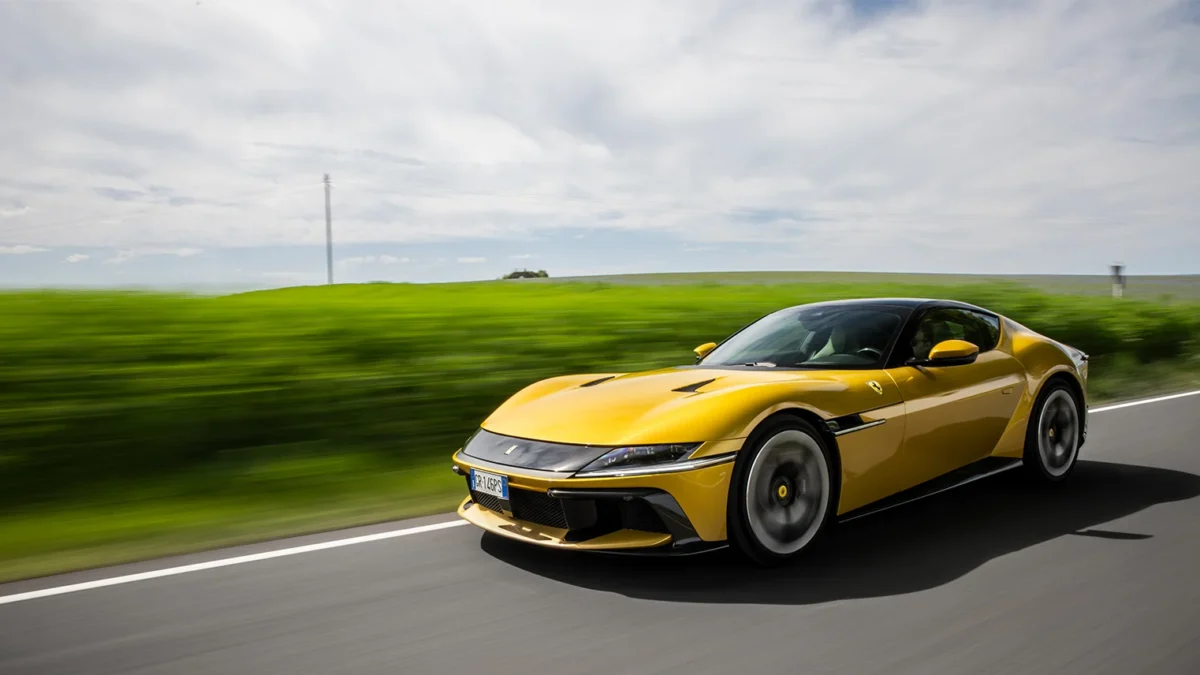
Every generation of journalist who has ever driven a Ferrari V12 has, at some point, written that it might be the last one. They have been wrong, repeatedly, for decades. The difference now is that they are probably right. Ferrari’s 12Cilindri — dodici cilindri, twelve cylinders, named with the kind of functional Italian directness that makes even a parts description sound like an aria — is the final naturally aspirated front-engined Ferrari grand tourer in production form. The next one will be electrified. Emissions regulations have seen to that.
Chris Harris, who has driven rather more of these things than most people have had hot dinners, recently put it simply on circuit at Anglesey: the 12Cilindri is easier to drive than the 812 Superfast it replaces, and that is not a criticism. It is, if anything, the highest possible compliment. The 812 was brilliant but occasionally alarming. The 12Cilindri is brilliant and, on the road, accessible. Ferrari has spent twelve years learning from the F12 and producing something that makes the basic recipe feel more complete than it has ever been.
Ferrari 12Cilindri Specs and Price
The numbers are appropriately immodest. A naturally aspirated 6.5-litre V12 producing 819 horsepower — 830 if you prefer your figures in metric PS, which Ferrari does — revving to 9,500 rpm, mated to an eight-speed dual-clutch gearbox, driving the rear wheels only. Zero to 62 in 2.9 seconds. A top speed north of 211 mph. A claimed dry weight of 1,560 kg, which for something with this much interior space and a proper boot is a genuine engineering achievement. Price, in the UK, starts at £336,500 before options — and you will tick options, because Ferrari expects it and because you will want them. In the US, you’ll clear $400,000 before the same exercise begins.
The Last Naturally Aspirated Ferrari
The engineering is genuinely remarkable for reasons beyond the headline figures. The 12Cilindri is the last naturally aspirated Ferrari of any kind, and keeping an unassisted 6.5-litre V12 compliant with modern European emissions and noise regulations — the same regime that pushed even Lamborghini to bolt a hybrid system to its latest V12 — was, by Ferrari’s own admission, an extraordinary piece of work. The next time Ferrari attempts this trick, electric motors will be involved.
What It’s Like to Drive
On track, Harris notes that the chassis systems are seamless and brilliant in a way that the driver cannot fully unpick — the differential talking to the power steering talking to the rear-wheel steering, all of it working invisibly to make a 315-section rear tyre on a car of this weight and power feel more tractable than the physics suggest it should. Ferrari, as he observes, remain the masters of making ordinary drivers feel like competent ones. That is not a cynical observation. It is the result of decades of concentrated engineering effort and it represents, for a car like this, exactly the right priority.
Off the circuit and onto public roads, the picture becomes slightly more complicated. The 12Cilindri is wide — notably wider than the 812, designed with California clients in mind rather than the narrow lanes of the British countryside. On UK roads, you are aware of the car’s dimensions constantly, the long bonnet stretching ahead of you, the wide mirrors filling the lanes around you. The ‘bumpy road’ setting works well enough that Harris calls it the best-riding Ferrari in twenty years. But you are never not aware of the car’s value, its width, and the shade of yellow it wears. The world notices a yellow Ferrari. The world does not always do so politely.
The interior is busy — buttons everywhere, screens in positions that require a degree of contortion to read fully, haptic controls that Harris has not fully made peace with after repeated exposure. These are not new criticisms of recent Ferraris. They are recurring ones, and the 12Cilindri has not solved them. The seats, electrically adjustable and equipped with massage function, fail at the one thing a seat in a performance car is specifically required to do, which is hold the occupant in place during cornering. An extraordinary oversight in an otherwise extraordinarily developed car.
The Engine Is the Point
But these are details. The substance of the car is the engine, and the engine is, by universal consensus, one of the finest things currently fitted to any production road car on earth. A 6.5-litre naturally aspirated V12 that revs to 9,500 rpm and puts out 819 horsepower was supposed to be a dying breed, killed off by emissions legislation. Even Lamborghini paired their latest V12 with a hybrid system. Ferrari found a way to do it without. Once more. Possibly for the last time. It is, in its own way, a tradition Enzo established with the F40 — the refusal to compromise an engine for the sake of regulatory convenience, signed off by a founder who treated emissions legislation as someone else’s problem and competitive engineering as his own. The 12Cilindri’s V12 is, in spirit, the F40’s twin-turbo V8 nearly four decades later.
Where the V12 Goes From Here
Ferrari has confirmed that internal combustion will remain a cornerstone of its lineup, outlining at its 2025 Capital Markets Day a plan to continue producing V6, V8, and V12 engines well into the next decade. By 2030, Ferrari expects its global lineup to be 40% pure combustion, 40% hybrid, and 20% fully electric. The V12 will continue, then, but in hybridised form. The 12Cilindri is the final version that simply burns fuel and converts it directly into theatre.
Maranello is not letting the model bow out quietly, either: the limited-run 12Cilindri MM has brought back the gated manual shifter — or at least the interface of one, with no conventional gearbox underneath it, which is a very 2026 kind of goodbye. And the 20% electric slice is no longer hypothetical: Ferrari’s first electric car, the LoveFrom-shaped Luce, represents the other half of Maranello’s twin-track future. The 12Cilindri is the goodbye. The Luce is the hello.
Ferrari 12Cilindri vs Aston Martin Vanquish
If you have the money and the inclination, the comparison set is limited. Harris puts it directly: in the class of big front-engined V12 grand tourers, the choice is this or the Aston Martin Vanquish. The Aston has magnificent turbocharged torque and considerable beauty. The Ferrari has better development, more performance, and the badge. In a class of two, he gives it to the Ferrari.
Buy it. Drive it. Keep the revs above 5,000 rpm at every available opportunity. And try not to think too hard about the fact that nothing like it will ever be made again.