Affalterbach is a small town northeast of Stuttgart in Baden-Württemberg. Around 10,000 people live there. It has a bakery, a few restaurants, a church. It is not, by any obvious measure, a place that should command attention from performance car enthusiasts in Tokyo, Los Angeles, or Dubai.
It is also where every AMG engine in the world is built, by hand, one at a time, by a single person who takes it from bare components to finished unit and then puts their name on it.
The Philosophy
The “one man, one engine” principle at AMG is not a marketing concept that was reverse-engineered onto an existing manufacturing process. It reflects a genuine approach to quality control that predates AMG’s integration into Mercedes-Benz and persists, unchanged in its essentials, today.
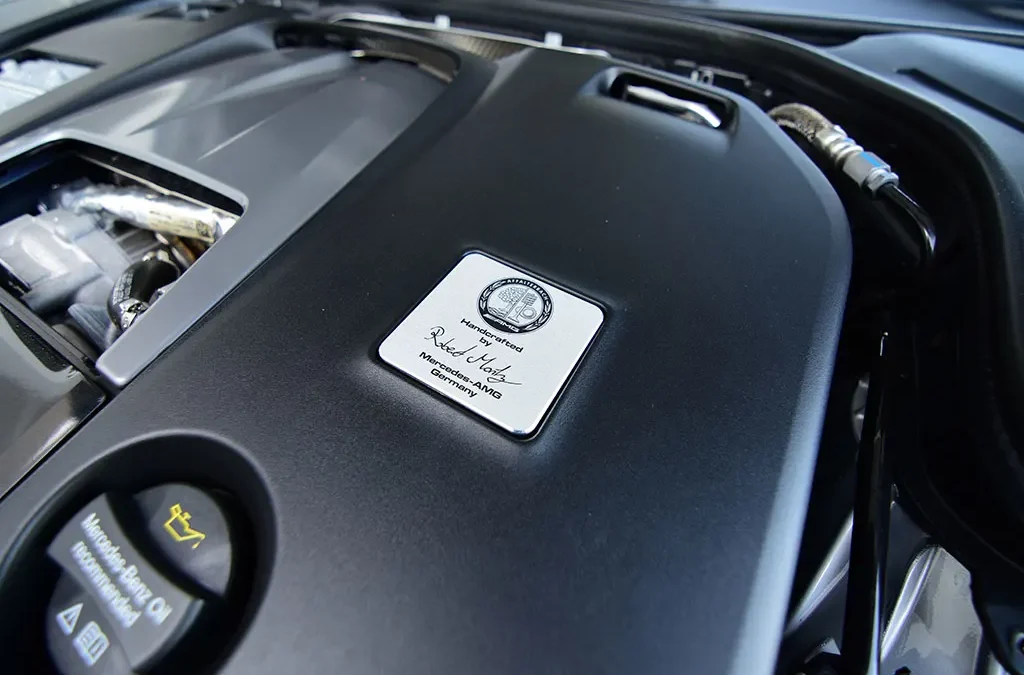
Each AMG engine builder is assigned their own workstation with their own set of tools. No two builders share tools. An engine arrives at the workstation as a collection of components — block, crank, heads, ancillaries — and leaves as a finished, tested unit. The builder who assembled it is the only person who touched it throughout that process.
When the engine is complete, a small aluminium plaque engraved with the builder’s signature is fixed to the cam cover. It is visible when the bonnet is opened. In most cars, lifting the bonnet reveals an engine. In an AMG, it reveals an engine and a name.
Why It Matters
The practical case for this approach is quality. When a single person is responsible for an entire engine from start to finish, their accountability for the result is total. There is no diffusion of responsibility across an assembly line. If the engine fails, the signature on the cam cover identifies precisely who built it. The incentive to get it right is personal in a way that conventional assembly line production does not replicate.
AMG engines are not built quickly. The assembly process for a single unit takes considerably longer than a conventional automated line would require. This is why, at peak production, there are approximately fifty AMG engine builders at Affalterbach. The facility is sized to the pace of hand assembly rather than to the scale of demand.
For buyers, the plaque is both a quality guarantee and an artefact. The engine in their car was built by a specific person. That person’s name is on it. The car becomes, in a small but tangible way, something individual rather than merely configured.
The Community Around It
What nobody at AMG predicted when the philosophy was formalised — and what says something genuine about the relationship between enthusiasts and the cars they love — is the community that grew up around the builders themselves.
AMG owners research their engine builders. They find out who signed their plaque and look up that person’s history with the company, how many engines they have built, which other cars they have worked on. Online forums dedicated to specific AMG models maintain lists of known builders, with owners comparing who assembled their cars.
People send cards to their builders. Birthday cards. Thank-you notes. Letters explaining how much the car means to them, addressed to the specific individual whose name is on the engine. AMG has, by various accounts, received correspondence on behalf of builders that the company passes on.
Some buyers go further. They specify, when ordering a new AMG, that they want a car assembled by a particular builder — someone whose engines they have previously owned, or someone recommended by friends in the community. The request is not always honourable, because allocation is complex. But the fact that it is made at all is remarkable.
People are forming relationships with the people who build their engines. The plaque made those people visible. What followed was entirely human.
The Scale
Approximately fifty people. The entire output of AMG’s hand-built engine programme — every V8, every inline-four produced under this system — passes through the hands of those fifty people. Each one builds their engines from start to finish, alone, with their own tools.
Considering how many AMG-badged vehicles exist globally, and how many are sold each year, this number is startling. The exclusivity it creates is not manufactured through limited editions or allocation strategies. It is a structural consequence of the manufacturing approach. There are simply not more engines than fifty people working at human pace can produce.
What It Says About AMG
The one man, one engine philosophy is, in miniature, the story of AMG itself. A company founded by two engineers who believed that personal commitment to a result — their result, accountable to them, signed by them in the victories it produced — was different in kind from institutional effort.
Hans Werner Aufrecht and Erhard Melcher put their initials on every engine they raced. Their successors, across fifty workstations in Affalterbach, put their names on every engine they build. The form has changed. The idea is the same.
The fastest cars Mercedes makes are signed. The people who made them are known. That is not a common thing in the world of mass automotive production, and it should probably be more celebrated than it is.