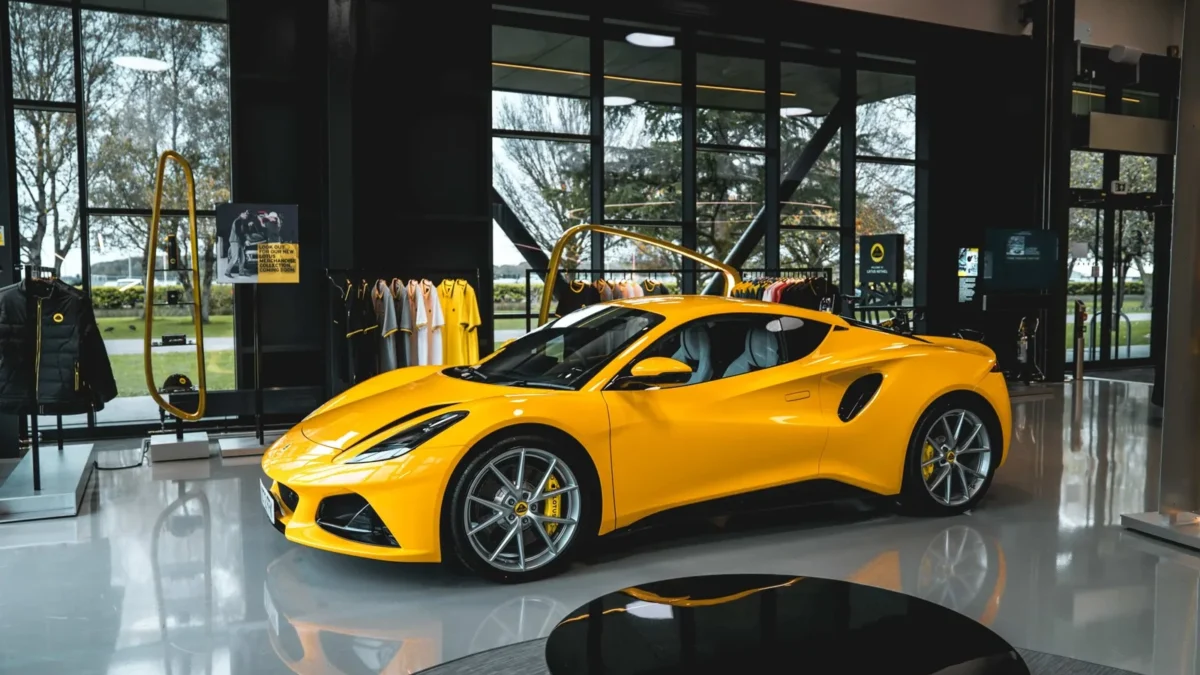
Four years ago, Lotus stood up at the launch of the Emira and told the assembled press, with the slightly forced gravitas of a man at a wedding speech, that this would be its last combustion car. Ever. From here on out, the storied British sports car maker would build only electric vehicles. Today the company’s CEO, Feng Qingfeng, said the quiet part rather loudly out loud: “We thought EVs could be the future. But the EV penetration rate was not as good as we expected.” New V6 in the Emira. New V8 in a supercar called Esprit. Both hybrids. Both burning petrol. Welcome back, world.
It is, on its own merits, an unremarkable announcement. Lotus is going to make a sports car with an engine in it. Stop the presses. What makes it interesting is the absolute confidence with which the opposite position was held in 2022, and the speed with which it has now collapsed. The all-electric Type 135, the planned Emira replacement that Lotus was co-developing with Alpine on a shared platform called LCA, has been quietly cancelled because there is essentially no market for a £80,000 electric sports car that does the things people buy sports cars for. The Emira has instead been given an extended life that runs well past 2030. The Esprit nameplate is being revived for a V8 hybrid supercar that arrives at Lotus’s Hethel plant in 2028. Production at Hethel, incidentally, collapsed to about 2,000 cars last year after the US slapped a 25% tariff on imported vehicles, which is roughly one-fifth of the plant’s capacity. New engines means more cars. More cars means jobs. You can see why the board signed off.
The new V6 is genuinely interesting. It’s a 3.0-litre twin-turbocharged hybrid unit developed by Horse Powertrain — the Geely-Renault-Aramco joint venture that has become the place every legacy automaker goes when they need a combustion engine and don’t have one of their own to hand. Horse claims its W30 is the lightest hybrid V6 in the world at 160 kg, only marginally heavier than a typical four-cylinder, and it will produce up to 536 bhp and 516 lb-ft of torque in the Emira. Horse’s CEO, Matias Giannini, says no other hybrid V6 on Earth fits in the package theirs does. He may be right; he is also slightly conflicted, given that selling these engines is his entire job.
Which brings us to the supporting cast. The Lotus story is almost identical to the Volvo Cars story from two weeks ago, and not by accident: both are Geely-owned brands, both committed publicly to all-electric futures, both have now discovered that they urgently need combustion engines they no longer have the factories to build, and both are quietly buying powertrains from Horse — which is, conveniently, also half-owned by Geely. The other half is owned by Renault, with a sliver belonging to Saudi Aramco. If you wanted a one-sentence summary of how the European auto industry is funding its retreat from the EV cliff, it is: “It is paid for by Geely, engineered by a French-Chinese joint venture, and signed off by an oil company.”
The sports-car-buyer numbers tell you why this is happening. JD Power reckons US customer preference is currently sitting at 62% ICE and 9% pure EV. Lotus says 88% of its Emira sales in America are manual-transmission V6 models, a figure that ought to be tattooed onto every product planner’s forehead. “They told us that they love the V6 engine,” Feng told Autocar this month. They told the world this five years ago, too, but nobody at the executive level was listening because everybody was busy commissioning slide decks about “the inevitable transition.” The transition, as it turns out, is inevitable. Its timeline, considerably less so. Meanwhile, Toyota’s GR division has become the case study for how to build an enthusiast pipeline — three-cylinder, manual, 300 horsepower, no apology — for the precise customer profile Lotus has just spent four years trying to disown. Toyota didn’t get distracted. Lotus did. Toyota is now ahead by exactly the time Lotus spent telling everyone the V6 was finished.
The forward-looking takeaway is that 2028 is shaping up to be the year European sports car makers stop apologising for combustion and start actively celebrating it. Lotus Esprit V8. Aston Martin Vanquish V12. Ferrari’s V12 line that simply refuses to die. The all-electric supercar, briefly the future, is now the niche curiosity. The hybrid V8 supercar, briefly the dinosaur, is now the future. It is almost as if the people who buy 980-horsepower toys for amusement and nothing else were never really going to be persuaded by a fuel economy chart. Imagine.