In the early 1970s, the automotive world briefly went mad for the Wankel rotary engine. Mercedes-Benz investigated it. Citroën built a car around it. NSU staked its future on it. General Motors spent $50 million acquiring a licence. The rotary promised smooth power, mechanical simplicity, and a compact form factor that conventional piston engines simply couldn’t match. The future, for a moment, looked triangular.
Then the oil crisis hit, fuel economy became the only number that mattered, and the rotary’s appetite for petrol — prodigious in relation to its outputs — became impossible to defend. Within a few years, every major manufacturer that had flirted with Wankel technology had quietly backed away. The licences were shelved. The programmes were cancelled. The engineers moved on.
Every manufacturer except one. Mazda looked at the same data, reached the same conclusions about the engine’s inefficiencies, acknowledged every problem that had sent its rivals running — and decided to stay anyway.
That decision cost them dearly, more than once. It also produced some of the most beloved sports cars in the history of Japanese motoring, a Le Mans victory no one has ever repeated, and gave a relatively small manufacturer from Hiroshima an identity that no amount of sensible hatchback production could have provided.
How Mazda Got Involved
Mazda’s relationship with the rotary engine began in 1961, when the company signed a licensing agreement with NSU and Wankel GmbH to develop the technology. The deal was not unique — over a hundred manufacturers investigated similar arrangements — but Mazda’s commitment to making it work was. Where others tested and moved on, Mazda’s engineers embedded themselves in the problem.
The first production rotary Mazda — the Cosmo Sport 110S, launched in 1967 — arrived the same year as the Toyota 2000GT, and Japan was already proving it could build world-class sports cars on unconventional foundations. The Cosmo was not a high-volume car, but it was a proof of concept: the rotary engine could work in a road car, could be made reliable enough for customers, and could deliver a driving experience that set Mazda apart from every other manufacturer in its segment.
Through the late 1960s and early 1970s, Mazda expanded the rotary across its range — the R100, RX-2, RX-3, RX-4, RX-5. By 1973, rotary-engined cars accounted for roughly a quarter of Mazda’s total sales. The engine was not a halo product or a limited-edition curiosity. It was central to how the company operated and how it positioned itself in the market.
Then October 1973 arrived, and with it the OPEC oil embargo.
Why Did Mazda Keep the Rotary When Everyone Else Quit?
The oil crisis did not merely inconvenience the rotary engine. It exposed its fundamental commercial vulnerability. The 12A engine producing around 120 horsepower in the RX-3 returned fuel consumption figures that, in a world suddenly obsessed with efficiency, were very difficult to justify. Emissions, too, were a growing concern: the rotary’s combustion characteristics made meeting tightening American standards increasingly expensive to engineer around.
Mazda’s management faced a decision that, framed purely as a business calculation, had a clear answer. The rotary programme was consuming resources, facing regulatory headwinds, and competing in a market that had abruptly stopped rewarding the qualities it offered. NSU, which had bet everything on the rotary with the Ro 80, had been forced into a merger with Audi under Volkswagen Group. The engine had broken the company that invented its production application.
Mazda’s board did not, however, frame it purely as a business calculation.
The engineers who had spent a decade solving the rotary’s problems — apex seal wear, fuel consumption, emissions compliance — believed those problems were solvable. Not easily, and not cheaply, but solvable. The argument they made to management was essentially: we have come further with this engine than anyone else. We understand it better than anyone else. Walking away now means handing that advantage to nobody, because nobody else is pursuing it. If we stay, we own the technology. If we leave, we own nothing.
Management, to their considerable credit, agreed.
What Staying Meant
Mazda’s commitment to the rotary after the oil crisis was not a passive decision to keep building the same cars. It required active, expensive, sustained engineering investment across the following decade.
The fuel consumption problem was addressed through the development of the REAPS — Rotary Engine Anti-Pollution System — and later through the thermal reactor system, both of which added complexity and cost. The apex seal reliability issues that had plagued early engines were progressively resolved through metallurgical improvements and tighter manufacturing tolerances. By the time the RX-7 arrived in 1978, Mazda had spent seven years and enormous resources making the rotary viable in a world that had moved against it.
The RX-7 itself was the vindication. Using the 12A engine in its cleanest, lightest application yet — a two-seat sports car with near-perfect front-to-rear weight distribution enabled by the rotary’s compact dimensions — Mazda produced something that the piston-engined competition genuinely could not replicate. You could not put a conventional inline-four or V6 of similar weight and power in the same location in the chassis and achieve the same result. The rotary’s physical smallness was the point. It was not merely an alternative to a piston engine. It was better in this specific application, for this specific purpose.
The first-generation RX-7 alone sold over 470,000 units, and the car went on to accumulate more race wins in IMSA competition than any other model in the series’ history. It became the foundation of an entire generation of enthusiast culture, particularly in Japan and North America — the kind of car that Japan is now actively working to preserve precisely because its combination of character and rarity makes it irreplaceable.
And in 1991, the rotary delivered the decision’s ultimate vindication. The four-rotor 787B won the 24 Hours of Le Mans outright — making Mazda the first Japanese manufacturer ever to win the race, a distinction it held alone until Toyota finally joined it in 2018. No rotary-powered car had won Le Mans before. None has since. The engine that every sensible manufacturer had abandoned two decades earlier had beaten all of their best work at the most famous endurance race on Earth.
The Third Generation and the Beginning of the End
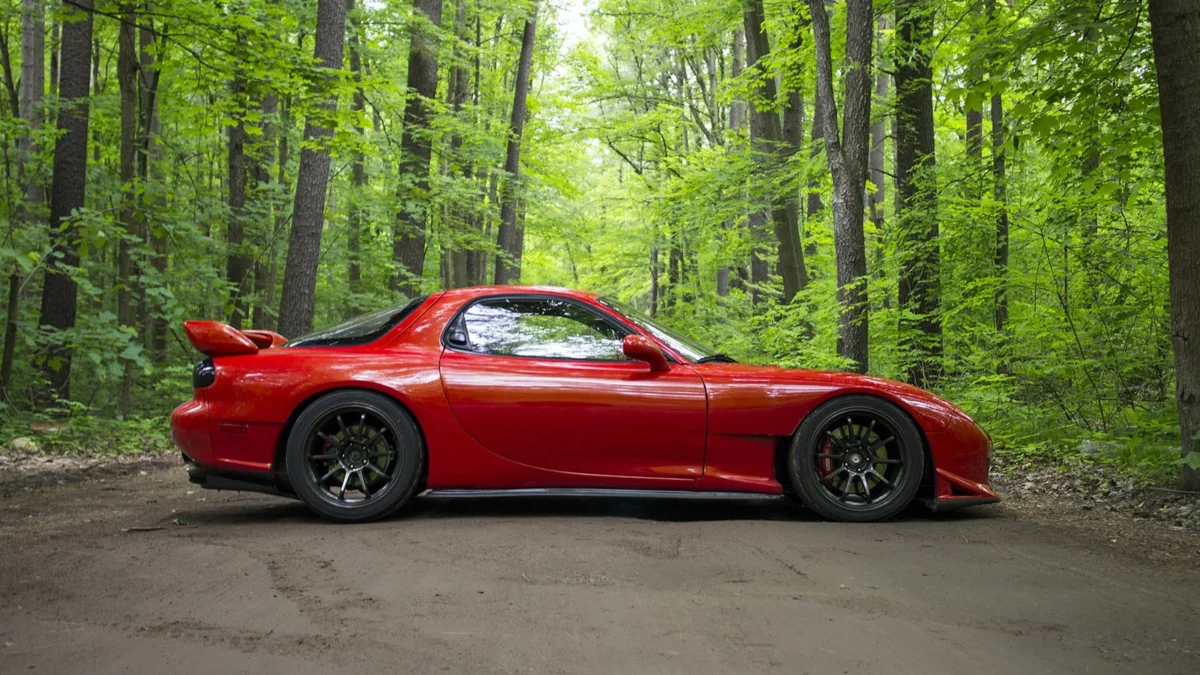
The FD RX-7, launched in 1992, was the rotary at its peak expression. The 13B-REW engine — twin-turbocharged, 255 horsepower in Japanese specification, positioned low and centrally within a new lightweight chassis — was by common consensus among the finest driver’s cars of its decade. It competed directly with the Honda NSX, the Toyota Supra, and the Nissan Skyline GT-R, and was considered by many who drove all four to be the most rewarding of the group.
It was also, commercially, struggling. American emissions and fuel economy requirements had tightened again. The cost of keeping the rotary compliant was rising. Mazda, which had endured a painful overexpansion in the early 1990s and required a rescue investment from Ford, was in no position to absorb indefinite losses on a low-volume sports car with an engine that regulators increasingly viewed with suspicion.
North American RX-7 sales ended after the 1995 model year. Japanese production continued until 2002. The car that had been the rotary’s greatest achievement was discontinued not because it had failed, but because the commercial environment that surrounded it had made continuation untenable.
It was, in its own way, the kind of pragmatic platform-sharing compromise that Mazda’s rotary philosophy had always made impossible — except this time, the compromise was simply stopping. There was no shared platform to fall back on, no partner to absorb the development cost, no version of the rotary that could be made economical enough to survive.
Why Did Mazda Stop Making the Rotary?
The RX-7’s end was not quite the rotary’s end. Mazda made one more attempt at keeping the engine in production, and its fate explains why the programme finally stopped.
The RX-8, launched in 2003, was built around the naturally aspirated 13B-MSP Renesis — a substantially re-engineered rotary with relocated exhaust ports that improved emissions and efficiency enough to win International Engine of the Year in 2003. The car itself was a curiosity in the best sense: a four-seat, four-door sports car (the rear-hinged half-doors remain one of the great packaging tricks of the era) that handled beautifully and revved to 9,000rpm. Mazda sold roughly 192,000 of them over nine years.
But the fundamentals that had stalked the rotary since 1973 never went away. The Renesis still drank fuel and consumed oil by design, warranty claims ran high, and each new round of emissions regulation raised the compliance bill on an engine only one company in the world was paying to develop. Euro 5 finished it in Europe — the RX-8 was withdrawn from the continent in 2010 because making it compliant was uneconomic — and the 2008 financial crisis, which also saw Ford sell down its stake in Mazda, removed any appetite for sentimental engineering programmes. The last RX-8 was built in June 2012, ending forty-five years of continuous rotary production that had begun with the Cosmo in 1967.
The rotary was not killed by a single decision, in other words. It was worn down by the same two adversaries it had faced its entire life — fuel and emissions rules — until the company that had defended it longer than anyone concluded, reluctantly, that there was no longer a car it could carry.
What It Tells Us
Mazda’s rotary story is one of the clearest illustrations in automotive history of the difference between a company with an identity and a company with a strategy. The manufacturers that abandoned the rotary in the 1970s made the correct strategic decision. They allocated their resources to more commercially viable technologies and built profitable, sensible cars.
Mazda built the RX-7.
The decision to stay with the rotary when every rational argument pointed elsewhere gave a mid-sized Japanese manufacturer a cultural significance entirely disproportionate to its market share. The RX-7 FD is not remembered as a compromise or a budget sports car. It is remembered as one of the defining driver’s cars of the 1990s, built around an engine that its maker had kept alive through stubbornness, talent, and the refusal to accept that the conventional answer was the only answer.
Will the Rotary Engine Come Back?
The rotary is not dead, incidentally. Mazda currently uses it as a range extender in the MX-30 R-EV hybrid, where the single-rotor 8C produces 75 horsepower — a number that would have made the engineers who built the 13B-REW wince. But Mazda has also re-established a dedicated rotary development group, and the Iconic SP concept — a genuinely beautiful sports car built around a twin-rotor range-extender layout — has spent the past two years dangling the possibility of a proper return. Whether it materialises is anyone’s guess. What is certain is that the technology survived, in Mazda’s hands, because a board of directors in 1973 listened to their engineers instead of their accountants.
Sometimes that is enough. Sometimes it produces something extraordinary. In Mazda’s case, it produced both.