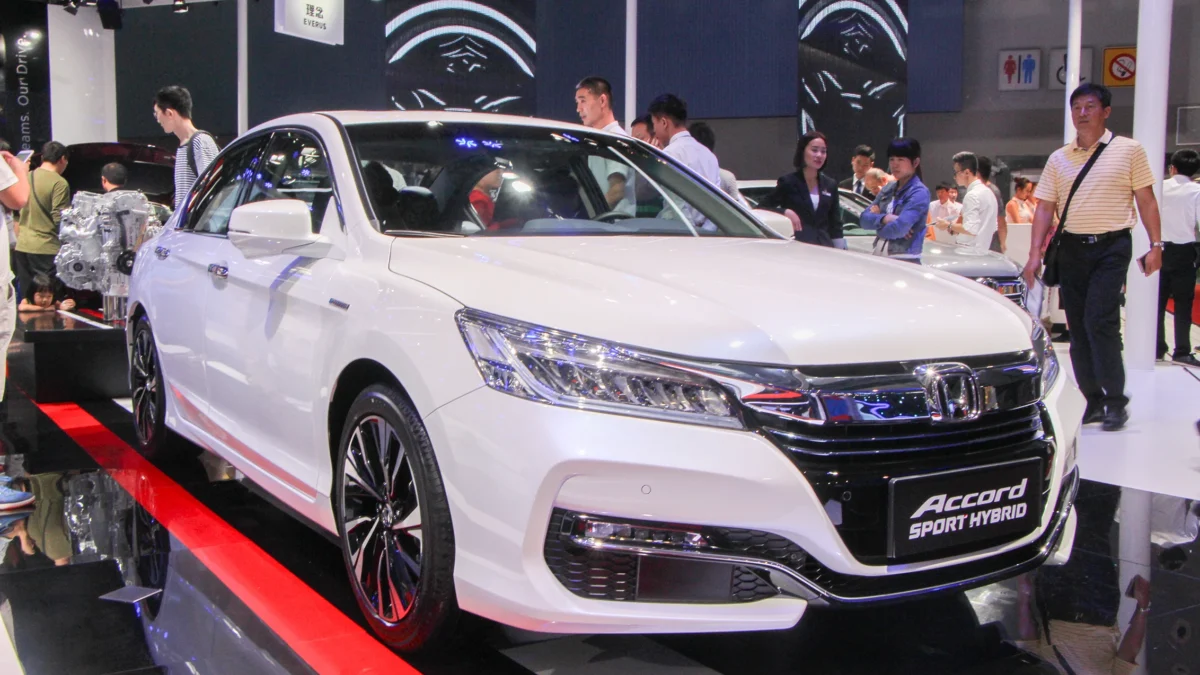
This is what happens when an EV strategy goes badly wrong. The Accord turned 50 on 8 May, with Honda marking the occasion at the Mobility Resort Motegi in Japan, a documentary on the way later this month, and 25 million cars sold across 11 generations in 160 countries. Lovely stuff. Slightly less lovely is the supplier memo that leaked to Automotive News last week, which confirmed that the next-generation Accord has been quietly shoved back to early 2030 — along with the Odyssey (March 2030), the HR-V (2032), the Acura MDX and the Acura Integra. The traditional five-to-six-year redesign cycle, the one Honda built its entire engineering reputation on, has been put on a treatment plan.
Why? Because in March, Honda announced a $15.8 billion write-down after cancelling its entire 0 Series electric programme — the 0 SUV, the 0 Saloon and the Acura RSX, all of them — and turned a forecast operating profit of $3.5 billion into an expected loss of somewhere between $1.7 billion and $3.6 billion for the fiscal year just ended. It is the first time Honda has stared down an annual net loss since it listed on the Tokyo Stock Exchange in 1957. Read that again. Honda has not had a year this bad in 69 years. Honda’s earlier decision to cancel three US EVs set the stage for everything that has followed: when you walk away from a $4.4 billion EV hub months from production, the bill has to be paid somewhere, and the Accord redesign is one of the places it’s now being paid. That $15.8 billion charge is itself a single line in the $70 billion in EV writedowns Honda just joined — an industry-wide reckoning that Honda is now sharing with Porsche, Ford, Stellantis and most of the names that spent the early 2020s competing to announce the most aggressive electrification timeline.
The maths is brutally simple. Honda is funding 13 new hybrids while every Asian brand’s hybrid sales explode — Toyota, Hyundai and Kia are all posting record hybrid numbers in 2026, and Honda is hurrying to make sure it has competitive product when the segment hits its stride. The cash to do that has to come from somewhere. Stretching the current Accord, Odyssey and HR-V means not spending billions on tooling, validation, supplier contracts and crash testing in 2027 and 2028, and instead milking platforms that are already paid for. It is the corporate equivalent of telling a dinner party guest you’ve simply re-plated last night’s risotto because the new dish didn’t come together. Honda is not alone in this either — Stellantis’s similar pivot from EVs to mixed powertrains has just been formalised as a five-year, €60 billion plan that funds 29 new EVs alongside 39 new combustion or mild-hybrid models. Different company, different continent, identical conclusion: the all-electric timeline has been quietly stretched, and the hybrid order book is where the cash for the next decade now sits.
In fairness to Honda, the current Accord is doing the heavy lifting rather well. US sales hit 150,196 units in 2025, up 1.5% year on year — a quiet victory in a midsize sedan segment that has been shrinking for over a decade. More than half of those Accords are hybrids, the Touring Hybrid returns 51 mpg city, and the car still arrives every January on Car and Driver’s 10Best list with the regularity of a tax bill. Marysville, Ohio, where the Accord became the first Japanese car ever built on American soil in 1982, is still humming. The product is not the problem.
The problem is what happens when the product is six years old, then eight, then ten, in a market that has decided AI dashboards, software-defined updates and BYD-grade screen acreage are now table stakes. Toyota’s Camry, the Accord’s lifelong sparring partner, is now hybrid-only and on a faster development cadence. Hyundai and Kia keep showing up with new platforms roughly every Tuesday. Honda’s bet is that buyers will stay loyal to a famously well-engineered sedan even when it starts to look, by 2029, like it was designed during the previous decade — because it will have been.
The deeper irony is that Honda was, until very recently, one of the world’s best hybrid manufacturers. Then it watched everyone else go electric, joined in late, spent more than $1 billion retooling its Ohio plants for a mixed gas-hybrid-EV line, and arrived at the EV party just as the host was turning the lights off. Now it is sprinting back to the hybrid territory it never really should have left, while the cars that actually pay the bills are being asked to hold steady for an unprecedented stretch. Toyota, by contrast, is still happily launching new manual-transmission combustion cars like the 300-horsepower GRMN Corolla — a reminder that one Japanese giant managed to stay focused on what enthusiast buyers were actually asking for while the other was busy retooling Ohio for cars that never arrived. There is at least one small consolation in all this: Japan’s heritage-parts ecosystem means that whatever ages out of the showroom in the next few years will be supported, restored and treasured long after the next-generation Accord finally arrives — a uniquely Japanese answer to the problem of cars being asked to last longer than their makers originally planned.
Fifty years in, the Accord remains a benchmark midsize sedan, the kind of car your reasonable uncle insists you should buy and is irritatingly correct about. Whether that holds when it is celebrating its 54th birthday in essentially the same suit is a different question. Many happy returns, Accord. Try not to look too tired.