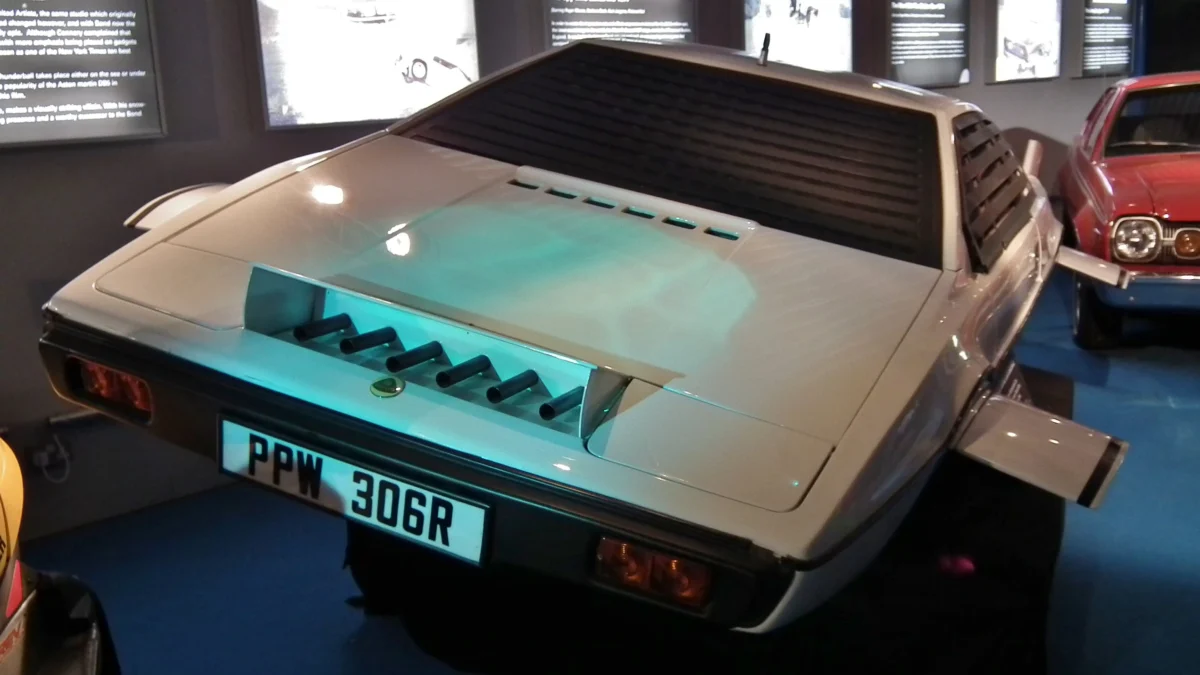
In 1977, a white Lotus Esprit drove off a pier in Sardinia and became a submarine. The sequence — from the film The Spy Who Loved Me, the tenth Bond film — lasted less than three minutes of screen time. The car spent the next fifteen years in a storage container in Long Island, forgotten, its origin unknown to the couple who bought it at a blind auction for $100.
When they opened the container and found what was inside, they spent years establishing provenance before selling it. In 2013, the car sold at auction for $997,000. The buyer was Elon Musk.
The Car
The Esprit that appeared in The Spy Who Loved Me was a Series 1, the first generation of a model that Lotus had launched in 1976. Designed by Giorgetto Giugiaro — one of the most celebrated automotive designers of the twentieth century — the Esprit was angular where most sports cars of the era were rounded, aggressively wedged where others were flowing. It looked like the future, which was why the Bond production team chose it.
For the film, Lotus and the production company worked together to modify a small number of cars. The submarine sequences required a purpose-built prop — the Esprit could not actually submerge — but the surface driving sequences used real cars, and the visual identity of the submarine vehicle was the Esprit’s. The association between the car and Bond was immediate and lasting. Lotus sold more Esprits after the film than before it.
The production car was powered by a mid-mounted Lotus 907 2.0-litre four-cylinder engine, produced 160 horsepower, and was built on a backbone chassis with a fibreglass body — both choices reflecting Colin Chapman’s consistent prioritisation of lightness over mass. The Esprit weighed around 900 kilograms. It handled accordingly.
Why Musk Bought It
Musk was specific about his reasoning. He wanted the car because he expected the Esprit’s submarine transformation to have inspired his own engineering imagination. When the car arrived and he examined it, he reportedly found the submarine conversion mechanism deeply unimpressive — a manually operated system with limited real-world capability.
He was also specific about what he planned to do with it. In interviews given around the time of the purchase, Musk said he wanted to convert the car to electric power and make the submarine mode actually functional. Whether this has happened is not publicly confirmed. Given Tesla’s current Roadster saga — a car promised in 2017, repeatedly delayed, and still without a confirmed production date — it would be entirely in keeping for the submarine Esprit to remain a project rather than a finished thing.
What matters about the purchase is not what Musk did with the car but what it reveals about the influence of Lotus on the thinking of the person who founded the company that has arguably done more than any other to reshape the automotive industry in the twenty-first century.
The Tesla Connection
The original Tesla Roadster, launched in 2008, was built on a heavily modified Lotus Elise platform. Tesla — then a small startup with limited manufacturing capability — had contracted with Lotus to use the Elise’s aluminium chassis and body structure as the foundation for their electric drivetrain. The two companies worked together for several years before Tesla developed their own platform.
The connection was practical: Lotus had one of the lightest, most driver-focused chassis platforms in production, and lightweight was critical for extending the range of an early-generation electric battery pack. Chapman’s fundamental insight — that removing weight achieves more than adding power — turned out to be directly applicable to electric vehicle engineering, where battery capacity is fixed and reducing the car’s mass is one of the most effective ways to improve performance.
In other words: Chapman’s philosophy, developed in a converted mill in Burgstall in the 1950s, ended up shaping the engineering approach of the company that would become the world’s most valuable automotive manufacturer. Tesla’s current FSD milestone — a Model 3 driving itself from New York to Los Angeles without a single human intervention — is several engineering generations removed from a fibreglass Lotus, but the underlying principle has not changed: every kilogram saved is range gained, and every line of code that removes a human task is a problem the hardware no longer has to brute-force.
The Esprit’s Legacy
The Lotus Esprit remained in production, in various evolved forms, until 2004. It was never a volume seller — Lotus never built cars in volume — but it maintained a devoted following throughout its production life. The Bond association sustained its cultural presence long after the original Series 1 was replaced by later, more refined versions.
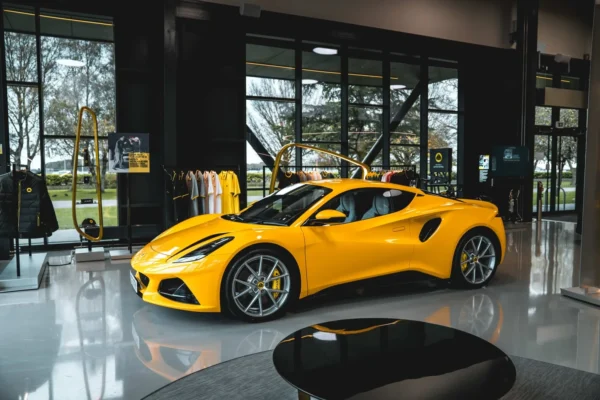
A planned Esprit revival was announced by Lotus in the 2010s, generating significant enthusiasm. It did not materialise in the form originally proposed. Lotus, now owned by Geely and focused increasingly on electric vehicles and the premium market, has taken the brand in a different direction. The Emira, launched in 2021 as Lotus’s final combustion-engined car, is the spiritual successor the Esprit never officially had.
The submarine car sits somewhere in Musk’s collection. The chassis technology it was built on helped launch the world’s most valuable electric car company. The designer who created the engineering philosophy that made the Lotus Esprit what it was died in 1982, before any of this happened.
Chapman spent his career proving that less is more. His legacy turned out to be rather more than he could have imagined.