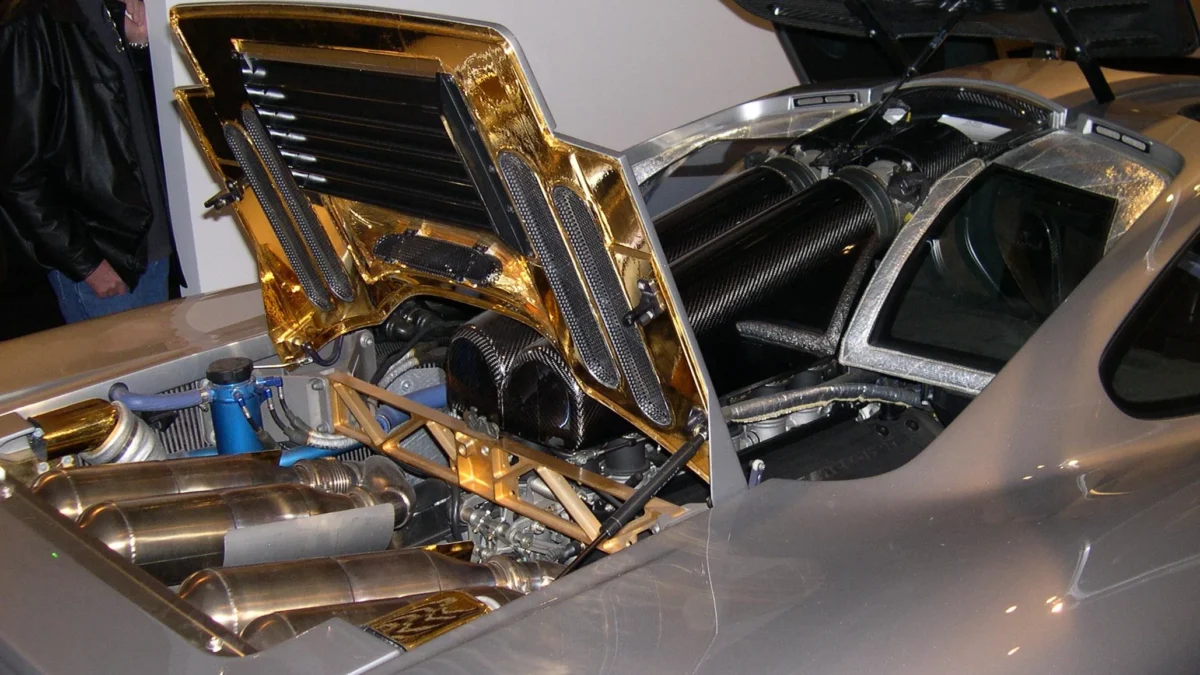
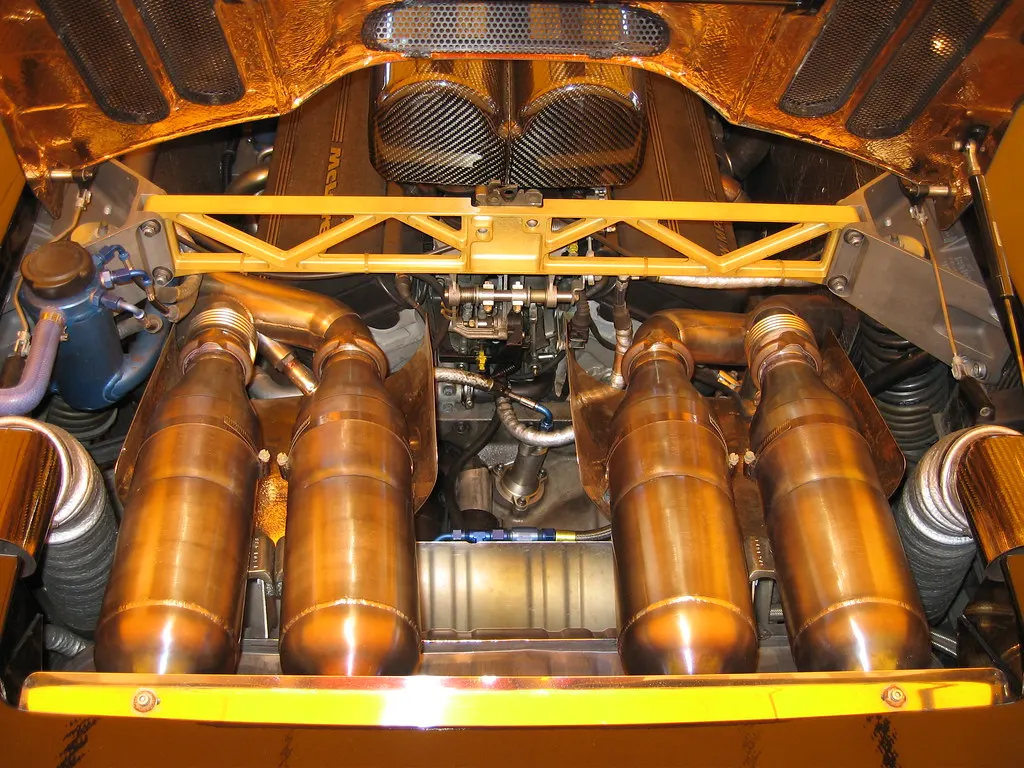
Open the engine cover of a McLaren F1 and you will find something that looks, at first glance, like an extravagance. The entire engine compartment is lined with gold foil — not a gold finish, not gold-coloured paint, but actual gold. It catches the light the way jewellery does. It feels entirely out of place in a machine otherwise defined by its obsessive practicality.
It is there because Gordon Murray, the F1’s chief designer, had a heat problem he could not solve any other way.
The Problem
The McLaren F1 was built around a BMW-developed 6.1-litre V12 engine — the S70/2, designed specifically for this car by BMW Motorsport under Paul Rosche. It produced 627 horsepower in a car that weighed 1,138 kilograms. The power-to-weight ratio was, at the time of the car’s launch in 1992, unprecedented for a road car.
That engine produced extraordinary heat. The F1’s chassis was made almost entirely from carbon fibre — at the time, its use at this scale in a road car was itself revolutionary — and carbon fibre does not respond well to sustained high temperatures. Murray needed to protect the monocoque from the engine’s thermal output without adding meaningful weight.
Conventional heat shielding — the ceramic-coated or metallic barriers typically used in motorsport applications — was effective but heavy. Murray’s entire design philosophy for the F1 was centred on the elimination of unnecessary mass. Every gram had a rationale. If a conventional heat shield was going to add weight, it needed to earn that weight through performance.
It didn’t earn it. Gold did.
Why Gold
Gold is one of the most effective infrared radiation reflectors known. In practical terms, this means it bounces heat away rather than absorbing and re-radiating it. NASA had been using gold foil to protect spacecraft components from solar radiation for decades — the James Webb Space Telescope’s mirrors, launched in 2021, are coated in gold for exactly this reason. The physics are unambiguous: for heat reflection per unit of weight, gold is exceptional.
Murray’s team applied gold foil — approximately 25 microns thick, thinner than a human hair — across the engine bay surfaces most exposed to heat from the V12. The foil reflected the engine’s thermal output away from the carbon fibre structure. The weight added was negligible. The protection was significant.
It was, in other words, the most weight-efficient solution available. The fact that it also looked extraordinary was, from Murray’s perspective, entirely beside the point.
The Broader Engineering Philosophy
The gold foil detail is illustrative of how the McLaren F1 was designed in its entirety. Murray’s approach was not to take an existing car and improve it, but to reason from first principles about what a road car could be if every decision was made purely on engineering merit, with no deference to convention or cost.
The central driving position — the driver seated in the middle, ahead of two passengers — was chosen because it offered the optimal sightline and weight distribution, not because it was marketable. The naturally aspirated V12 was chosen over a turbocharged alternative because Murray wanted linear, predictable power delivery, not because it was the path of least resistance. The carbon fibre monocoque was chosen because it was the lightest structure strong enough for the purpose, at a time when the tooling costs were almost prohibitive.
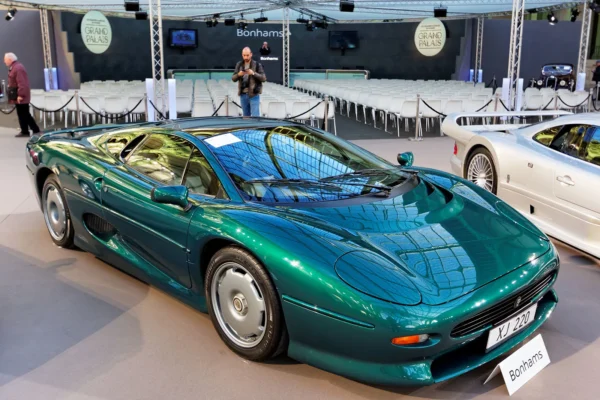
Every decision in the F1 followed the same logic: what is the best solution to this specific problem, regardless of what it costs or how unusual it is? Gold in the engine bay was the answer to a thermal management question. It happened to be beautiful. That was a consequence, not a goal — which is more than could be said for its contemporary rival from Coventry, where Jaguar had promised customers a V12 XJ220 and quietly delivered a twin-turbocharged V6 instead, generating lawsuits, refunds, and three decades of footnote-grade controversy that Murray’s F1 has been quietly travelling above for its entire production life.
The Number
McLaren built 106 F1s between 1992 and 1998. Of those, 64 were road cars. Each one was lined with gold foil applied by hand by a small team of specialists. The material cost of the gold itself, relative to the total cost of the car — which retailed at around £540,000 at launch, equivalent to over £1.5 million today — was trivial. But the decision to use it reflects something important about the project’s priorities.
The McLaren F1 was never a cost-optimisation exercise. It was an attempt to build the best road car possible. When the best material for a specific application happened to be gold, Murray used gold. The question of whether buyers would notice or care was not one that appears to have been seriously discussed.
Legacy
Gordon Murray went on to found Gordon Murray Automotive, and in 2022 launched the T.50 — a spiritual successor to the F1, again with a central driving position, a naturally aspirated V12, and an obsessive focus on weight reduction. The T.50’s engine bay is also gold-lined.
Some engineering decisions, when they’re correct, stay correct.