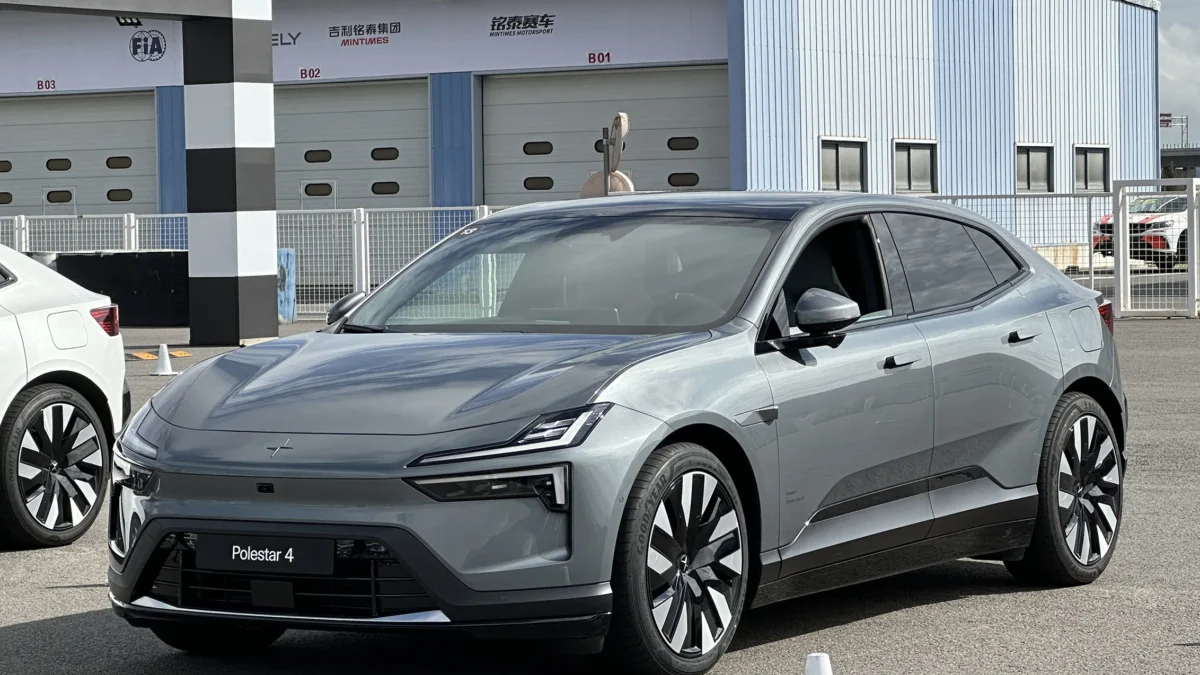
The Polestar 4 — a name that tells you it is the fourth Polestar model released, in release order, which is not a hierarchy or a size or a price guide, just a number — is classified by its maker as an SUV coupe. Doug DeMuro, who reviewed the car at length, put it plainly: it is a sedan. A tall sedan, with no back window.
Is the Polestar 4 an SUV or a Sedan?
It has four doors. It has a sloping roofline. It sits 60 inches tall, which is about three inches taller than a Toyota Camry and three inches shorter than the Polestar 3, which is demonstrably an SUV. Polestar markets the 4 as an SUV because SUVs are what people buy, which is commercially rational but strictly incorrect. It is a tall sedan wearing crossover marketing, and once you see it that way you cannot unsee it.
Why Does the Polestar 4 Have No Rear Window?
The rear window decision has a genuine engineering rationale behind it, which makes it slightly less eccentric than it initially appears. By replacing the glass with a camera system feeding a digital rearview mirror, Polestar’s designers were able to pull the rear seat further back, maximising interior space in a car of this footprint, and maintain the sloping coupe roofline without reducing rear headroom to something embarrassing.
The payoff is a back seat that is genuinely generous for a car of this size — DeMuro notes you can sit comfortably behind a tall front-seat occupant — and proportions that look considerably more purposeful than the soft-edged crossovers it is competing against. Delete the window, in other words, and you get the coupe silhouette and the headroom, rather than choosing between them.
Living With the Camera Mirror
The trade-off is that you are now looking at a screen when you check your mirrors, which requires your eyes to refocus from road distance to close distance every time you glance at it. In good conditions, most reviewers report you get used to this relatively quickly. In rain or at night, there is glare; the camera view can blur in wet conditions after dark, and a strip of ambient lighting mounted near the digital mirror reflects distractingly into the display. Top Gear concluded rather tersely that they simply didn’t get used to it. Whether you do is something that a test drive is more likely to determine than a review.
The Rest of the Car
Beyond the rear window, the Polestar 4 is a car of studied minimalism and reasonable substance. The interior is genuinely good — decluttered Scandinavian surfaces, excellent material quality, a 15.4-inch central touchscreen running Google-based software that DeMuro praises for being uncommonly well laid out and simply described. The climate vents are hidden to maintain the clean aesthetic, which means adjusting them requires going into a menu, which is the price you pay for looking calm. The seat belts are gold, because Polestar’s signature colour is gold, and that detail manages to be both slightly odd and rather pleasing at the same time. Interior mood lighting comes in several settings, all named after planets. This is very much a car for people who like that sort of thing.
Performance in dual-motor form is serious. 544 horsepower, 0-60 mph in 3.7 seconds, an EPA-rated range in the 270-mile region from a 100 kWh battery that supports 200 kW DC fast charging, taking the pack from 10% to 80% in about 30 minutes. The ride and handling draw consistent praise across reviewers — quiet, composed, quick when asked, and steered with more precision than the body style typically suggests. Polestar built early models in China, but those destined for the US are now assembled in Busan, South Korea, sidestepping the tariff volatility that has complicated Chinese-made EV imports. The brand itself remains part of China’s broader premium-EV push — Geely-owned, with engineering and design centres in Europe but a corporate parent that is increasingly the most aggressive force in the global premium electric segment.
Polestar 4 Price and Rivals
Pricing starts at $56,400 for the single-motor rear-wheel-drive car, rising to $62,900 for the dual-motor. A well-equipped dual-motor example lands around $80,000 once options are applied. At that price, it is competing against the Porsche Macan Electric, the BMW iX3, and the forthcoming electric Mercedes GLC — cars with considerably stronger brand equity and, in most cases, a rear window. The value case is reasonable but not overwhelming, and Polestar’s challenge remains what it has always been: the brand doesn’t generate the loyalty or the cultural cachet that turns a good car into a sold car.
A Car With a Point of View
What the Polestar 4 does have is a point of view, which is rarer than it should be in this segment. Most premium electric crossovers are competent, quiet, and entirely forgettable as objects. The Polestar 4 is none of those things. It has made a specific set of design decisions — the window, the minimalism, the planet-named lighting modes, the buttonless key fob, the exterior spec sheet printed on the door — and it stands behind them without apology. You may find this approach charming. You may find it exhausting. Either way, you will form an opinion about this car, which puts it ahead of roughly half its rivals before it has moved an inch. Compare it with the Tesla Model Y, which makes the opposite choices — appliance-first, opinion-free, engineered to be the rational default rather than the conversation piece — and you have a fairly clean illustration of the two strategies competing for the premium electric buyer right now: the car that wants to be loved versus the car that wants to be bought.
The EV market is full of cars that are technically accomplished and aesthetically anonymous. The Polestar 4 is neither. Whether that turns out to be a winning formula commercially is another question entirely.
At least you’ll always know which direction you came from.