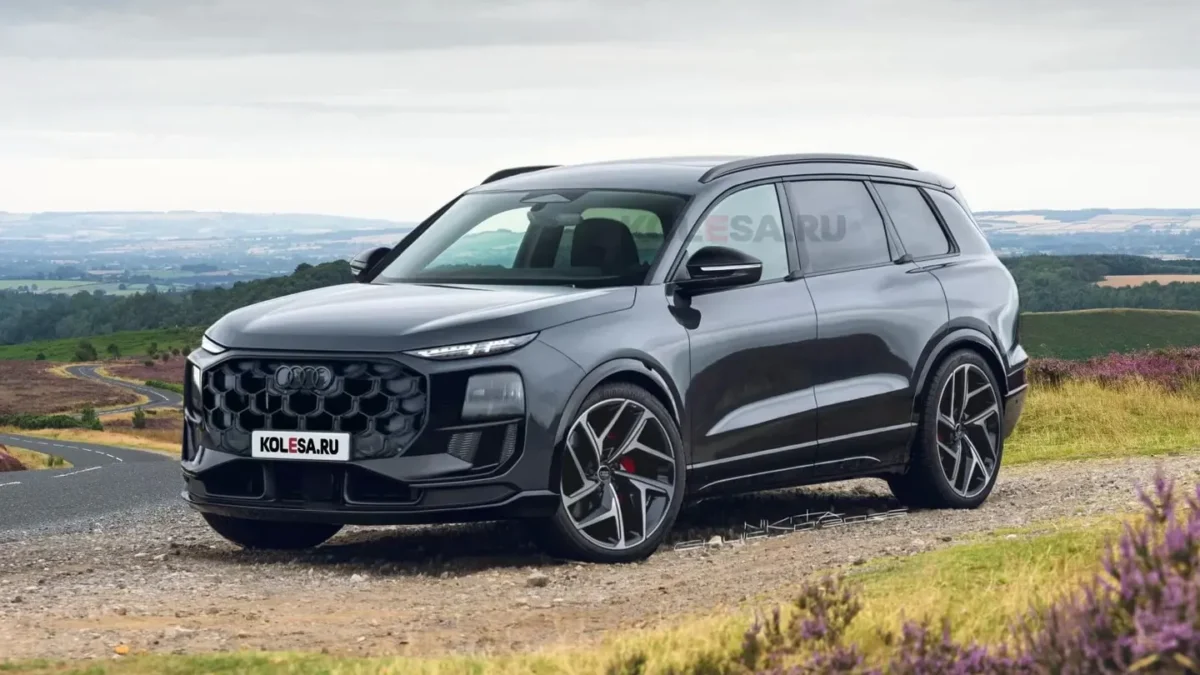
After 13 years, multiple lobbying rounds, a federal rule change, and roughly an entire generation of European drivers wondering what was wrong with us, Audi has finally been permitted to sell its proper adaptive headlights in the United States. The vehicle delivering this enormous technological leap forward is a three-row, twin-turbo, petrol-burning SUV the size of a Greek island. Welcome to 2026.
The announcement landed yesterday, 21 May. The 2027 Audi Q9 — the company’s new full-size flagship, aimed squarely at Cadillac Escalade and BMW X7 territory — will be the first Audi sold in the US with the Digital Matrix LED system actually switched on. Each headlamp module contains 25,600 individually addressable micro-LEDs, each one roughly 40 micrometres across, packed into a unit 13 millimetres wide. The system reshapes its beam pattern in real time, blocking light from oncoming drivers’ eyes while leaving the rest of the road blazingly visible. Europe has had this since the 2014 Audi A8. The US has had US headlights.
The regulatory back-story is exquisite. American headlight law was written when sealed beam units were state-of-the-art, which was 1939. The relevant federal standard, FMVSS 108, required vehicles to have distinct low and high beam settings, which technically banned a single adaptive beam doing both jobs simultaneously — the whole point of matrix lighting. NHTSA finally rewrote the rule in February 2022 after a decade of complaints, but the new specification was so unique to US conditions that automakers had to redesign the systems from scratch. Audi has spent four years doing exactly that. Rivian beat them to market in 2024, becoming the first car sold on US roads with proper adaptive driving beams. Audi is, in pure pedantic terms, second.
Which brings us to the car. The Q9 is not a green halo project. It is built on Audi’s Premium Platform Combustion architecture — yes, that is literally what they call it — alongside the next-generation Q7, and will be assembled in Bratislava, Slovakia next to the petrol-and-PHEV Porsche Cayenne. Expected powertrains include a 3.0-litre turbocharged V6 with mild-hybrid assistance, a plug-in hybrid V6 producing somewhere around 400 horsepower, and — if you ask nicely — a V8 borrowed from Porsche’s Euro 7-compliant playbook, because nobody buys an Escalade-sized luxury barge to lecture them about CO2. Pricing is expected to start near $90,000 and climb past $120,000 for higher trims. The Q9 will also be the first Audi to launch in the US market before any other, which tells you everything about where Audi thinks the buyers actually are.
The context behind this charm offensive is fairly stark. Audi’s US sales have been losing ground to BMW, Mercedes-Benz and Lexus for several quarters running. The brand badly needs a flagship SUV — it has, remarkably, never sold one of this size in America — and the Q9 is meant to be the wedge. The headlights are a symbol: see, we can finally give you the proper version of the thing. Just like Stellantis and GM rediscovered the V8, Audi has rediscovered the obvious truth that American luxury buyers want big, comfortable, internal-combustion family haulers with all the toys, ideally including toys that other countries got over a decade ago. Just as American combustion muscle is now travelling the other direction across the Atlantic — Stellantis has just launched the Charger in Europe, complete with V8, in a market that has spent the last decade being lectured about emissions targets. The trade in big-engined luxury is, suddenly, working in both directions.
It is also a useful reminder of how the all-electric pivot got partially walked back. Five years ago, Audi loudly committed to launching its last new combustion model in 2026 and going EV-only by 2032. That timeline has now been quietly revised by CEO Gernot Döllner, who told investors that combustion engines “will continue to play an important role.” Translation: we are launching a brand-new ICE platform precisely because the EV market did not arrive on the schedule the slide decks insisted upon. Volvo Cars is currently making the same discovery, only without any of its own engine factories. Worth noting, by contrast, that Toyota’s quieter, more confident lineup of combustion enthusiast cars never required a U-turn — because Toyota never insisted on the all-electric pivot in the first place. The brand that was mocked for hedging now looks considerably less foolish than the brand that committed.
The forward-looking takeaway is that 2026 has become the year European luxury brands stopped pretending they were Tesla and started remembering they were Audi, BMW and Mercedes — makers of large, refined, beautifully engineered petrol-burning SUVs for people who want to be driven somewhere nice without thinking about charging infrastructure. The Q9 is exhibit A. The headlights, finally, are the cherry on top. American drivers can now see in the dark like Europeans always could. Only thirteen years late. Practically rushed, by US regulatory standards.