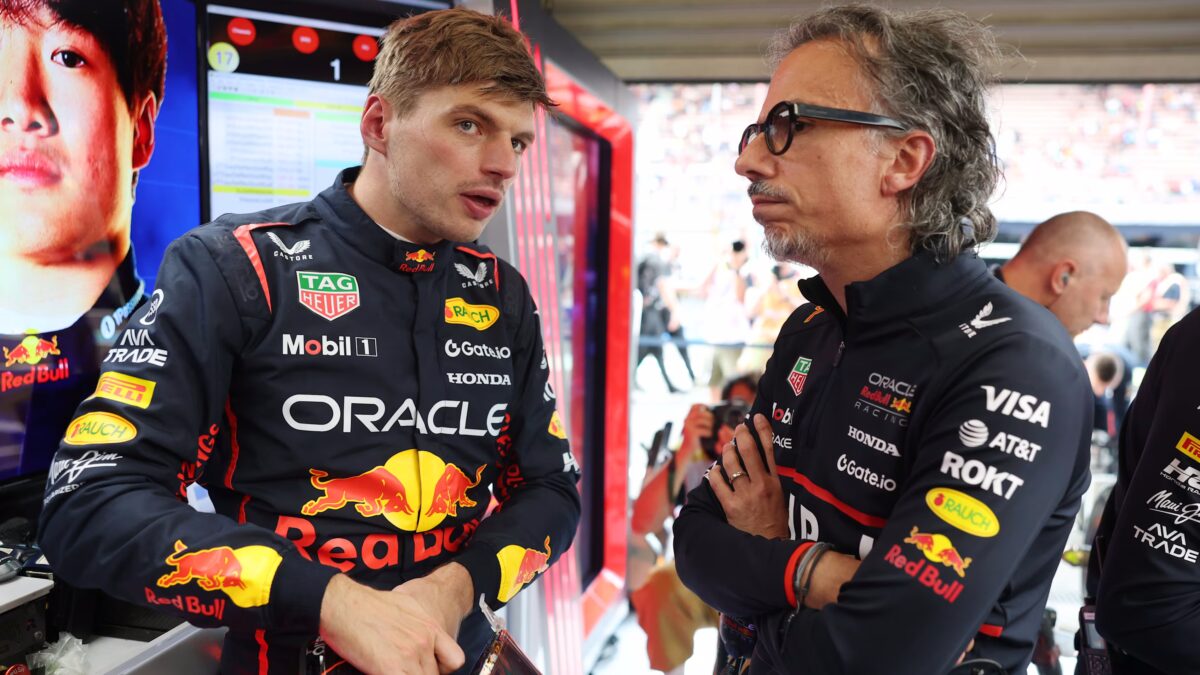
Max Verstappen turns up at the Red Bull Ring this weekend sitting seventh in the Formula 1 World Championship. Seventh. With 55 points, after seven race weekends. He is 101 points behind Kimi Antonelli, the 19-year-old who replaced Lewis Hamilton at Mercedes. He has stood on the podium exactly once in 2026 — Canada, third place — and his power unit failed on lap one of the Monaco Grand Prix. He has, by his own admission, found driving the new cars somewhere between unpleasant and “a bit weird.” And the clock on the most consequential exit clause in modern Formula 1 has, according to Sport Bild, five weeks left to run.
Five weeks. That is the time between today and the start of the Hungarian Grand Prix weekend on 31 July, by which point Verstappen must either be inside the top two of the World Championship or be entitled to walk out of the Red Bull contract he signed through 2028. He is currently five places below the top two. He would need to score roughly twice the points he has scored to date in roughly half the remaining races. He would need, in other words, a miracle.
Let’s deal with the contract first, because the precise wording matters. According to multiple reports — Sport Bild, Bild, ESPN, Motorsport.com — Verstappen’s deal contains a performance clause specifically negotiated in anticipation of the 2026 regulatory upheaval. It allows him to terminate his contract unilaterally, with no compensation owing to Red Bull, if he is outside the top two of the Drivers’ Championship at a specified reference point in the summer. The reference point is the summer break, which begins after Hungary on 26-27 July. He would then have a window, reportedly running August to October, to activate the clause and leave at the end of the season. A similar clause reportedly carries into 2027, in case Red Bull’s situation doesn’t improve.
This was not, as ESPN reported via Martin Brundle on the F1 Show, an accident. Verstappen’s management built this clause into the deal precisely because Red Bull-Ford was an untested engine partnership beginning in a year of fundamental regulation change, and Verstappen was, quote, “apprehensive” about both. He was right to be apprehensive. The Red Bull-Ford power unit is currently the weakest on the grid, behind Mercedes, Ferrari and Honda. Red Bull’s chassis has handed Verstappen a car that, on his own assessment, has been “fighting with the midfield.” His teammate Isack Hadjar is fifth in the standings with 76 points. The four-time reigning World Champion is two places behind the man he is supposed to be mentoring.
The interesting part is what’s happened in the last fortnight.
Ahead of the Barcelona Grand Prix, Verstappen made a brief stop in Austria to meet Red Bull’s senior leadership — Chalerm Yoovidhya (the Thai shareholder), Mark Mateschitz (son of the late Dietrich), and Oliver Mintzlaff (the Red Bull GmbH CEO). According to Bild, the meeting was an attempt to extract a long-term commitment. According to Bild, Verstappen declined to give one. The Red Bull leadership then reportedly offered to buy out his exit clause — a sum described as “in the low double-digit millions of euros.” Verstappen, according to Bild, also declined that. Internal Red Bull opinion is now reportedly split, with Yoovidhya wanting to neutralise the clause whatever the cost and Mateschitz/Mintzlaff preferring to spend the money on the car. The most powerful driver in modern Formula 1 is, as I write this, sitting on an option that allows him to leave for free, and his employer is unable to agree what to do about it.
This week, his manager Raymond Vermeulen put a marker in the ground. “We’d like the decision to be made soon so that everyone knows where they stand,” he told Bild. “It could be made before the summer break.” Translation: Verstappen will probably announce his 2027 destination within the next five weeks. Which means the Austrian Grand Prix — at the Red Bull Ring, in front of the company that owns the team, the energy drink brand printed on every garage wall, and a circuit named after Niki Lauda — has just become a job interview.
The Mercedes question is the obvious one. Toto Wolff has spent the last three contract cycles publicly courting Verstappen, and Mercedes are currently winning everything. But the seats are filled — Russell is under contract through 2027 (he hasn’t yet signed an extension, but is reportedly comfortable), and Antonelli is locked in through 2029. Ralf Schumacher claimed last week that Wolff has put an offer to Verstappen, but described it as “financially so bad that it’s not an option.” Mercedes, having built its 2026 strategy around a teenager who has won five Grands Prix already, is not going to displace him for a 28-year-old with form questions and contractual leverage that would price comparable to small countries. Aston Martin is the alternate landing spot — Honda power, Adrian Newey, Lawrence Stroll’s wallet — but Aston Martin has scored five points all season and is publicly described, by F1 paddock sources, as “not operating at F1 standards.” That leaves a sabbatical, retirement, or, most likely, staying at Red Bull while waiting for the 2027 V8 reset incoming.
Which brings us, properly, to the question this column has been circling for two months. Verstappen has spent 2026 making it increasingly clear that his most enjoyable racing is happening elsewhere — the 20 hours he led at the Nürburgring 24 Hours being the most visible example. Ford, meanwhile, is in active talks with him about a Le Mans hypercar entry as early as 2027. If you were Verstappen, what would you do? Stay at Red Bull through 2026, take the V8 reset in 2027, race Le Mans on weekends off, and consolidate the position as the highest-paid driver in the sport while waiting for the formula to suit you again? Or detonate the entire structure for a Mercedes seat that doesn’t currently exist?
The answer, I suspect, is that the exit clause is a negotiating tool more than a route. Verstappen will use the next five weeks to extract concessions from Red Bull — development priority, engineering focus, a Hadjar-or-not call for 2027. He will not jump to a team without a seat. But the threat alone is now the single biggest political story in F1, and it is unfolding in real time at the Red Bull Ring this weekend.
The practical bit: Austria expects 30C+ heat across all three days with rain possibly arriving on Sunday. Antonelli leads the championship. Hamilton, having won Barcelona, is on a five-podium streak. Russell, after his Canadian engine failure and the Monaco penalty debacle, is fifteen points behind Hamilton in third. None of this is the story. The story is whether Verstappen finishes ahead of his teammate this weekend, on the track owned by the company that employs him, with the clock ticking down on the clause that determines whether he’s an employee at all.
Going well at the Red Bull Ring is, historically, very easy for Verstappen. Going well at the Red Bull Ring while your contract is in front of you and your phone is ringing is a different sort of test entirely.