Enzo Ferrari was 89 years old, had been mostly blind for two years, and was running out of time. He knew it. His engineers knew it. The company that bore his name — now majority-owned by Fiat, run in part by people he hadn’t hired and wouldn’t have — knew it too. Ferrari’s fortieth anniversary was approaching in 1987, and someone in the building had the idea that they should mark it with something extraordinary.
They brought him a proposal. A car with no carpets. No radio. A turbocharged V8 producing 478 horsepower. A body made largely from composites that flexed when you pushed on it with a thumb. A cabin that would be, in the parlance of the time, raw — meaning hot in summer, loud at all times, and possessed of a windscreen so raked that taller drivers would find themselves peering through the tinted strip at the top.
Enzo said yes.
That decision — or more precisely, that refusal to compromise — produced one of the most important cars of the twentieth century, and the last one Enzo Ferrari would personally sign off on before his death in August 1988.
How the F40 Came to Exist
By the mid-1980s, Ferrari had a problem that most manufacturers would consider a luxury: their road cars had become too civilised. The 308 and 328 were beautiful, relatively approachable grand tourers. The Testarossa was spectacular to look at, the subject of every teenager’s bedroom poster, and broadly regarded by serious drivers as somewhat soft for a car wearing that badge. The mid-engined 288 GTO, produced in limited numbers from 1984, had briefly recaptured the sense of occasion — but it had been built for a Group B rally programme that was cancelled before the car could compete, and production ended after 272 units.
What Ferrari needed, in the view of its founder, was not a better touring car. It was a statement. Something that reminded the world — and reminded Ferrari’s own engineers — what the company was actually for.
The brief that emerged from those conversations was essentially an instruction to remove everything unnecessary. Nikolaos Geronikolas, Enzo’s chief engineer at the time, worked with a team that approached the F40 not as a development of existing Ferrari road cars but as the closest thing to a race car that could be legally driven on public roads. The twin-turbocharged F120A V8 engine — displacing 2.9 litres and featuring twin IHI turbochargers — was a development of the 288 GTO’s unit, tuned to produce figures that, in 1987, were genuinely shocking.
Zero to sixty in 3.8 seconds. A top speed of 324 km/h — making it, at launch, the fastest production car in the world.
What Enzo Actually Approved
The details of what Enzo signed off on are worth dwelling on, because they represent a set of decisions that most manufacturers in 1987 would have considered commercially questionable at best.
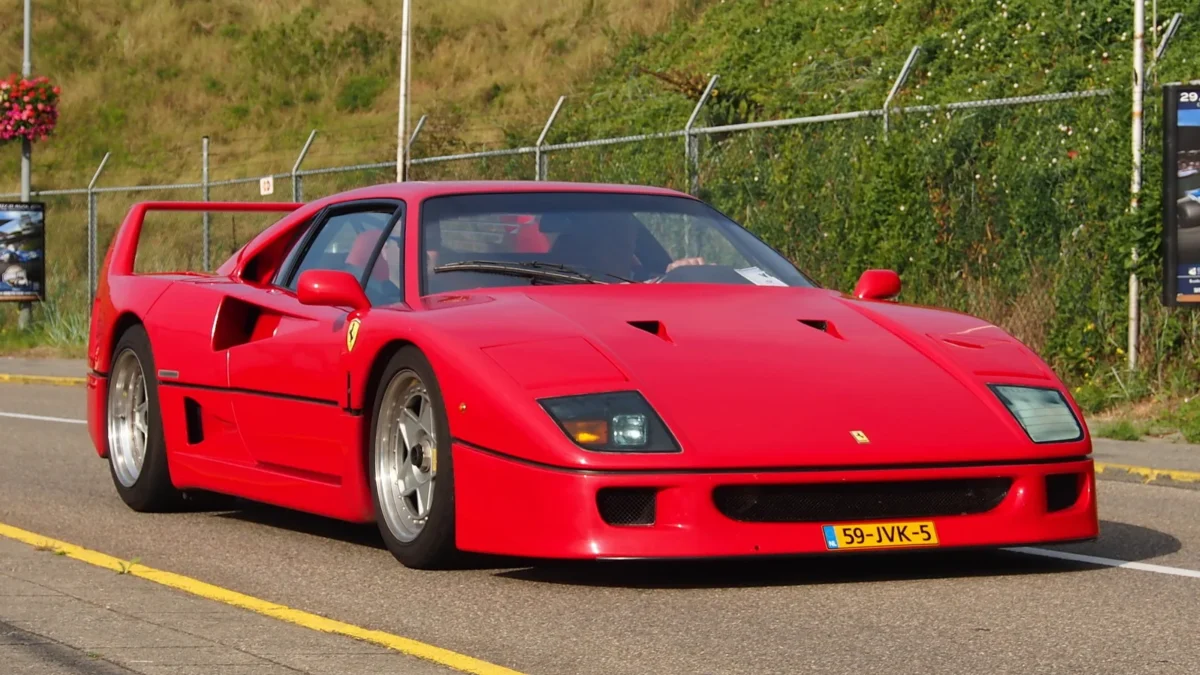
There were no door handles on the inside. The windows were fixed Lexan panels that could not be opened, with small sliding sections for ventilation. The door cards were replaced with fabric straps. The dashboard was bare carbon fibre and raw metal. There was no storage. There was no stereo. The seats were fixed; you adjusted your position relative to the pedals, not the seat relative to you.
The body panels were made from Kevlar, carbon fibre, and fibreglass. In the interests of weight — the F40 came in at under 1,100 kilograms — the panels were thin enough to be translucent in strong light, and the surface finish was functional rather than jewel-like. Up close, the car looked almost unfinished. The engine cover, in particular, had the texture of something built to work rather than to impress at a concours.
All of this was a choice. Ferrari’s production facilities were perfectly capable of producing more refined cars — the Testarossa sitting in the same range demonstrated as much. The austerity of the F40 was not a budget constraint. It was a philosophy, and the philosophy was Enzo’s.
The Price and the Waiting List
Ferrari priced the F40 at 390 million Italian lire at launch — roughly £148,000 in period UK pricing, a figure that was itself a statement. Demand immediately and dramatically outstripped supply. Speculators bought allocation slots and flipped them before the cars were built, with some early examples trading at twice the list price before they had left the factory.
Ferrari had planned to build 400 examples. They eventually produced 1,311, the production run extended to meet demand and then extended again. The increase in numbers generated its own controversy — purists argued that Maranello had diluted the car’s exclusivity — but the F40’s character was sufficiently extreme that even with 1,311 in existence it never became ordinary. Every one of them was, by design, a demanding and occasionally alarming driving experience, which is not a quality that fades with repetition.
Present-day values tell their own story. Clean F40s now regularly sell for well above £1 million, with exceptional examples achieving considerably more. The car that was built with no carpets and no door handles has become one of the most financially significant Ferraris ever produced — including, to the quiet amusement of anyone paying attention, some of the more lavishly equipped Ferraris that Enzo had been trying to react against.
The Last Signature
Enzo Ferrari attended the F40’s public launch at Maranello on 21 July 1987, in what would be one of his final public appearances. He died on 14 August 1988, aged 90, before the last cars had been delivered to customers. The F40 outlived him and went on to define a generation of thinking about what a Ferrari should feel like at its most concentrated.
There is a version of the story in which Enzo’s approval was a formality — in which the engineers had already decided what the car would be and the old man simply ratified it. That version probably undersells his influence. This was, after all, a man who had never much cared for rules he found inconvenient — whose first instinct, when confronted with a regulatory framework he didn’t like, was to find a way around it. The decision to strip the F40 of every comfort and convenience was entirely consistent with a career spent prioritising performance over palatability.
The engineers who worked on the car have said, in various interviews over the years, that Enzo was clear about what he wanted and clear about what he didn’t. What he didn’t want was a grand tourer with a Ferrari badge. What he wanted was a car that would embarrass drivers who were not good enough to drive it — and would reward, handsomely, the ones who were.
What It Tells Us
The F40 represents a specific kind of decision that has become almost impossible in the modern industry: a product approved by a single person on aesthetic and philosophical grounds, with the commercial considerations running a distant second.
Every contemporary hypercar is the product of committees, of clinics, of customer residency programmes and brand equity studies and long PowerPoint decks about aspirational lifestyle positioning. They are excellent, most of them. They are not the F40.
The F40 was what happened when an 89-year-old man with failing eyesight and a clear sense of what mattered looked at a proposal for a car with no carpets and no door handles and decided, without apparent hesitation, that this was exactly right.
His successors have been trying to recapture that clarity ever since. The last Ferrari to carry a naturally aspirated V12 — the 12Cilindri — is evidence that they still understand what they’re aiming for. Whether you can manufacture conviction by committee is a question Ferrari’s next forty years will answer.
Enzo already knew the answer. He just didn’t bother writing it down.