For most of 2026, the narrative around Western electric vehicle manufacturers has been a catalogue of retreats: cancelled models, idled factories, revised forecasts, and a general atmosphere of people quietly hoping the situation improves before anyone notices. Today, BMW opened order books for its new i3 electric sedan months ahead of schedule because demand was so high it couldn’t wait. This is what the other story looks like.
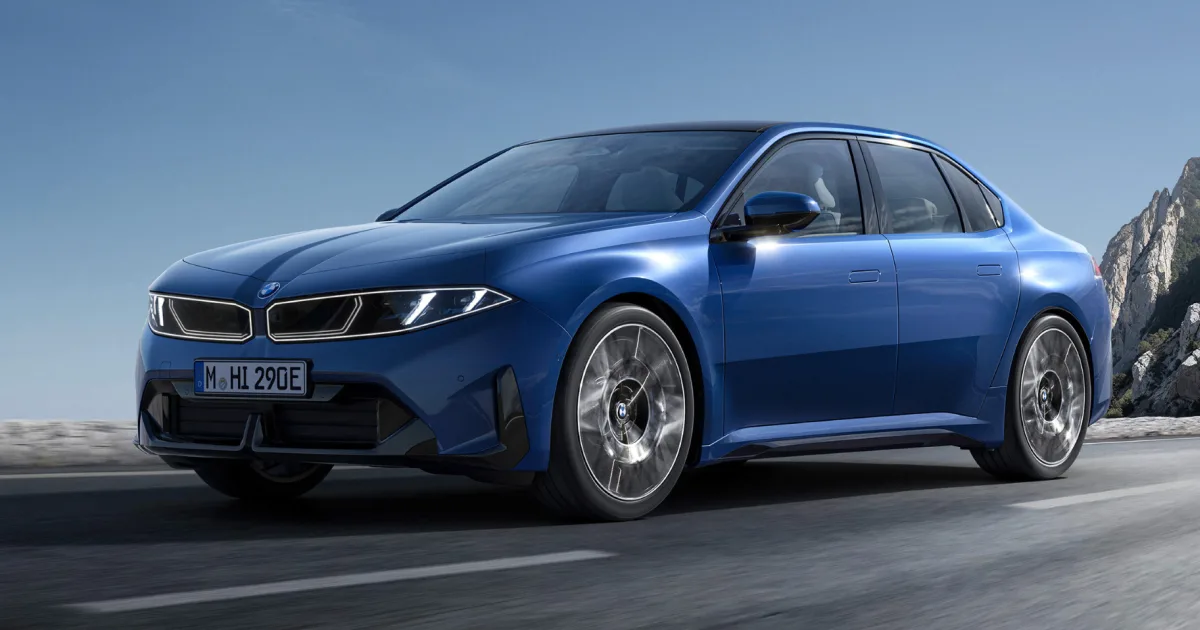
BMW opened European orders for the i3 50 xDrive First Edition on Thursday, June 18 — months ahead of the originally planned timeline — after demand significantly exceeded expectations following the car’s March unveiling. The First Edition is priced from £57,905 in the UK, with the standard i3 50 xDrive arriving at £53,005 when it launches in autumn 2026. Production begins in August at BMW Plant Munich; US customers will need to wait until 2027. The reason for the early order opening is not complicated: the Neue Klasse iX3 had already generated over 50,000 orders, and BMW wanted to capture similar momentum for its second Neue Klasse model before the formal launch window.
The specification is the headline. The i3 50 xDrive is powered by a 108.7 kWh battery pack using new cylindrical cells in an 800-volt architecture, with WLTP range of up to 563 miles for the First Edition and up to 567 miles for the standard model. Under EPA testing — the more rigorous American standard — the figure comes down to approximately 440 miles, which still represents an 80-mile advantage over the Tesla Model 3 Long Range AWD’s 363 miles. The Model 3 has been the benchmark for premium electric sedans since 2017. BMW has just arrived with a longer ruler.
The charging story is equally pointed. Connected to a 400 kW DC rapid charger, the i3 can add up to 263 miles of range in just 10 minutes. Tesla’s Model 3 charges at 250 kW maximum. In practical terms, BMW’s 800-volt architecture closes the charging gap that has long been one of the Model 3’s competitive advantages. Bidirectional charging is also supported — meaning the car can feed energy back to a home or grid — which is a feature Tesla has promised and deferred on several occasions.
The technology inside is worth cataloguing. The interior features BMW’s Panoramic iDrive system, projecting information across the full base of the windshield from A-pillar to A-pillar alongside a 17.9-inch central display, with Nvidia’s DRIVE AGX Orin chip handling in-vehicle AI compute. The optional Motorway Assistant enables hands-free driving at up to 81 mph with automated lane changes confirmed by eye-tracking — BMW’s most advanced driver assistance system to date, operating at SAE Level 2. BMW’s “Symbiotic Drive” concept allows the driver to override assistance systems naturally without disengaging them — the opposite of the current generation of systems that disengage the moment a human dares to steer.
The context is what makes this story worth more than a straightforward launch piece. BMW’s China sales are running roughly 18% below pace through May 2026 — the same Chinese premium EV competitors who debuted at Beijing with six-seat SUVs at BMW prices have been taking market share on BMW’s home turf. The i3 is BMW’s most direct response — a car built specifically to beat Chinese competitors on range, charging speed, technology, and the one dimension Chinese manufacturers cannot easily replicate: the emotional premium of a Munich nameplate with a 109-year history.
Whether that emotional premium is worth the price differential is the question the EV transition is asking of every legacy European manufacturer simultaneously. The iX3’s 50,000 orders before launch, and the i3’s early order books now filling, suggest the answer in Europe is at least partially yes. BMW board member Jochen Goller noted that the i3 “will be competing in a high-volume segment and is therefore extremely significant for the BMW Group.” Competing in a high-volume segment against a Tesla Model 3 with 80 fewer miles of range, and against Chinese manufacturers building technically superior cars for significantly less money, is not a comfortable position. But it is at least, for the first time in a while, a position BMW appears to be approaching with the right tools. The wider question of what premium EV buyers actually want in 2026 is now visibly fragmenting along brand lines — Porsche has answered it with simulated gears and a synthetic engine note on the 2027 Taycan, while BMW has answered it with 563 miles of range and a 400 kW charger. Same segment, same problem, two completely different theories of the buyer.
The BloombergNEF forecast sees European EV sales growing steadily through 2030 and beyond. The i3 needs to be a significant part of BMW’s position in that growth, or the story of Western automotive resilience in 2026 will have one fewer chapter worth writing. On today’s evidence, BMW is at least showing up with a car worth discussing.
Production starts in August. UK deliveries begin in autumn. The order book is already open. Months early. That is not nothing.