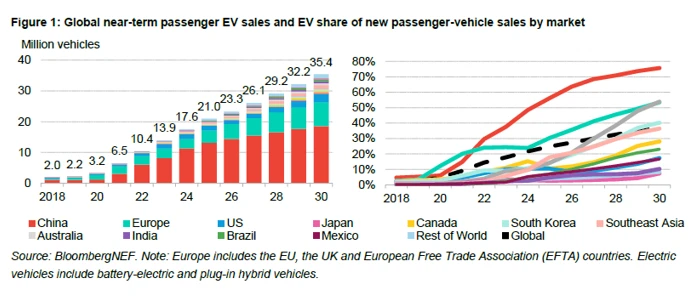
BloombergNEF does not typically deal in certainties. It publishes forecasts, runs scenarios, and issues carefully hedged projections. Which is why the opening claim of its 2026 Electric Vehicle Outlook — published yesterday — deserves a moment of attention: over half of all passenger vehicles sold globally will be electric by 2035, and by 2050, virtually every new car sold on earth will be electric. Not most. Not the majority. Every one.
The report expects over 23 million passenger EVs to be sold globally in 2026 — an 11% increase from 2025 — with EVs accounting for 27% of all new car sales. That headline figure is slightly more conservative than the IEA’s 30% projection from last month, which itself acknowledged the role of Iran war-driven oil price spikes in accelerating European adoption. BNEF’s number is a cleaner measure — it strips out the geopolitical tailwind and asks what the underlying trend actually is. The answer is still 27%. Still more than one in four. Still a number that would have seemed fantastical in 2019.
The China story remains what it always is: the dominant fact around which everything else organises itself. China accounted for 63% of electric cars sold globally in 2025 and will continue to account for more than half of global sales through 2030. BYD’s overseas export surge — the 65% year-on-year export growth that has seen the company build dealership networks from Canada to the UK to Australia — is the mechanism by which China’s manufacturing dominance converts into global market share. BNEF’s long-term forecast sees that dynamic continuing well into the 2030s, with Chinese automakers supplying not just their domestic market but significant portions of emerging markets in Southeast Asia and Latin America.
Emerging markets including Southeast Asia and Latin America are growing rapidly, driven both by domestic production and Chinese automaker adoption. This is the part of the global EV story that Western coverage consistently underweights. The transition is not a European or North American phenomenon that is struggling to catch up with China. It is a Chinese phenomenon that is happening simultaneously in every developing economy with a functioning road network, driven by the combination of affordable Chinese product and rising petrol costs.
The United States is, as has become something of a theme in 2026, the complicating footnote. BNEF’s long-term outlook for EVs is slightly lower than its previous forecast due to a rollback of regulations in the U.S. and a maturing EV market in China. “Slightly lower” is doing considerable work in that sentence. The elimination of the $7,500 federal tax credit, factory shutdowns at GM and the retreat of Honda, Ford, and others from their EV commitments — these are not rounding errors. They represent a policy U-turn in the world’s second-largest car market that has materially altered the trajectory BNEF was projecting twelve months ago.
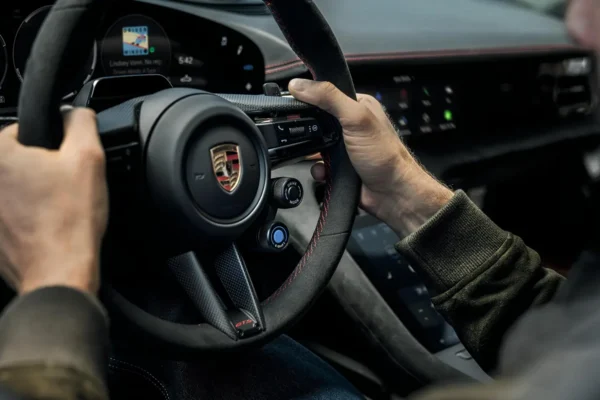
Affordability remains a key factor in the rate of EV adoption globally. In the major European markets of Germany, Italy, and the UK, battery electric vehicles are still 17% more expensive than competing ICE cars — though the BEV price premium over ICE has dropped from an average of 34% in 2024. Batteries remain the main cost component of EVs and in many markets remain too expensive for BEVs to match combustion cars on price. That 17% gap is closing — from 34% to 17% in two years is a remarkable compression — but it has not closed, and it will not close uniformly or simultaneously across all markets. The UK’s ZEV mandate assumes a level of affordability parity that the BNEF data suggests is still some years away from being self-sustaining. Affordability is only one of the open questions: the emotional engagement question every EV brand is wrestling with — Porsche has now answered with simulated gears and a synthetic engine note on the 2027 Taycan, which is either a brilliant acknowledgement that performance EVs need character or a quiet admission that the segment has a problem the spec sheet can’t solve. Probably both.
The long view is the one that cuts through most of the short-term noise. Electric van sales are expected to reach more than one third of global sales, and by 2030, EV sales are expected to reach 60% of the total passenger car market. By 2035, that number crosses 52%. By 2050, it is, effectively, everything. The internal combustion engine, which powered every car sold on earth for over a century, has a known endpoint. BNEF has put a date on it.
What happens between now and 2050 is where the genuine uncertainty lives — in the EV sector’s ability to close the affordability gap, in whether Western manufacturers can find a credible response to Chinese competition, and in whether the political headwinds that have defined 2026 in America turn out to be a detour or a destination. The destination itself, at least, is no longer in question. BloombergNEF has done its modelling. The internal combustion engine is borrowing time. It just has, on current projections, rather more of it than the optimists would like.