The International Energy Agency does not typically deal in dramatic flourishes. It publishes data, runs projections, and issues reports in the measured tone of an institution that has decided facts are sufficient. Which makes the opening line of its 2026 Global EV Outlook — published this morning — rather more pointed than usual: nearly 30% of all new cars sold worldwide this year are set to be electric, as countries and consumers respond to the energy crisis. One in three. A number that was theoretical five years ago and is simply scheduled for this year.
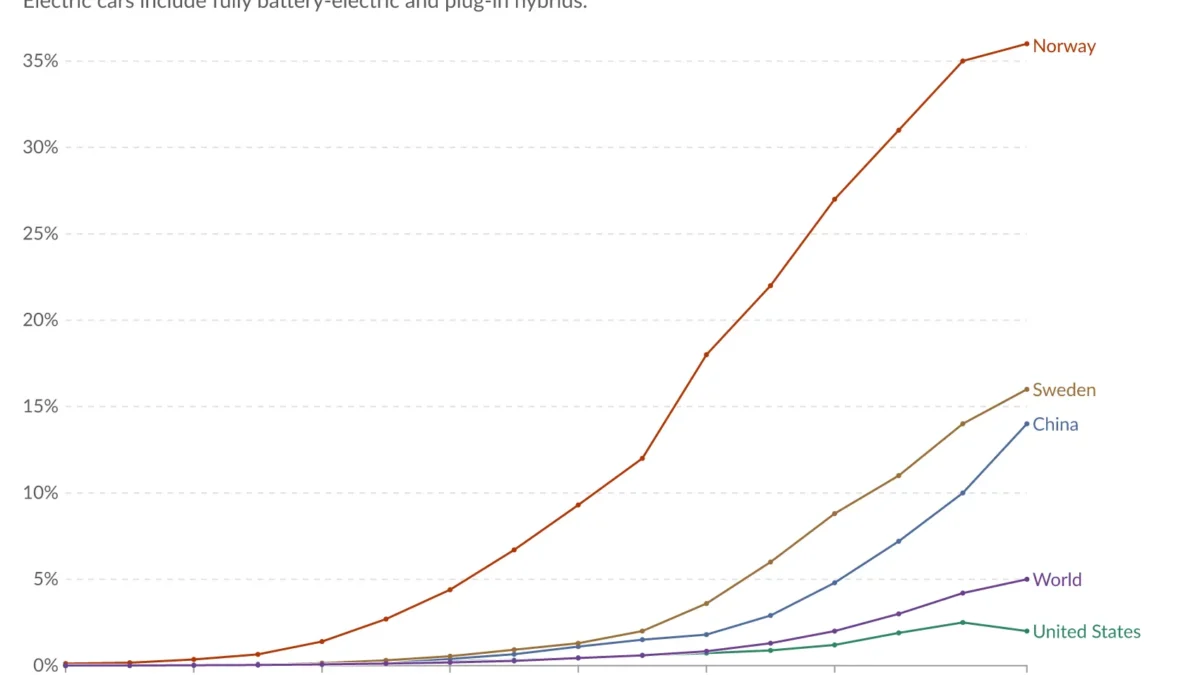
In 2025, global electric car sales grew by 20% to exceed 20 million — meaning that a quarter of all new cars sold worldwide were electric. In around 40 countries, electric cars accounted for 10% or more of new cars sold. Sales of purely electric and plug-in hybrids combined are expected to grow to 23 million in 2026, representing about 28% of total sales. These are not projections based on optimistic assumptions. They are trajectories based on what is already happening in showrooms, with the IEA noting that the falls in battery prices and the potential policy responses to the current global energy crisis are set to provide further momentum.
The energy crisis is doing work that policy incentives never quite managed. Petroleum price spikes from the Iran war appear to be boosting EV sales in some places — and not marginally. Europe’s record EV surge of 51% in March was driven almost entirely by consumers doing basic arithmetic at the fuel pump. When petrol becomes genuinely expensive, the running cost argument for an EV stops being a projection and becomes a monthly bank statement. The IEA’s report captures that dynamic in aggregate: the Iran crisis has accelerated a transition that subsidies nudged, tax credits encouraged, and geopolitics has now forcibly sped up.
Chinese automakers supplied 60% of electric cars sold worldwide in 2025, while European and North American automakers were each responsible for about 15% of global sales. That 60% figure deserves a moment. China is not merely winning the EV race in its home market — it is supplying the majority of the world’s electric vehicles. BYD’s overseas sales surge — 65% year-on-year export growth — is the commercial expression of that manufacturing dominance. It is building cars at a pace and price point that the rest of the world’s manufacturers are still trying to match from a standing start.
The American exception hangs over the report like an awkward footnote. EV sales have dropped sharply in the U.S. — down 28% in Q1 2026 after the federal tax credit expired, with factories shuttered and models cancelled across the EV sector. The report frames it plainly: the global automotive history is being written right now, and the world’s largest economy has chosen, for the moment, to sit it out. The IEA notes this without editorialising. The numbers do the editorialising for it.
Electric truck sales more than doubled in 2025, with electric models accounting for nearly one in ten trucks sold worldwide — the vast majority in China. Southeast Asia is highlighted as a region of particular momentum. Two- and three-wheelers continue their electrification at pace. The report’s scope is global in a way that most Western EV coverage is not, and its message is clear: the transition is not waiting for any single market to get its policy in order.
The IEA’s Executive Director said: “Looking ahead, the falls we have seen in battery prices and the potential policy responses to the current global energy crisis are set to provide further momentum in EV markets.” That “potential policy responses” is the tell. The energy crisis is the accelerant. Policy is the amplifier. In Europe, governments are already responding to the oil shock with renewed EV incentives. In China, the industrial support apparatus is already in motion. In the United States, the political direction is, at minimum, ambiguous.
One in three new cars sold this year will be electric. The IEA has done its sums. The global car market is doing its sums. The only outstanding question is how long it takes for every government involved to do theirs.