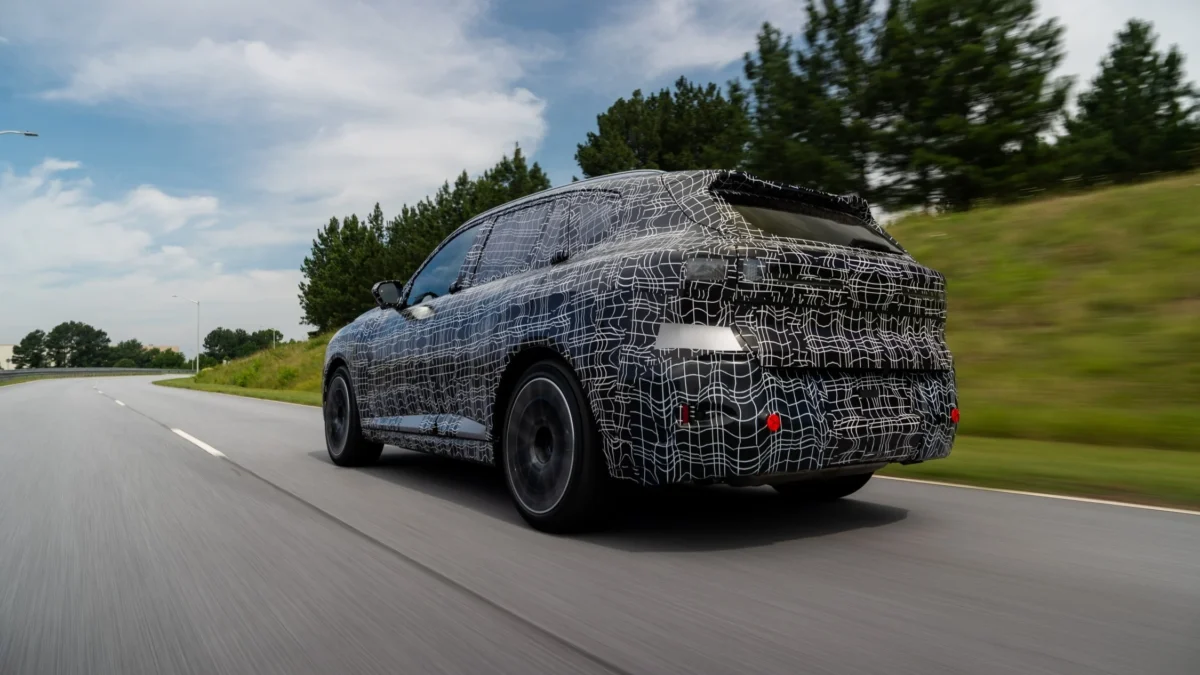
At some point in the last five years, every major luxury car maker on Earth marched up to a microphone, declared its electric future with the certainty of a Victorian explorer, and committed to a single propulsion pathway. Volvo went all-electric by 2030. Audi went all-electric by 2032. Lotus said never-again-combustion in 2022. All of them have now revised those positions in the manner of someone pretending they didn’t mean what they obviously did. On Monday in Munich, BMW took a different approach. It unveiled a fifth-generation X5 — the G65 — that you can buy with petrol, diesel, plug-in hybrid, battery-electric, or hydrogen fuel-cell power. Five entirely different powertrains. One car. Pick whichever you like. BMW will be in the back having a coffee.
The G65, in fairness, is a serious piece of engineering. The X5 is BMW’s best-selling model globally, with 3.1 million units sold across the four previous generations since the original arrived in 1999. The new car is the first BMW production model ever offered with five drive-system technologies at launch — the petrol and diesel arrive with 48-volt mild-hybrid assistance, the 50e xDrive plug-in hybrid produces 490 hp and offers around 60 miles of EV range, the all-electric iX5 60 xDrive puts out 578 hp via BMW’s sixth-generation eDrive, and the hydrogen-powered iX5 Hydrogen arrives in 2028 on the third-generation fuel-cell system BMW developed jointly with Toyota. There are persistent rumours of a sixth variant: a range-extender EREV, primarily for China and the US, which would take BMW’s roster to truly absurd territory. All of it built at Plant Spartanburg, South Carolina, where BMW has been making the X5 for 27 years.
The strategic message is unmistakable. Where rivals have spent the last half-decade trying to pick a winner and then quietly losing money on it, BMW has decided not to pick at all. The CLAR platform underneath the G65 has been modified to take both combustion and battery propulsion, which means a buyer in Texas can have a 3.0-litre straight-six mild hybrid, a buyer in Oslo can have an iX5 EV, a buyer in Munich can have a 50e PHEV, and a buyer in Yokohama can eventually have a hydrogen one. The whole lineup will be built on the same production line in Spartanburg, with floor-mounted hydrogen tanks that share packaging with the EV’s battery. BMW has, in other words, engineered a single car for an industry that doesn’t yet know what powertrain it will be selling in 2032.
The statistical context is brutally instructive. Mercedes-Benz’s EQE and EQS sales fell 39% globally in 2025. Audi’s e-tron range is shifting an average of 60% lower volume than its combustion equivalents. Porsche’s Macan EV missed its 2025 launch target by 47%. Volvo Cars, which famously divested its combustion engine factories, has spent the last six months trying to find a supplier to build them again. In that environment, building a single platform that can run on five fuels is not corporate indecision — it is rational risk management. The X5 PHEV (xDrive50e) was the bestselling premium PHEV in America for three consecutive years. The X5 diesel is still Europe’s bestselling premium combustion SUV. The iX5 EV, BMW expects, will be a meaningful but minority player. Diversifying the powertrain mix isn’t a hedge: it’s the strategy.
BMW also benefits from being unusually candid about it. CEO Oliver Zipse, who has been a vocal critic of EU regulators’ insistence on a single 2035 ICE phase-out date, told investors this year that “customer choice will remain the most important factor in our product strategy.” Compare that with Volkswagen’s 2018 declaration that 2026 would be the year of its last combustion-engine product launch — a pledge VW has now formally abandoned after the ID. range underperformed by approximately every metric except press-release count. BMW didn’t make that promise. BMW didn’t have to walk it back. BMW gets to spend 2026 selling cars instead of issuing apologies.
The forward-looking takeaway is that the G65 is the template for the rest of the decade. Expect Mercedes to follow with a five-powertrain GLC redesign next year. Expect Audi to quietly rejoin the multi-pathway approach by 2027. Expect Hyundai — already producing PHEV, EV, hydrogen and ICE in parallel — to point at BMW’s announcement and say nothing. The luxury SUV buyer of 2027 will not be asked to pick a religion at the dealership. They will be asked what they want their car to drink. Petrol, diesel, electricity, plug-in, hydrogen — all good. The single-pathway era of automotive marketing is, mercifully, dead. The customer, against all expectations, has been allowed to choose. Imagine that.