Most electric vehicle startups follow a familiar arc: ambitious launch, missed targets, emergency fundraise, repeat until either profitability or obituary. Lucid has been doing something rather different lately. It has been quietly assembling one of the stranger and more compelling business models in the industry — and the pieces are now close enough to falling into place that it is worth paying proper attention.
In the first quarter of 2026, Lucid produced 5,500 vehicles — up 149% from Q1 2025 — generated $282.5 million in revenue, up 20% year-on-year, and ended the period with approximately $3.2 billion in liquidity. These numbers are not, in isolation, a case for celebration — the company is still burning cash at a rate that would concern most CFOs, and its stock trades at $9.96, well below both the 200-day moving average of $16.58 and the 52-week high of $33.70. But the numbers are moving in the right direction, and the strategic context around them has shifted considerably.
In April, Uber increased its purchase commitment to at least 35,000 Lucid vehicles for use as robotaxis, expanding a deal that began with 20,000 Gravity SUVs to include the upcoming Lucid Midsize platform. Uber also raised its total investment in Lucid to $500 million, alongside a $550 million convertible preferred stock purchase by Ayar Third Investment Company, an affiliate of Saudi Arabia’s Public Investment Fund — bringing the total capital raise to approximately $1.05 billion. That is a considerable amount of money from two parties whose continued backing tells you something important: the PIF has been investing in Lucid since 2018 and has not flinched, and Uber’s expanding financial commitment suggests the robotaxi programme is progressing beyond the theoretical.
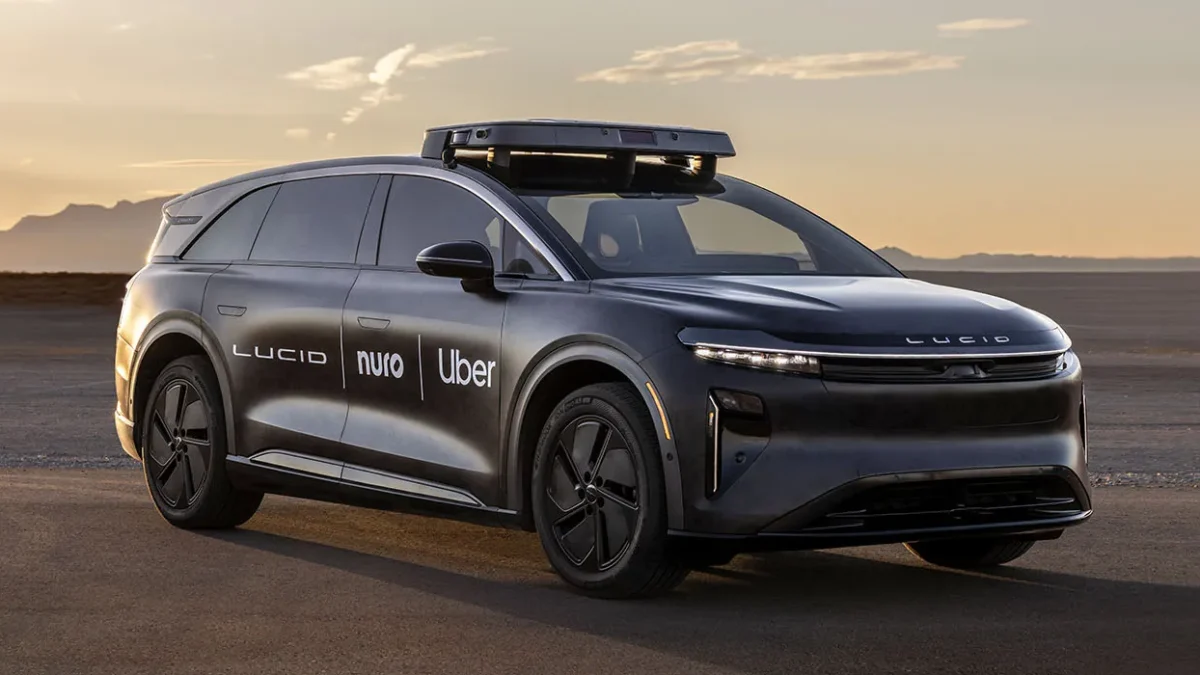
The robotaxi programme is the story worth watching. The Lucid-Nuro-Uber robotaxi, built around the Gravity SUV, features a purpose-built roof-mounted sensor halo combining lidar, cameras, and radar, and is designed for six passengers plus luggage. Autonomous on-road testing began in December 2025, led by Nuro — the autonomous driving company founded by former Waymo engineers — and the commercial launch is targeted for the San Francisco Bay Area later in 2026. That is a real timeline, with real test vehicles on real roads. Nuro’s Waymo heritage matters here; these are not engineers learning autonomous driving from first principles. The competitive context is also tightening: Tesla’s robotaxi lead over Lucid and Waymo is now measurable in actual revenue-generating miles, with the Cybercab having expanded across the full Austin metro and operating unsupervised in Dallas and Houston. Lucid’s San Francisco launch needs to happen on schedule, because the gap between “tested” and “deployed” is the gap that defines the segment right now.
At its first-ever Investor Day in March, Lucid also unveiled Lunar — a purpose-built two-seat robotaxi concept based on the upcoming Midsize platform, designed specifically to maximise utilisation and lifetime operating economics. If the Midsize robotaxi deal matches the Gravity commitment of 20,000 vehicles, the total programme reaches approximately 40,000 units — a scale that would make Lucid one of the most significant robotaxi vehicle suppliers in the world, before it has delivered a single commercial autonomous ride. That is a remarkable sentence for a company that most mainstream automotive commentary still discusses primarily in terms of whether it will survive.
The consumer car business, meanwhile, is quietly improving. The 2027 Gravity has picked up the 2026 World Luxury Car of the Year award, Lucid is outpacing the Rivian R1S in early Gravity sales momentum, and over-the-air updates are now rolling out Apple CarPlay and Android Auto to existing owners. The 2026 production guidance of 25,000 to 27,000 vehicles has been reaffirmed — a figure that, if met, would represent a near-doubling of 2025 output.
The comparison with Rivian’s parallel American EV journey is instructive. Both are American EV startups that spent years losing money at scale, both are now ramping production on new, more affordable platforms, and both have struck significant autonomous vehicle partnerships — Rivian with Uber for commercial delivery, Lucid with Uber for passenger robotaxis. The difference is that Lucid has staked its entire future on the proposition that a luxury electric vehicle with exceptional range and an autonomous-ready architecture is exactly what the coming robotaxi era needs. It is, as bets go, a specific and coherent one.
Whether Nuro can deliver Level 4 autonomy at commercial scale in San Francisco — a city that has already hosted Waymo, Cruise, and an impressive catalogue of autonomous vehicle incidents — remains the open question. Autonomous driving milestones are being set with increasing frequency, but the distance between impressive demonstration and profitable commercial operation has proven elastic in ways that no technology roadmap has successfully predicted.
Lucid has Saudi sovereign wealth, half a billion dollars from Uber, the former Waymo engineers at Nuro, and the world’s most energy-efficient electric drivetrain. It is burning through cash on a timeline that requires everything to go right. That is, in fairness, the same timeline it has always been on. The difference is that, for the first time, the plan is legible enough that you can see exactly how it might work.