In the early 1970s, Porsche built a turbocharged racing car called the 917/30 and very nearly broke Can-Am racing with it. The 917/30 produced somewhere between 1,100 and 1,500 horsepower — the exact figure depends on who is telling the story and how much boost they are allowing themselves — and was so dominant that it won every race it entered in 1973 and prompted the organisers to change the regulations specifically to stop it competing. It was, by any measure, an extraordinary piece of work.
The engineers who built it then had to decide what to do next.
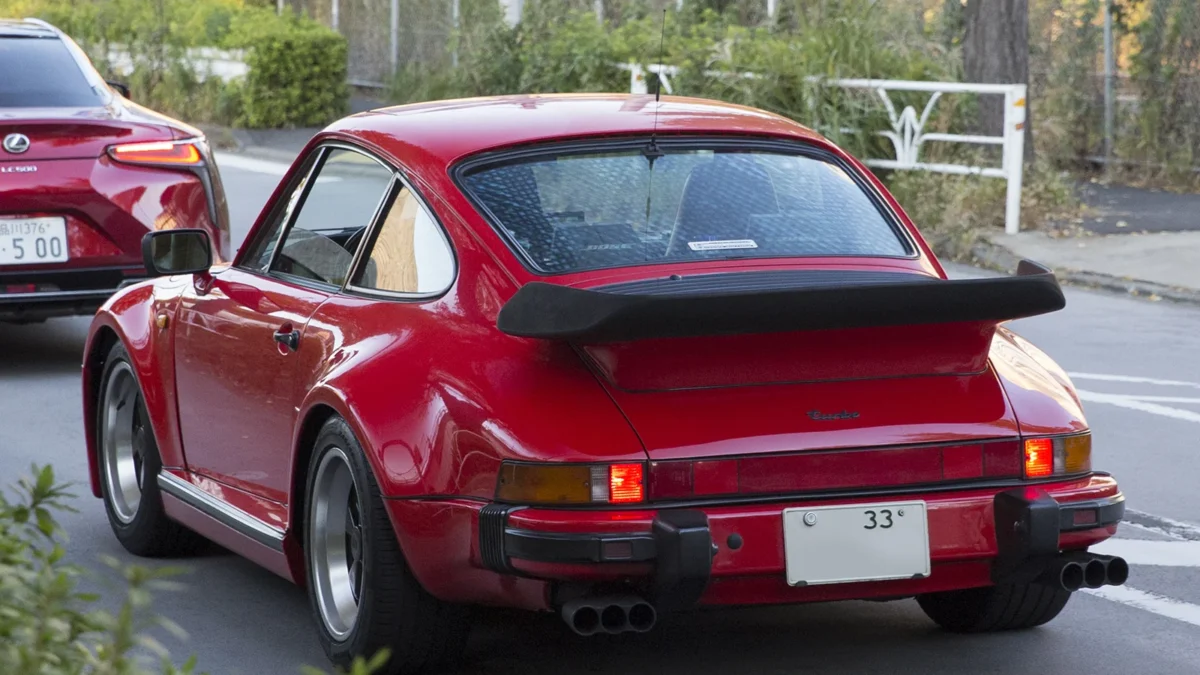
What they did was take the turbocharged flat-six technology they had developed for the 917/30, adapt it for a road car application, put it in a 911, and sell the result to members of the public for a price that, in 1975, represented a very significant sum of money. The car this decision produced — the 930 Turbo — was the fastest production car in Germany at the time of its launch. It was also, by broad consensus among those who drove it seriously, the most dangerous production car in the world.
Portsche knew this. The question worth asking is why they built it anyway.
What Turbocharging Did to the 911
To understand the 930’s particular character, you need to understand what a turbocharger does to power delivery, and what Porsche’s rear-engine layout does to the consequences of that delivery.
A turbocharger uses exhaust gases to spin a compressor that forces more air into the engine, increasing power output significantly. The process is not immediate — the turbine takes time to spin up to the speed required to build boost, producing the phenomenon known as turbo lag. In early turbocharged road cars, this lag was pronounced. The driver would press the throttle and the engine would respond with what felt like normal naturally aspirated power — and then, several seconds later and often in the middle of a corner, the turbo would spool up and the full power would arrive. All at once.
In a front-engine, rear-drive car, this sudden power delivery was challenging but manageable. The front wheels steer; the rear wheels drive; the weight of the engine over the front axle provides some inherent stability. A skilled driver could catch the resultant oversteer.
In the 911, the rear-engine layout that the turbo’s arrival made considerably more eventful meant the weight was already biased toward the rear. Add sudden, massive power to rear wheels that are also carrying most of the car’s weight, in a corner where the driver has already committed to a steering angle, and the physics produce a response that is, in the understated language of engineering, non-trivial to manage. The tail steps out. The weight transfer to the outside rear wheel increases the oversteer. The car rotates. The driver’s instinctive response — lifting off the throttle — shifts weight forward, reducing rear grip further, and makes things worse.
This sequence became known, in the press and among owners, as the Turbo’s “on-off” characteristic. It had a nickname in Germany: Turboloch, meaning turbo hole. The gap between nothing and everything, into which several 930s and their drivers disappeared.
Why Porsche Built It Anyway
The honest answer involves several motivations operating simultaneously, not all of them equally flattering.
The first was commercial. The oil crisis of 1973 had hit Porsche, like every other manufacturer, with the sudden and politically inconvenient reality that fuel economy mattered. Porsche’s response — counterintuitive but commercially shrewd — was to go faster rather than slower. A turbocharger extracts more power from less fuel by using energy that would otherwise be lost through the exhaust. The 930’s 3.0-litre turbocharged engine was more thermally efficient than a larger naturally aspirated unit producing similar power. This was a genuine engineering argument, not a rationalisation, and it gave Porsche a performance flagship at a moment when most manufacturers were retreating.
The second motivation was homologation. Porsche wanted to race turbocharged cars in the World Sports Car Championship, and the regulations required production road car equivalents. The 930 was, in part, a regulatory instrument — the road car that justified the race car. This was a pattern Porsche had followed before with the 917 and would follow again with the 959, the company consistently using competition requirements to produce road cars that were more extreme than the market would otherwise have demanded.
The third motivation was identity. Porsche’s engineers understood, at a level that product planners sometimes struggle to articulate, that a car with no edge is a car without character. The 930’s on-off power delivery was a problem. It was also what made it memorable, what made it require something of its driver, what gave skilled ownership a quality that smoother, more forgiving cars could not provide. Danger, carefully calibrated, is a feature.
The “Widowmaker” and What It Actually Meant
The 930 earned several nicknames in the years following its launch. “Widowmaker” was the one that stuck in the English-speaking press, and it is worth examining what it actually described.
The 930 did not kill people because it was badly engineered. It killed people — and it did kill people, a number of them — because it required a specific skill set to drive at the limit, and the price point at which it sold attracted buyers who did not always possess that skill set. A car costing, in 1975, the equivalent of several years’ professional salary tends to be bought by people with the means to afford it rather than exclusively by people with the ability to manage it. The gap between those two groups, in the case of the 930, had consequences.
Porsche’s engineers were aware of this. The car’s development files, referenced in several histories of the marque, contain notes about the handling characteristics and their implications for drivers unfamiliar with the behaviour. The decision to proceed was made with eyes open.
What the “Widowmaker” label obscured, in the retelling, was that the 930 was entirely manageable for drivers who understood what it was doing. Skilled Porsche drivers of the era reported it as thrilling rather than terrifying — a car that rewarded commitment and punished timidity, which is a description that applies to most of the best sports cars ever made. The problem was not the car. It was the mismatch between the car and some of its owners.
What the 930 Established
The turbocharged 911 that the 930 introduced has been in continuous development since 1975. Each subsequent generation has addressed the lag and on-off delivery that defined the original — through twin turbos, variable geometry turbines, and eventually the near-instantaneous response of modern turbocharged flat-sixes that bear almost no relationship to the 930’s character in that specific dimension.
The current 911 Turbo S produces 650 horsepower, reaches 60 mph in 2.6 seconds, and is by all accounts an extraordinarily easy car to drive quickly. The turbo lag that killed people in the 1970s has been engineered out of existence. The car is faster, safer, and more accessible than anything the 930 generation could have imagined.
It is also, in the view of a significant number of Porsche enthusiasts, less interesting — precisely because the characteristic that made the 930 demand something of its driver has been resolved rather than managed. The 930’s power delivery was a problem. It was also, in the way that problems sometimes are, the thing that made the car worth talking about fifty years later.
What It Tells Us
The decision to turbocharge the 911 in 1974 was made knowing the result would be a car that was faster and more dangerous than anything Porsche had previously sold to road-going customers. The company understood the physics. They understood the implications of those physics for drivers who encountered the turbo’s power in the middle of a corner without expecting it. They built it anyway.
This was not recklessness. It was a considered decision that weighed performance, commercial opportunity, racing homologation requirements, and a specific philosophy about what a Porsche should demand of the person behind the wheel.
The 930 is now one of the most desirable air-cooled Porsches in existence. Examples in good condition command prices that would have seemed extraordinary even a decade ago. The car that was once described as a widowmaker is now described, by the same enthusiast community, as a pure expression of what the 911 was in its most uncompromising form.
Danger, it turns out, appreciates nicely.