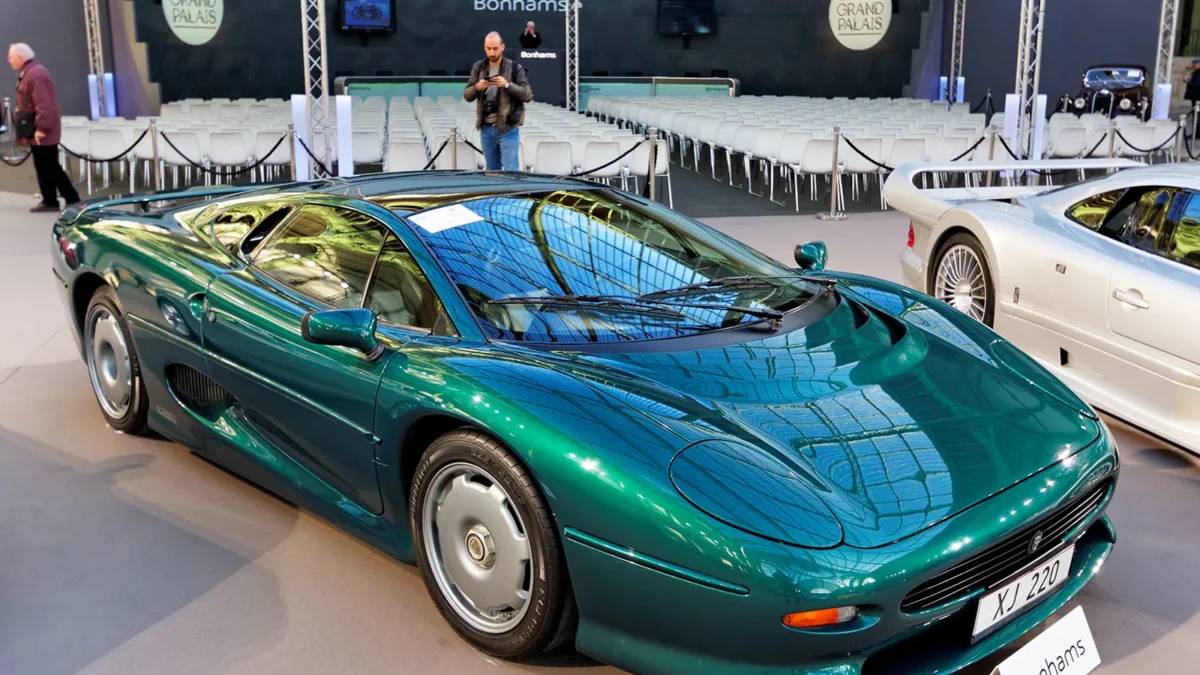
The XJ220 concept was enormous — nearly five and a half metres long — and powered by a 6.2-litre V12 engine with four-wheel drive. It looked like the future. It looked like the car that would finally give Jaguar a genuine hypercar to set against Ferrari and Lamborghini. The people who saw it wanted one immediately, and they were prepared to pay accordingly.
Jaguar took deposits. Around 1,500 of them, at £50,000 apiece, from buyers who believed they were reserving the car they had seen in Birmingham.
They were not.
The car that reached production in 1992 had a twin-turbocharged V6 engine and rear-wheel drive. The V12 was gone. The four-wheel drive was gone. The car was shorter than the concept by nearly half a metre. The price, meanwhile, had increased from the original £361,000 reservation price to £470,000. And by the time deliveries began, the property market had collapsed, the recession had arrived, and a significant number of the people who had signed deposit cheques in the enthusiasm of a motor show hall had concluded that they would rather not take delivery after all.
Jaguar said the deposits were non-refundable.
The lawsuits followed.
How the XJ220 Concept Happened
The XJ220 concept was not, initially, a factory project. It was developed by a group of Jaguar engineers — the so-called “Saturday Club” — working in their own time, using their own resources, with informal blessing from Jaguar’s management rather than a formal development budget. The project was passion-driven in a way that large manufacturer programmes rarely are, and the concept that emerged from it reflected that quality: it was ambitious to the point of impracticality, genuinely spectacular, and built around specifications that would require a vast industrial effort to deliver in production form.
When Jaguar’s management saw the reaction at Birmingham, they decided to put the car into production. The Saturday Club’s passion project had become a production commitment. The challenge now was engineering a road-legal, production-viable version of something that had been designed without those constraints.
Why the Engine Changed
The V12 that powered the concept was Jaguar’s 6.2-litre unit — a large, naturally aspirated engine that produced impressive power but was heavy, long, and required significant modification to meet the emissions and packaging requirements of a production mid-engine supercar. The four-wheel drive system added further weight and complexity.
Jaguar’s engineers, working on the production version, concluded that the V12 and four-wheel drive combination was not viable within the constraints they were operating under. The car would be too heavy. The development timeline was already challenging. The engineering resources required to make the V12 work properly in a mid-engine, production-legal application — with catalytic converters, with the thermal management requirements of a road car, within a packaging envelope that allowed the driver to see where they were going — were beyond what the programme budget could support.
The alternative was a twin-turbocharged version of the V6 engine used in Jaguar’s Group C racing cars. The racing V6, developed by Tom Walkinshaw Racing, was already proven in competition, already understood, and already producing power outputs that, in turbocharged road specification, would exceed what the V12 could deliver without turbocharging. It was lighter. It was more compact. It made the engineering problem tractable.
Jaguar chose the V6. They communicated this change to depositors in 1990, two years before deliveries began. They did not, at that point, offer refunds.
The Recession and the Lawsuits
The timing of the XJ220’s production coincided with one of the sharpest economic downturns in recent British history. Property values collapsed in the early 1990s. The demographic of XJ220 buyers — wealthy individuals who had made their money in the property boom of the late 1980s — were precisely the people most affected. The car they had ordered at £361,000 was now being invoiced at £470,000, during a recession, with a different engine and drivetrain from the one they had been shown.
A group of depositors refused to complete their purchases and sued for the return of their deposits, arguing that the production car was materially different from what they had agreed to buy. Jaguar’s position was that the deposit agreements had not specified the V12 engine or four-wheel drive as contractual requirements, and that the production car fulfilled the commitment to build and deliver an XJ220.
The legal proceedings were settled in ways that varied by jurisdiction and individual arrangement. Some depositors received partial refunds. Others completed their purchases. A number of cars were sold on the open market as the order book shrank, and values promptly collapsed below list price as the combination of recession, reduced desirability, and damaged reputation hit simultaneously.
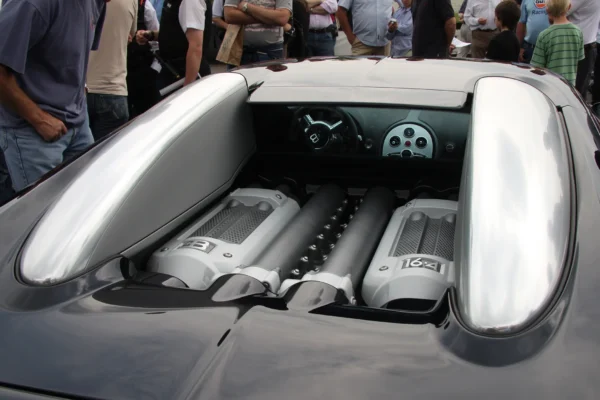
At its lowest point in the mid-1990s, you could buy a Jaguar XJ220 for less than half its original list price. Another hypercar manufacturer had discovered the gap between what a car promises and what it costs to deliver — the difference was that Bugatti’s gap was in development cost, while Jaguar’s was in customer trust.
What the Car Actually Was
Here is the part of the XJ220 story that tends to get lost in the contract dispute narrative: the car was extraordinary.
The twin-turbocharged V6 produced 542 horsepower. The XJ220 weighed 1,470 kilograms. The combination was sufficient to propel it to 60 mph in 3.6 seconds and to a top speed that, in a 1992 test by Autocar on the Nardò Ring in Italy, reached 212.3 mph — making it, at that moment, the fastest production car in the world. The record was subsequently disputed on technical grounds relating to the catalytic converter fitment, but the performance was real regardless of the paperwork.
The handling, developed by engineers who had benefited from the weight reduction that the V6 and rear-wheel drive combination enabled, was by contemporary accounts excellent. The McLaren F1, which arrived in the same era and delivered everything it promised without changing a single specification, is the canonical hypercar of the 1990s in the public imagination. The XJ220, had it arrived without the controversy, might have competed for that status. It was fast enough. It was capable enough. The engine, it turned out, was not the problem.
The problem was that the people who bought it had been shown something else.
The Rehabilitation
Time has been generous to the XJ220 in ways that its original owners might find ironic. The cars that were selling below £200,000 in the mid-1990s have recovered comprehensively. Clean examples now achieve prices in the region of £400,000-£500,000, and exceptional cars command more. The market has, in other words, arrived at roughly the original list price after three decades of depreciation and recovery.
The racing record has helped. An XJ220 won its class at Le Mans in 1993 — driven by David Coulthard, among others — in what was one of the more remarkable results in the race’s history. The win was subsequently stripped due to a technical infringement involving a post-race fuel sample, which added another layer of controversy to a car that had not been short of it. The disqualification has since been viewed by most historians as debatable at best.
The enthusiast community has also done its part. The XJ220 is now understood, by the people who actually drive them, as one of the most rewarding large supercars of its era — fast, involving, and possessed of a character that the V12 concept, had it been built, might not have delivered. The engine that caused such fury in 1990 turns out to be one of the car’s genuine strengths.
What It Tells Us
The XJ220 story is a case study in the difference between what a car is and what a car is perceived to be — and in the commercial consequences of allowing that gap to open without managing it properly.
Jaguar’s engineering decision to substitute the V6 for the V12 was, on the evidence of the finished car, probably correct. The XJ220 that was built was lighter, faster, and more dynamically capable than the V12 four-wheel drive version would likely have been. The decision served the car.
What it did not serve was the relationship with the customers who had committed their money on the basis of a different specification. The communication of the change, the timing of the invoice increase, and the refusal to offer refunds when the recession made the purchase untenable — these were decisions that prioritised Jaguar’s commercial position over its customers’ reasonable expectations.
The car was better than the concept. The process of getting there was worse than it needed to be.
That is a distinction that matters, and it is one that the automotive industry — which routinely shows concepts that bear only an approximate relationship to the cars that eventually go on sale — would do well to remember more often than it does.