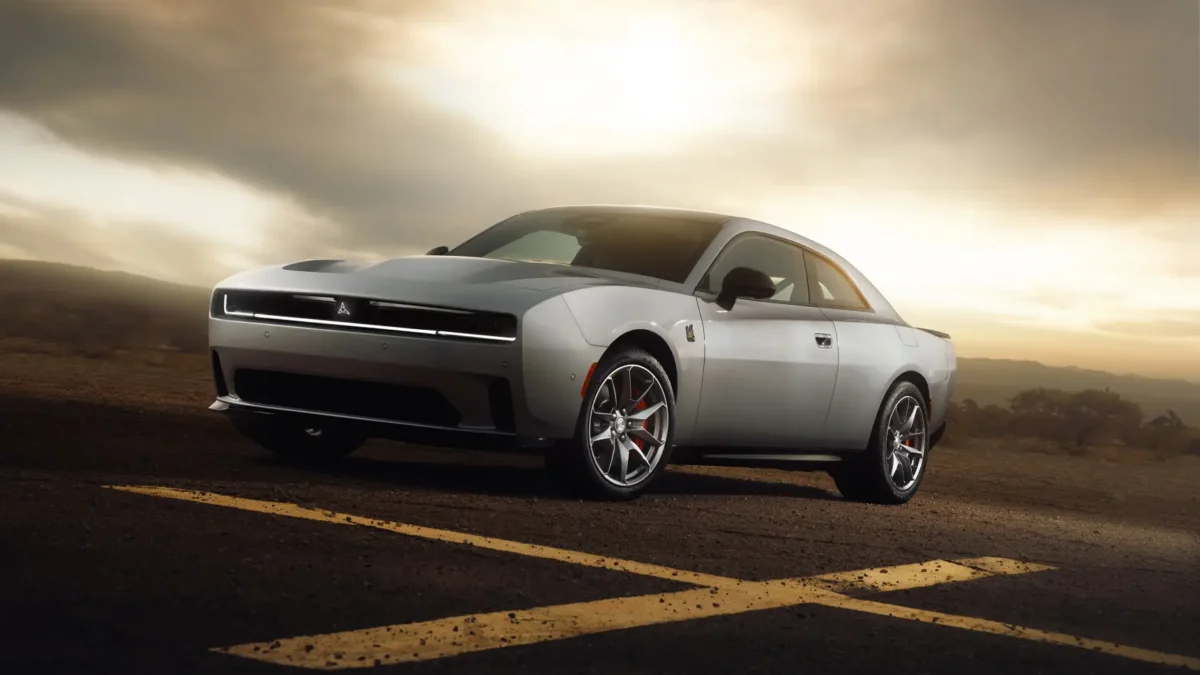
At three o’clock this morning Central European time, while Brussels was asleep and most of the continent was busy regulating something, Dodge quietly opened the European order books for the eighth-generation Charger. Two-door coupe, four-door sedan, 420-horsepower twin-turbo inline-six, all-wheel drive as standard, and a starting price of €66,000. First deliveries in September. Sixty years to the month after the original Charger went on sale in Detroit. Sixty years too late, depending on whom you ask.
Let’s get the absurdity out of the way first. The 2026 Dodge Charger SIXPACK is a 5.25-metre-long, 2,185 kg, 12.9-second-quarter-mile muscle car powered by a 3.0-litre Hurricane straight-six producing 420 hp in R/T trim and 550 hp in the Scat Pack. The European Union has, as a matter of binding policy, committed to ending the sale of new internal-combustion passenger cars by 2035. Multiple member states have urban low-emission zones that would charge a Charger SIXPACK roughly the gross national product of Andorra to enter a city centre. Pricing starts at €66,000 and climbs comfortably past €90,000 for the EV version. Dodge expects to sell, depending on which Stellantis press release you read, somewhere between “limited numbers” and “we have two distributors in the European Economic Area, please be patient.”
And yet. The Charger is going to Europe because, as far as anyone in Auburn Hills can work out, Europe might be the one market on Earth where the combustion muscle car still has a clean run. BMW has hybridised the M5 and softened the M3 with electrification. Mercedes-AMG has slapped a four-cylinder into the C63. Audi’s RS5 is now PHEV-only. Porsche has electrified large chunks of the Cayenne and Panamera ranges. The Ford Mustang is being sold in Europe in significantly smaller numbers since the 5.0-litre V8 became increasingly difficult to homologate. The territory the Charger is walking into is, in muscle-car terms, almost completely undefended. The price, while eye-watering, is roughly in line with a base-trim BMW M3 Touring.
The statistical comedy is the EV side of the launch. The all-electric Charger Daytona, billed as “the world’s most powerful muscle car,” sold 7,421 units in the US in 2025 — a number that sounds respectable until you discover that the gas-powered SIXPACK launched in December 2025 has already outsold its electric stablemate in the first five months of 2026 by a factor of roughly ten. In Q4 2025, Dodge sold 346 Charger EVs in the US. In Q1 2026, that figure fell to 240. Two hundred and forty cars. In an entire quarter. In a country of 330 million people. The Charger Daytona is, by any reasonable measure, the worst-selling muscle car of the modern era. Stellantis is now shipping it to Europe, where electric muscle cars face, as InsideEVs delicately put it, “practically zero competition from local automakers.” There is no competition because there is no market. The continent will get to test that hypothesis personally, starting September.
The ICE version, however, has a chance. The Hurricane straight-six is one of the genuinely interesting combustion engines of the decade — a low-inertia, twin-turbo, all-aluminium unit that produces 420 hp in standard tune, can run on E85 in some markets, and arrives in Europe at a time when the all-electric pledges of legacy luxury brands have been quietly walked back. Sixty per cent of Stellantis’s European revenue still comes from internal-combustion cars. The Hellcat-supercharged-V8 Charger has also been confirmed for production, though Tim Kuniskis has not yet committed to selling it in Europe — European emissions law would make the homologation costs eye-watering, and the Hellcat’s 717 hp would attract a Belgian wealth tax in its own right. American muscle is heading east; Italian supercar engineering is doubling down on the V12 — the Revuelto SV’s 1,200-horsepower Monterey debut is the same combustion-revival story playing at a higher altitude, and the fact that both stories are landing in the same calendar window tells you the appetite isn’t a one-segment phenomenon.
The forward-looking takeaway is that 2026 is shaping up as a strange, sideways year for muscle cars. The American market is rebuilding combustion engines while quietly idling EV plants. Europe is committed to banning new combustion cars in nine years’ time but is, at the moment, importing a 550-horsepower Dodge from Canada. There is a Hellcat Charger coming back, a Copperhead halo car with a confirmed combustion engine, and a Hurricane I6 that may genuinely outlast the EV transition it was designed to coexist with. Sixty years in, the Charger remains a magnificent answer to a question approximately nobody is asking. Europe will now decide whether the question is worth answering — and, as it turns out, the domestic reception has already answered a rather more urgent one, with the Charger becoming America’s slowest-selling vehicle by July and Dodge quietly reactivating Power Dollars to move the metal. Place your bets.