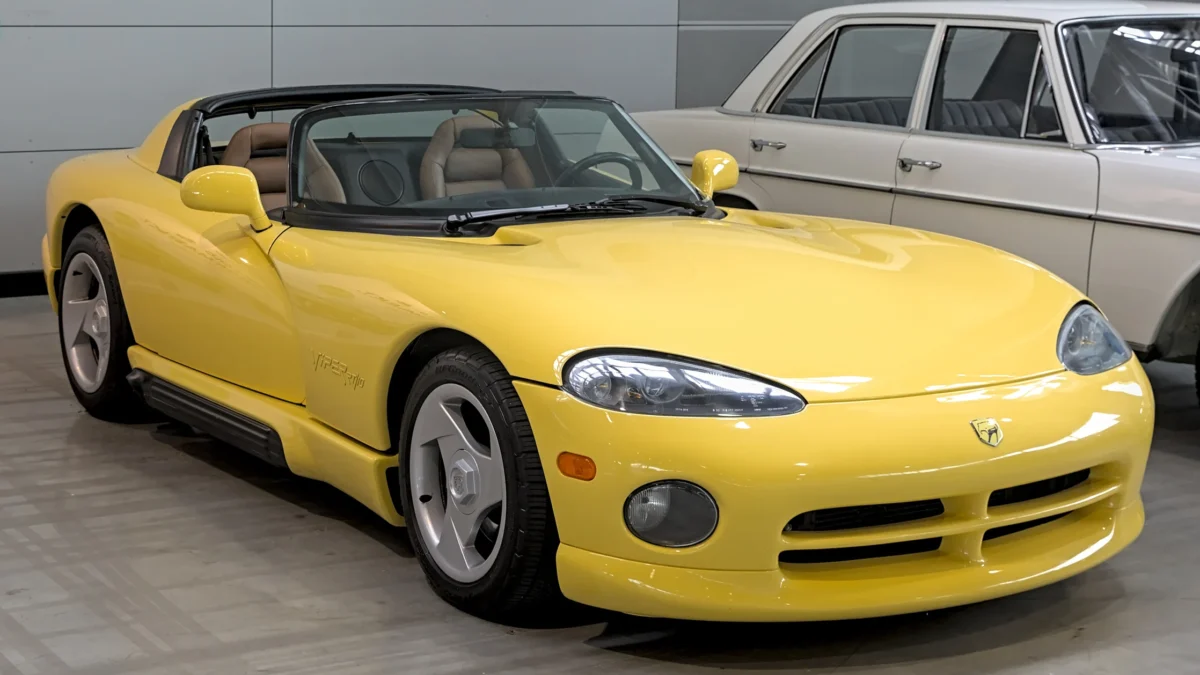
The 1992 Dodge Viper RT/10 was one of the most deliberately dangerous cars ever approved for road use by a major manufacturer. It had no airbags. No ABS. No traction control. Eight litres of V10 engine producing 400 horsepower, side exhausts that ran along the door sills at temperatures capable of causing serious burns, and a fabric roof that required a degree in origami to attach correctly.
None of this was accidental. Chrysler’s engineers and executives knew exactly what they were building. The absence of safety technology was a choice, and it was made deliberately, repeatedly, and with full awareness of what it meant for the person behind the wheel.
The Origin
The Viper began as a concept car shown at the 1989 Detroit Motor Show, developed under the supervision of Bob Lutz, then Chrysler’s president, and with engineering input from Carroll Shelby — whose connection to outrageous American performance cars was by then well established. The brief was simple and brutal: build the closest thing to a racing car that could legally be sold to the public.
Shelby’s influence on the project was both practical and philosophical. He had spent his career building cars that prioritised performance over comfort and driver skill over electronic assistance. The Viper absorbed that philosophy at a foundational level. If you couldn’t handle what the car was doing, the car would not intervene on your behalf. That was considered a feature.
The Decision
By the early 1990s, airbags were becoming standard equipment on mainstream American cars. The regulatory environment was moving towards mandating them, and most manufacturers were fitting them ahead of the legal requirement. Chrysler fitted them to their family cars without hesitation.
For the Viper, they chose not to. The reasoning, as articulated by the car’s development team, was that the Viper was not a car for ordinary use. It was a pure sports car — a machine for drivers who understood what they were getting into. Adding airbags, ABS, and stability control would add weight, add complexity, and soften the car’s character. More importantly, it would send the wrong message: that Chrysler thought the Viper needed to protect its driver from itself.
The car’s target customer, in Chrysler’s view, did not want that protection. They wanted the Viper to be honest about what it was. The missing airbags were part of that honesty. That honesty stood in sharp contrast to what was happening at General Motors during the same years — the Corvette’s fifty-one-year refusal to build the mid-engine car its engineers knew it should be is the institutional counterexample that makes the Viper’s approach look, in retrospect, almost old-fashioned in its clarity. Chrysler decided what the Viper was and built it. GM knew what the Corvette should be and declined to build it for half a century.
The Consequences
The Viper’s reputation for punishing inattention was earned quickly and maintained consistently. Its throttle response was sharp, its rear end was willing to step out without much provocation, and the power delivery offered little in the way of gradualism. Accidents happened, some of them serious, and the car became the subject of recurrent discussions about whether a vehicle this unforgiving should be road-legal.
Chrysler’s position throughout was essentially consistent: the Viper was sold with adequate warnings, to adult buyers who were capable of understanding the risks. That position held legally and commercially. The car sold well enough to sustain five generations of production.
ABS was added in 2001. A passenger airbag arrived for 2003. A driver airbag — the last major safety concession — came for 2003 also, a full eleven years after the car’s launch. By that point, the regulatory environment made further resistance impractical.
What the Viper Represented
The Viper’s no-airbag era represents a specific and probably unrepeatable moment in American car culture — a point at which a major manufacturer could build a genuinely dangerous road car, sell it openly, and face no regulatory consequence beyond the need to include sufficiently alarming warning labels in the owner’s manual.
That window has closed. Modern safety regulations, liability frameworks, and consumer expectations make a car like the original Viper essentially impossible to repeat. The last generation Viper, produced until 2017, had full airbag coverage, stability control, launch control, and a price tag that reflected how much engineering was required to make its performance accessible.
It was faster than the original. It was also, in the way that matters most to the people who loved the first one, something rather different.