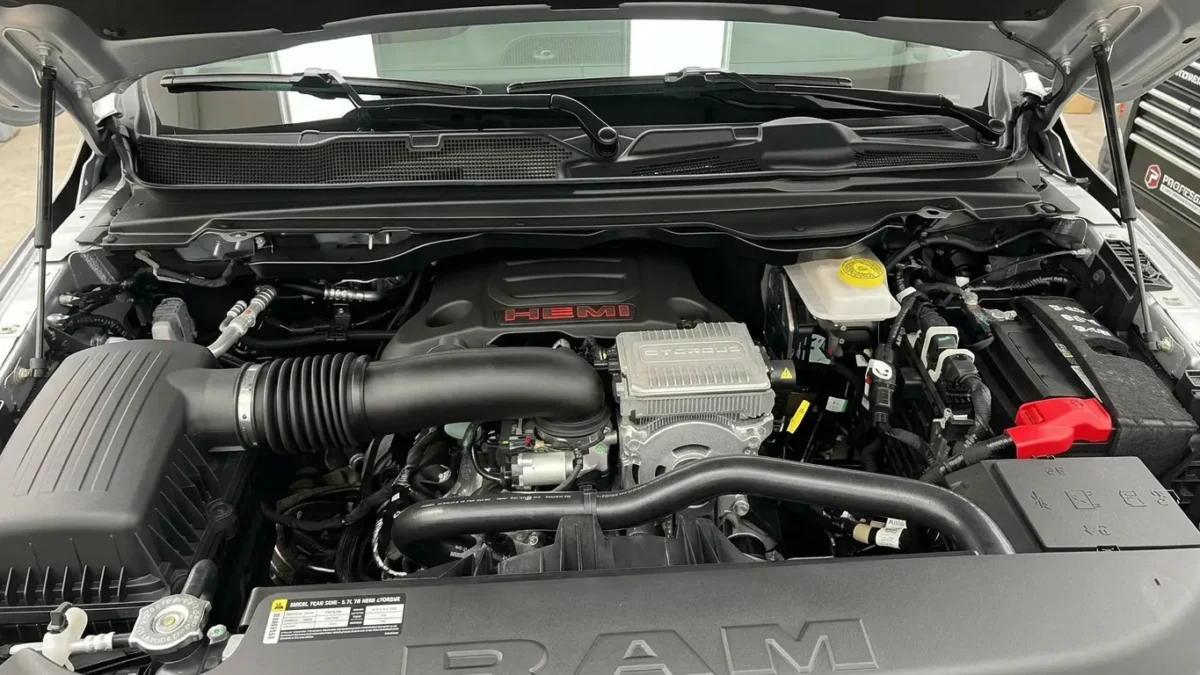
Two years ago, Ram launched a “Final Edition” of its Hemi-powered 1500 truck. There were ceremonies. Press releases. A great deal of solemn talk about the inevitability of electrification and the dignified retirement of America’s loudest engine. Last week, Stellantis reported a $440 million Q1 profit, swung back from a $455 million loss in the same quarter a year ago, and the single biggest reason was the engine they buried.
Forty percent of Stellantis’ Q1 Ram 1500 pickup deliveries were Hemi V8s. Ram brand sales were up 20 percent year-on-year — its best first quarter since 2023. The Ram 1500 line specifically rose 27 percent. In a US market that contracted 6 percent in Q1, Stellantis was the fastest-growing manufacturer, gaining around 80 basis points of market share. The company that lost $26 billion in 2025 is suddenly making money again, and CEO Antonio Filosa was happy to spell out why on the earnings call: “We are anticipating a strong acceleration with that powertrain, and we know that is associated with higher margin than the rest of the lineup.” The same week, Volvo Trucks’ new diesel reveal landed from Gothenburg — a fresh, hydrogen-ready 13-litre platform launched on the exact assumption that combustion still has a future. Two companies on different continents, telling the same story with different accents.
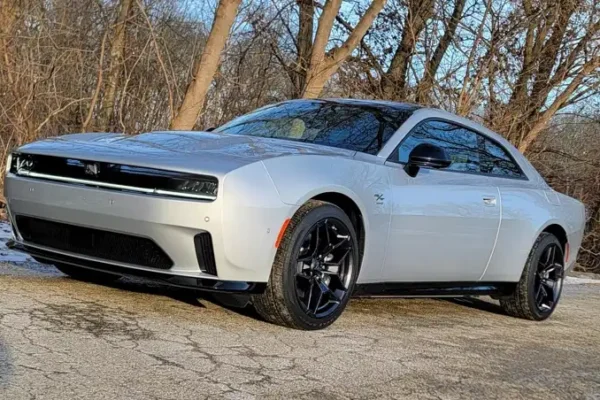
For anyone keeping score, this is the same powertrain Stellantis publicly killed in 2024 to make room for hybrids and the all-electric Charger Daytona. The all-electric Charger Daytona, you may recall, sold so badly that Dodge has already pivoted to a Hurricane inline-six version called the Charger Sixpack and is reportedly developing a Hellcat-powered V8 Charger for 2028. The 2024 “Final Edition” Ram 1500 turned out to be quite a long way from final. Awkward.
The scale of the reversal is genuinely something. Last year, Stellantis booked $25.4 billion in EV-related write-downs, sold its stake in a Windsor battery plant to LG, axed the Wrangler 4xe hybrid lineup, and converted the Ram electric truck into a range-extended hybrid platform. That $25.4 billion charge sits inside $70 billion in industry EV writedowns spread across Stellantis, Ford, Honda, Porsche and most of the names that once raced to publish the most aggressive electrification timelines. This year, Ram CEO Tim Kuniskis told the Detroit Auto Show in January that Stellantis would build over 100,000 Hemi V8 engines in 2026, more than triple the roughly 30,000 it managed in 2025 — a year in which it received around 50,000 orders and could only fulfill 60 percent of them. The company is now actively expanding production beyond its Saltillo, Mexico plant, which has become a bottleneck. Demand exists, in other words, in quantities the manufacturer cannot currently meet. While Ford battles aluminum shortages on the F-150, Stellantis has the opposite problem: too many orders, not enough engines. Both are, in their own way, signals of a truck market behaving nothing like the one electrification strategists were planning for.
What changed? Two things, mainly. The first is regulatory. The Trump administration’s repeal of the EPA’s Endangerment Finding and ongoing weakening of fuel economy standards has handed American automakers a window of permission to build the high-displacement engines their customers actually want. The second is that Filosa, who replaced Carlos Tavares last year, has spent his time undoing roughly every electrification commitment his predecessor made. He calls it the Value Creation Program. Critics might call it a strategic admission that the previous CEO sold a future that customers had no interest in buying.
Which brings us, inevitably, to the question of whether this is a triumph or a cautionary tale. Q1 results were not flawless. Stellantis shares fell 7 percent on the Milan exchange after the announcement because analysts spotted that around $460 million of the operating income came from a one-time tariff refund following the US Supreme Court’s February ruling against parts of the Trump tariff regime. Strip that out, and the recovery looks rather more modest. Industrial free cash flow remained negative €1.9 billion. European margins collapsed to 0.1 percent. South American operating income fell. The recovery is real, but it is not yet broad. The European angle is particularly interesting given that Stellantis is now shipping its combustion muscle cars to Europe as well — an unusual reversal for a market that has spent the last decade being told it should care about Citroëns and CO2, not American V8s.
It is also entirely dependent on a regulatory environment that, by definition, does not last forever. Every American election cycle now involves a complete reversal of the previous administration’s emissions policy. Stellantis is racing to get the Hemi back into as many vehicles as possible — the Wrangler 392, the Grand Cherokee, eventually the Charger — in the time available before whoever wins the next presidential election starts undoing it again. The longer the regulatory door stays open, the more vehicles Stellantis can build. The shorter it stays open, the more stranded assets the company creates for itself the next time around.
Filosa’s full strategic plan was unveiled on May 21 at Stellantis’ investor day in Auburn Hills, where he confirmed a focus on four brands — Ram, Jeep, Peugeot, and Fiat — with the rest receiving smaller investment. Stellantis’s full FaSTLAne 2030 strategic plan formalised what this quarter already implied: 39 new combustion or mild-hybrid models alongside 29 EVs, a sub-€15,000 European city car at Pomigliano by 2028, and a new small Ram Dakota pickup. The Hemi, predictably, featured prominently. So will the new Ram SRT TRX, due later this year, and the supposedly-coming Charger Hellcat for 2028.
There is something almost touching about an industry that spent a decade insisting the V8 was finished and is now scrambling to reopen production lines because the customers, awkwardly, never quite got the memo. Stellantis will take the win. The Hemi, it turns out, is rather harder to kill than a corporate strategy slide deck.