While the American automotive industry has spent the first quarter of 2026 cancelling things — EVs, factory shifts, optimism — a startup in Indiana has been quietly building something. Today it announced it now has $650 million to prove it.
Slate Auto, the Jeff Bezos-backed electric vehicle startup, has raised $650 million in a Series C funding round as it prepares to deliver its first vehicles by the end of 2026. The Slate Truck will cost in the mid-$20,000s — with the exact retail price to be announced in June. To put that in context: the cheapest new electric vehicle currently available in America costs around $30,000. The average new car costs over $48,000. Slate is proposing to sell you an electric pickup truck for less than either of those numbers, and has somehow persuaded serious institutional money that this is a credible plan.
The Series C round was led by TWG Global, a firm run by Guggenheim Partners CEO Mark Walter — who also happens to own the Los Angeles Dodgers — bringing Slate’s total funding to roughly $1.4 billion. That is a considerable sum for a company most people outside the automotive press have never heard of. It also suggests that people who manage large amounts of money professionally believe a mid-$20,000 electric truck is something Americans will queue up to buy, which is either very shrewd or very brave, and quite possibly both.
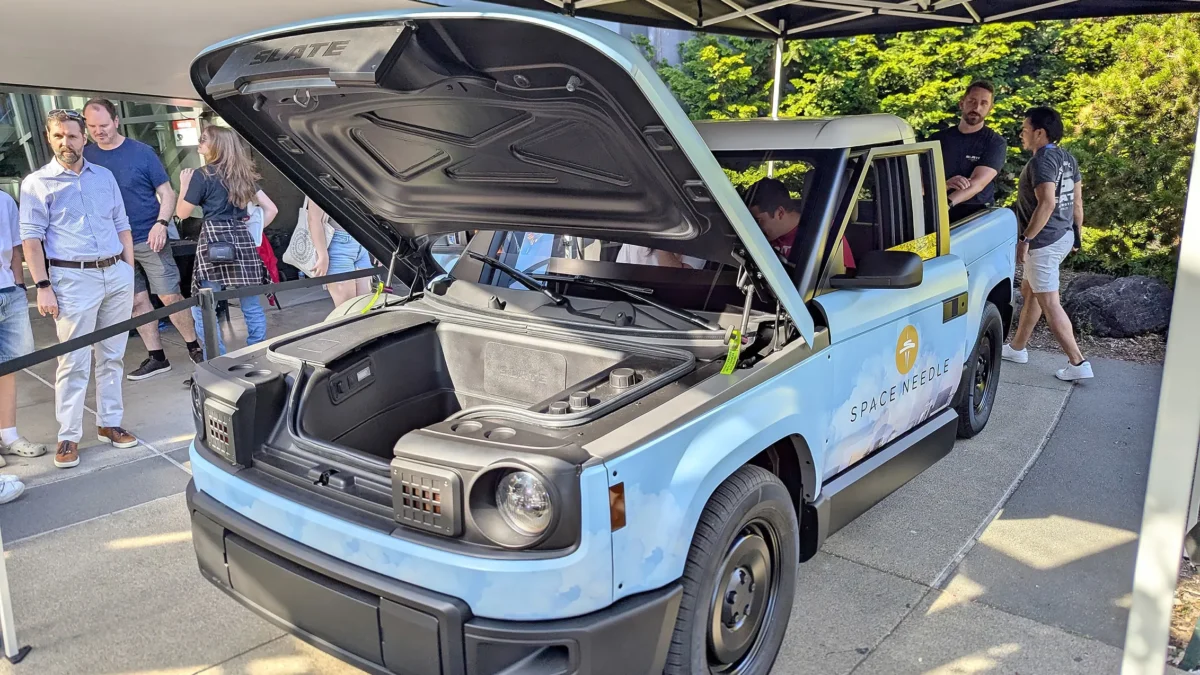
The business model is worth understanding because it is not quite like anything else on the market. The truck will be stripped down in its base form — a two-seater, offered in 150-mile or 240-mile range configurations — with customers able to add features at additional cost after purchase. Every Slate Truck will be built in the same configuration, ready for accessorisation after delivery. The idea is that the base vehicle is cheap and simple, and those who want air conditioning, a back seat, or a more finished interior pay for those things separately. It is, in essence, the Ikea approach to car buying: here is the flat-pack, the extras are your problem. Honda’s tiny Super-N takes a similar approach in Europe — different vehicle category, same underlying conviction that affordability is a design discipline rather than a marketing tagline. Both companies have concluded, independently, that the small, focused, deliberately uncluttered EV is the segment that has been underserved while everyone else chased premium.
This either sounds brilliant or deeply annoying depending on your disposition. It is, however, a legitimate attempt to solve the problem that has plagued the American EV market all year: price. That goal was complicated when Congress eliminated the $7,500 federal EV tax credit last year, which would have brought a mid-$20,000 truck to around $17,500 — genuinely transformative territory. Without the credit, Slate must make the maths work on sticker price alone, which is harder but not impossible if manufacturing discipline holds. The competition at the affordable end is also about to get considerably more crowded: Stellantis’s sub-$30,000 Chrysler Arrow, confirmed at last week’s Investor Day as part of a wider seven-vehicle sub-$40,000 American product push, is exactly the kind of legacy-automaker response that turns a startup’s price advantage into a price expectation. Slate moved first. It now needs to move fastest.
On that front, the signals are encouraging. Slate’s new CEO Peter Faricy says the company is “on time and on budget” to deliver its first trucks by year-end, with over 160,000 reservations already in hand — up from 150,000 in December. Production will take place at a reindustrialised factory in Warsaw, Indiana, where Slate is expected to invest nearly $400 million, create over 2,000 jobs, and contribute up to $39 billion to Indiana’s economy over 20 years — projections that should be taken with the appropriate pinch of salt, but speak to genuine long-term intent rather than vaporware ambition. The site, previously a printing plant closed in 2023, is being retrofitted for vehicle production with a target capacity of up to 150,000 vehicles per year.
Slate drivers will have access to Tesla’s Supercharger network via a standard NACS port, and the company has partnered with RepairPal’s 4,000-plus service centres for warranty work — solving, in advance, two of the objections most often levelled at EV startups: where do you charge it, and who fixes it when it breaks?
There are caveats, naturally. Every EV startup promises to deliver by year-end until it doesn’t. The industry has watched Rivian, now building the R2 in Illinois, Lucid, and others burn through capital and miss deadlines with the depressing regularity of a late train. Slate’s stripped-down approach reduces complexity, which reduces risk, but this is still a new company attempting to manufacture a vehicle at scale in a market littered with the wreckage of similar ambitions.
But here is the thing: in a week when the dominant EV narrative has been retreat, write-downs, and factories going dark — as GM idled Factory Zero again, sending 1,300 workers home for the second time in three months — $650 million landing behind an American electric truck that costs less than many people’s annual salary is a genuinely different kind of story. The industry could use one of those right now. So could Indiana.
UPDATE — June 24, 2026: $24,950. The Number Is Real. The Truck Is Happening.
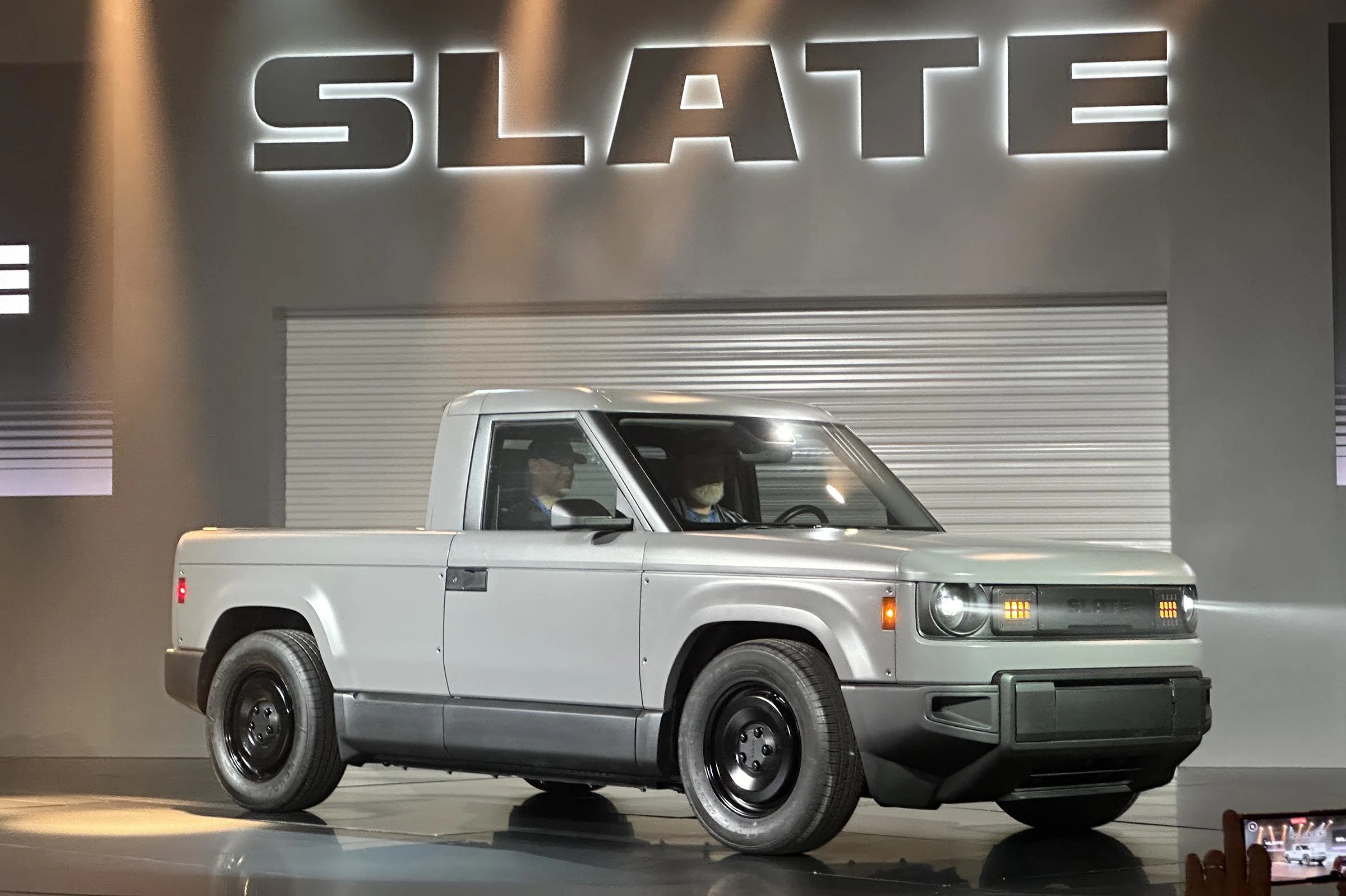
What’s changed: Slate Auto today confirmed final pricing at $24,950, opened preorders, increased the base model’s range estimate from 150 to 205 miles, revealed the SUV conversion price at $29,950, launched Slate University how-to videos, and confirmed a Carvana partnership. This is the moment when a startup becomes something more serious than a promise.
The Price
$24,950. That is the number Slate Auto confirmed this morning when it opened preorders for its electric truck. Not mid-$20,000s. Not approximately $25,000. $24,950 — the lowest starting price of any new electric vehicle in America, at roughly half the current average new-car price of around $50,000.
The figure excludes taxes, title, registration, destination, and documentation fees — so the actual out-the-door number will be higher. But even with those added, you are looking at a new American-made electric pickup truck that costs less than most used pickup trucks of comparable size. The Chevrolet Bolt, currently the closest EV competitor on price, starts at around $29,000. The Nissan Leaf is around $32,000. Slate just stepped below both.
The SUV configuration — which converts the two-seat pickup into a five-seat family vehicle — starts at $29,950, confirmed today for the first time. That conversion is something buyers can do themselves or have done professionally, using kits Slate is selling separately. It is, to put it plainly, a car that turns into a different car. The price of the second car is under $30,000.
The Range Upgrade Nobody Saw Coming
Slate originally planned two battery configurations: a 52.7 kWh pack for approximately 150 miles, and an 84.3 kWh pack for approximately 240 miles. Today, Slate confirmed the base model’s estimated range has been upgraded from 150 miles to around 205 miles — while the larger battery option has been discontinued. There is now only one battery: delivering approximately 205 miles of range.
That is a meaningful jump. 150 miles was marginal for most use cases. 205 miles is genuinely usable as a daily driver and capable weekend-hauler. The trade-off is that buyers who wanted the 240-mile extended range option no longer have it. For the majority of buyers who would have ordered the base model anyway, the range upgrade at no extra cost is unambiguously good news.
How It’s Being Sold — and the Carvana Wrinkle
Slate will sell direct to consumers. Orders placed with a $50 reservation deposit now convert to full preorders with a $300 non-refundable deposit; those who haven’t reserved can place a full preorder directly for $300. Reservation holders get priority delivery windows.
The more interesting distribution element is Carvana. Slate Auto has granted Carvana a warrant to purchase its shares — suggesting the two will collaborate on selling the truck. Carvana recently announced plans to sell new cars, and the Slate truck appears to be among the first it will offer. The connection is less surprising given that Guggenheim Partners CEO Mark Walter — who led Slate’s $650 million Series C — is a major Carvana shareholder.
Slate University and the DIY Philosophy
Today also saw the launch of Slate University — a series of how-to videos covering modifications and maintenance, starting with the SUV conversion and headlight covers. This is central to Slate’s identity: the truck is designed to be modified and maintained by owners, with a parts ecosystem built around accessibility matching the price tag.
The truck ships as a two-seat pickup in bare composite grey with hand-crank windows, no infotainment system, and no paint options. Wraps are available for customisation. Slate University is how the company turns that blankness into a feature.
Where It Sits
Compared to its nearest affordable EV competitor — Rivian’s R2, which starts at $53,990 in launch edition form — the Slate truck is in a completely different price bracket. The USDM EV market has been short on affordable options since the federal tax credit expired, and Slate is arriving at precisely the moment that gap is widest. The global EV affordability picture the IEA laid out in May identified affordability as the single biggest barrier to EV adoption. Slate has spent the past year trying to be the answer to that question.
First deliveries are still targeted for late 2026 — though most buyers should realistically plan for early 2027. The Warsaw, Indiana factory has its body shop robots installed and trim line going in. Slate’s stripped-down design reduces production complexity, which reduces ramp-up risk. It doesn’t eliminate it.
The truck exists. The price is real. The order books are open. Everything else is Indiana making good on a promise.