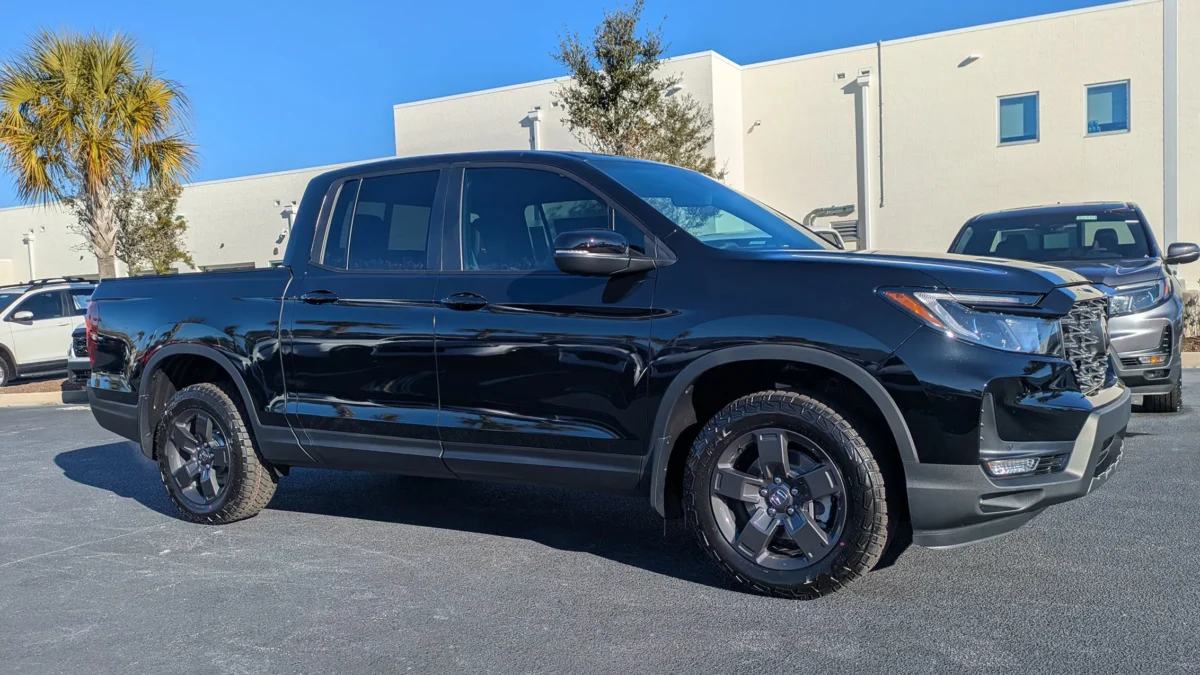
In an automotive year defined by GM, Ford and Stellantis quietly rebuilding their combustion-engine factories, Honda has just achieved something genuinely impressive: it has the only pickup truck in America that has been disqualified from production because its engine is too dirty. The Ridgeline is going off the menu for nearly two years.
Automotive News reported this morning that Honda will pull its only pickup, the Ridgeline, out of production in the fourth quarter of 2026 and not bring it back until the third quarter of 2028. Roughly twenty-one months of empty space at the Lincoln, Alabama plant where Hondas with beds have been built since 2016. The reason is not a strategic pivot, not weak demand, not a chip shortage and not a flood. It is, embarrassingly, the engine. The 280-horsepower 3.5-litre J35Y6 V6 that has soldiered on under every Ridgeline since 2017 cannot meet the upcoming federal emissions standards, and Honda’s replacement powertrain isn’t ready in time.
The replacement, when it eventually arrives, will be a V6 mated to Honda’s new large-vehicle hybrid system — the same setup that will eventually power the Pilot and Passport SUVs that share the Ridgeline’s platform. This system was originally scheduled to be ready in 2027. Then Honda blew $15.8 billion writing down its cancelled 0 Series electric programme in March, the company swung from an expected $3.5 billion operating profit to a possible $3.6 billion loss for the fiscal year just ended, and a lot of timelines got rearranged. The big-vehicle hybrid has now been pushed out far enough that the Ridgeline, the Pilot and the Passport are caught in the middle of the queue. The Pilot and Passport will keep going — they apparently pass the emissions tests — but the Ridgeline does not.
The numbers, briefly, because they deserve a moment. Honda sold roughly 50,000 Ridgelines in the US in 2025, which is small change in the midsize pickup segment (Toyota shifts about 230,000 Tacomas a year), but every single one is profitable and Honda was selling them as fast as Lincoln, Alabama could make them. The TrailSport trim has waiting lists. The unibody construction — unconventional for a pickup, much loved by people who actually use a truck like a car and detested by people who use a truck like a truck — has built a small but ferociously loyal following. Pulling the entire model off the market for almost two years is the sort of decision a company makes when it has no other option.
Which brings us to the deliciously bad timing. Federal CAFE standards are being rolled back. The Trump administration is dismantling the regulatory framework that pushed automakers toward electrification. Congress killed the $7,500 EV tax credit last year. GM has poured $6 billion into V8 production over the past 12 months. Stellantis has resurrected the Hemi. Ford is fighting a $2 billion aluminium shortage just to keep more F-150s on dealer lots. The American truck market in 2026 is, by any sensible reading, the most combustion-friendly it has been in fifteen years. And Honda, alone, has managed to produce a pickup truck whose engine cannot legally be made any more.
The broader Honda story is by now familiar. The company over-committed to EVs late, then over-committed to walking back from EVs late, and is now holding the entire non-electric lineup steady until 2030 while it scrambles to fund 13 new hybrids. The Accord, the Odyssey, the HR-V, the Pilot, the Passport, the Acura MDX and the Integra are all on extended life cycles. The Ridgeline is on something rather more dramatic: an enforced sabbatical. When it returns in late 2028 it will be marketed as a refreshed truck “intended to create the impression of a next-generation truck” — internal sources’ words, not mine — and the genuinely new Ridgeline arrives later still.
The forward-looking takeaway is that the gap left by the Ridgeline’s absence will be promptly filled by people in showrooms saying “how about the Tacoma”, which will be Toyota’s quiet little Christmas gift for the next two years. Toyota currently has 67% of the midsize pickup segment, with Honda contributing a 6% slice that is about to disappear entirely. The Ridgeline will come back. The 50,000 buyers a year may not. That is the price of arriving at the wrong engine party with the wrong powertrain at exactly the wrong moment. Bad luck or bad planning? In Honda’s case, increasingly, the honest answer is yes.