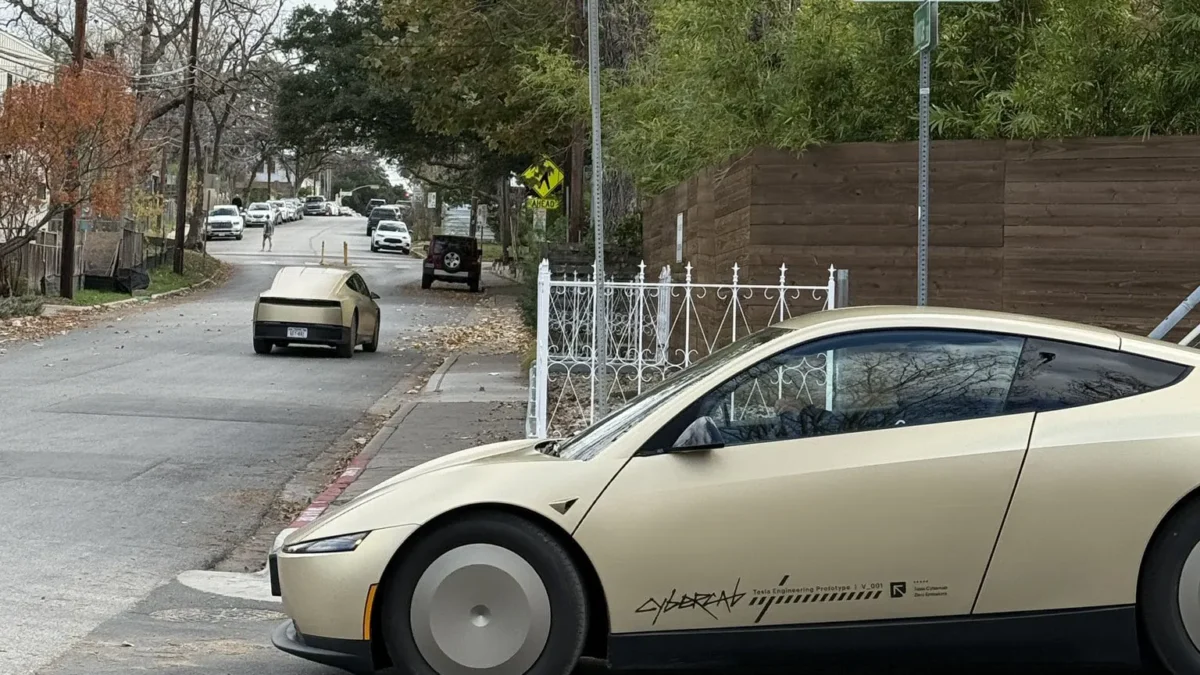
The Tesla Cybercab has no steering wheel, no pedals, and no human driver. It seats two passengers, charges wirelessly through the floor, and is powered by Hardware 5 — Tesla’s most advanced AI platform yet. It is also, as of this week, confirmed to be joining Austin’s live robotaxi fleet “soon,” according to Tesla’s VP of AI. Austin covers 4,285 square miles. Tesla currently has approximately 20 unsupervised vehicles operating in it. The ratio of ambition to fleet size is, one might say, characteristically Texan.
Tesla expanded its unsupervised robotaxi service to cover the entire Austin Metropolitan Area this week — a geofence spanning roughly 4,285 square miles that makes it, in coverage terms at least, one of the most expansive autonomous vehicle deployments in the world. Tesla VP of AI Ashok Elluswamy confirmed this week that the Cybercab — the purpose-built, two-passenger, no-controls autonomous vehicle — will “soon” join the active fleet. Which is the kind of announcement that would generate considerably more excitement if the service were not currently operating with approximately 20 vehicles across a metro area the size of a small country.
Tesla’s robotaxi operation in Austin has been running since June 22, 2025, initially using Model Y vehicles. Unsupervised operations — no safety driver onboard — began in January 2026, with the service subsequently expanding to Dallas and Houston by April 2026. Available data from May 2026 puts the active unsupervised fleet at approximately 20 vehicles: 14 in Austin, 3 in Dallas, and 3 in Houston. That is a total of 20 genuinely driverless commercial vehicles, covering three major Texas cities. Waymo, for context, operates over 700 vehicles in San Francisco alone. Tesla’s fleet is, by any conventional measure, tiny.
And yet the conventional measure may be the wrong one. Tesla’s strategy appears to be to shrink to full unsupervision first, then scale — prioritising the quality of the autonomous capability before the quantity of the fleet. This is the opposite of how most technology rollouts work, and it requires a very particular kind of confidence in your underlying software. The FSD coast-to-coast achievement in May — 2,833 miles, zero interventions, including autonomous parking at Superchargers — is the data point that gives that confidence some grounding. A system that can navigate from New York to Los Angeles without a human touch can probably manage a trip to a San Antonio taco restaurant.
The Cybercab itself is in production at Gigafactory Texas. The first unit rolled off the line on February 17, 2026, and official production started April 24, 2026, targeting hundreds of units per week. The vehicle uses Hardware 5 — Tesla’s AI5 platform — with a vision-only sensor suite, inductive wireless charging, and butterfly doors. Its production cost is under $30,000, which matters enormously: the economics of a robotaxi network only work if the vehicle is cheap enough to deploy at scale while generating revenue per mile that exceeds operating cost. At under $30,000 a unit, Tesla’s maths looks considerably better than most of its competitors’.
The competitive landscape is worth mapping. Waymo dominates in San Francisco and has expanded to Phoenix, Los Angeles, and Austin itself — where it operates alongside Tesla. Zoox, Amazon’s autonomous vehicle subsidiary, is planning Austin and Miami deployments. And then there is Lucid’s Nuro-powered robotaxi programme, backed by Uber with 35,000 vehicles committed, targeting San Francisco’s Bay Area for commercial launch later in 2026. The robotaxi race, which looked theoretical for most of the last decade, is now being run in real cities with real passengers and real revenue.
Tesla’s ace is the one that nobody else holds: millions of FSD-capable vehicles already on the road, any of which could theoretically join the network once the software and regulatory approvals reach the appropriate threshold. A Wall Street analyst this week argued that Tesla has effectively achieved Level 4 autonomy in most conditions across its entire fleet — a claim that, if accurate, would make the current 20-vehicle deployment look less like a ceiling and more like a floor.
The Cybercab has no steering wheel. That is not a design statement or a cost-saving measure — it is a declaration that the vehicle will never need a human to take over. That confidence, embedded in the hardware, is either the most audacious bet in automotive history or entirely reasonable given what the broader EV transition has already demonstrated. History suggests it is probably both simultaneously, and that the answer will become clear at some point between 2026 and whenever the fleet reaches 700 vehicles.
Austin is covered. The cars are on their way. There are just, at the moment, rather a lot more square miles than there are cars.