Porsche’s GT division has spent the better part of three decades making people feel slightly inadequate at car parks and entirely alive on racing circuits. Its GT3 has become one of the most celebrated driver’s cars ever built — a naturally aspirated, high-revving, rear-wheel-drive monument to the idea that a car should reward engagement rather than simply tolerate it. It has a following that borders on religious. And so when Porsche announced it was making a convertible version, a specific segment of that following did what enthusiast communities do best, which is conclude that everything they loved was being destroyed.
They were, it appears, entirely wrong.
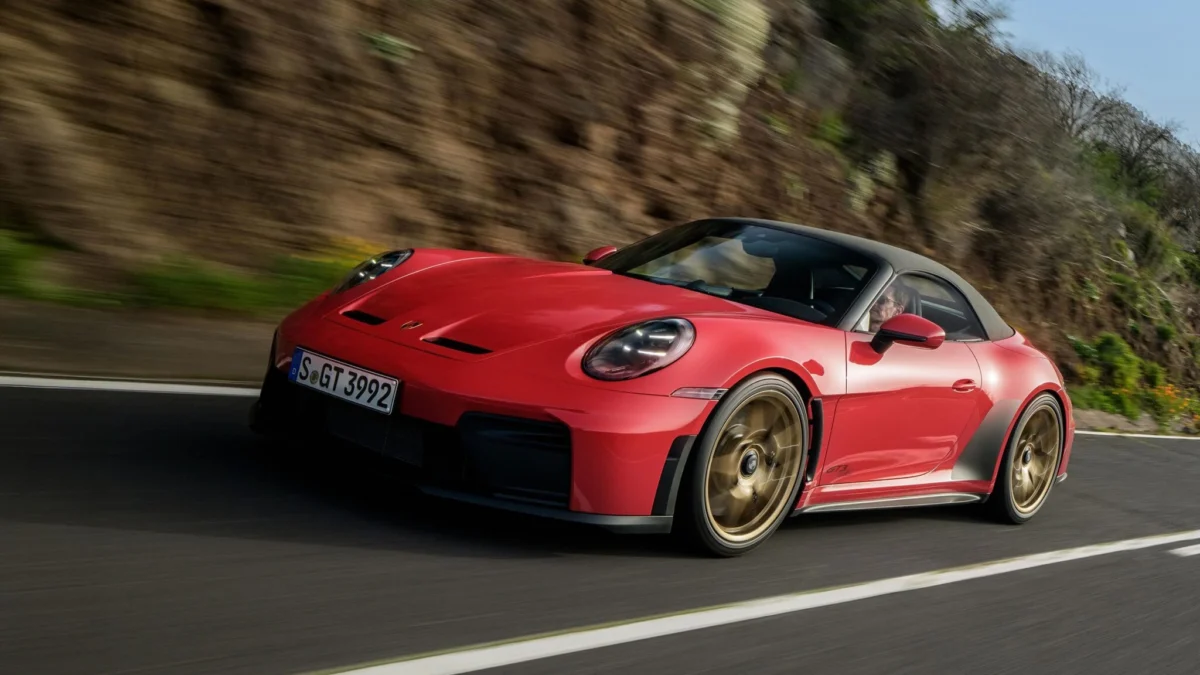
The 911 GT3 S/C — Sport Cabriolet, with the S/C badge reviving a name last used on 911s between 1978 and 1983 — was officially revealed this week and is the first GT3 in the model’s history to feature a fully automatic convertible roof. Chris Harris, who drove a development car at Porsche’s Weissach test track before the public announcement, put it with characteristic bluntness: around the track, if you removed the sensation of wind on your face, you wouldn’t know it was a convertible. The body feels that stiff. The dynamics are that intact.
The numbers explain how. At 3,322 lbs, the GT3 S/C is 203 lbs lighter than a standard 911 Carrera Cabriolet and only 266 lbs heavier than the hard-top S/T, despite its hydraulically operated folding roof. This was not achieved by clever marketing. The bonnet, fenders, and doors are made of carbon-fibre, carried over from the 911 S/T. The rear anti-roll bar, connecting links, and underbody panel are also carbon fibre. The Porsche Ceramic Composite Brake system, more than 20 kg lighter than cast iron rotors, is fitted as standard, as are magnesium centre-lock wheels saving around nine kilograms of rotating mass. Magnesium is also used in the convertible roof mechanism itself. The result is a car that is lighter than most people expected a GT3 cabriolet to be, and more rigid than most people thought was achievable without a roof.
The naturally aspirated 4.0-litre flat-six produces 510 PS, equipped with more aggressive camshafts carried over from the GT3 RS for more responsive power delivery in the upper rev range. The sole transmission available is a six-speed GT Sport manual with a short final-drive ratio. No PDK. No automatic. You shift it yourself or you don’t buy it. This is a position that will please the right people enormously. It is also a notable statement of priorities from a company that, elsewhere in the building, is having a rather harder time of things — Porsche, currently writing off billions on EVs, has seen its operating profit collapse 92% as the Taycan stumbled and the electric 718 was shelved. The GT3 division, in other words, is the part of Porsche that still works exactly as advertised, and the S/C is what happens when the engineering culture that built the brand gets to keep building cars for the people who actually want them.
The roof itself deserves mention. It opens in 12 seconds at speeds of up to 50 km/h, and unlike the previous 911 Speedster, uses a fully automatic mechanism rather than the manual unfurling that the Speedster required. The fabric stretches from the windscreen frame to the compartment lid with no visible bows underneath, maintaining the flowing 911 silhouette in convertible form. The front roof frame, rear window frame, and the top’s two panels are all made of magnesium, which allows for a coupe-like roof curvature. This is not, in other words, a hastily engineered open-top variant. It has been properly thought through.
Andreas Preuninger, the head of GT cars and the man who essentially defines what a GT3 is, told Harris directly: the car is as precise and as GT-like as any other GT3 variant. The scuttle shake — the unsettling flex through the steering wheel and body that afflicts poorly engineered convertibles — is, by Harris’s account, essentially absent. There is a small amount of structural difference between this and the coupe, roughly in the five-percent range if you are specifically looking for it. At speed, on circuit, with the engine working, it is imperceptible.
The S/C is positioned between the GT3 Touring coupe and the RS — not as limited as the S/T, not as extreme as the RS with its fixed wing, but fully deserving of GT3 credentials. It starts at $273,000 in the US, which Porsche argues represents a discount of roughly 11% compared to a GT3 coupe specced with the same S/T upgrades. This calculation is not entirely unreasonable, given that the magnesium wheels, PCCB brakes, and lightweight package would cost considerably more as individual options. Whether buyers will see it that way depends largely on whether they can find one, since the GT3 purchasing experience tends to involve a degree of dealer relationship management that the uninitiated find confronting.
What the S/C represents, beyond the engineering, is a philosophical evolution. The GT3 programme began as an uncompromising tool for track use; it has quietly become something broader. Porsche’s own data shows that nearly 50% of GT3 buyers now choose the Touring variant — the one without the fixed wing, better suited to road driving, more daily-usable. The GT3 is no longer exclusively for people who want to feel like they should be wearing a firesuit. The S/C is the next step in that direction — a car that lets the engine breathe on you while you drive it on a country road, that makes the already-remarkable flat-six sound even more remarkable because the air between you and it has been removed. It is, in its way, the philosophical opposite of where the rest of the industry is heading: the Polestar 4 takes the opposite path, removing the rear window entirely in service of an aerodynamic minimalism that the GT3 driver would, on principle, find baffling.
Harris noted, with the self-awareness of someone who has spent considerable time making fun of people who like convertibles, that he now owns two. That the GT3 programme has arrived at the same place is perhaps not a coincidence.
The purists still have the RS. The rest of us get the sun.