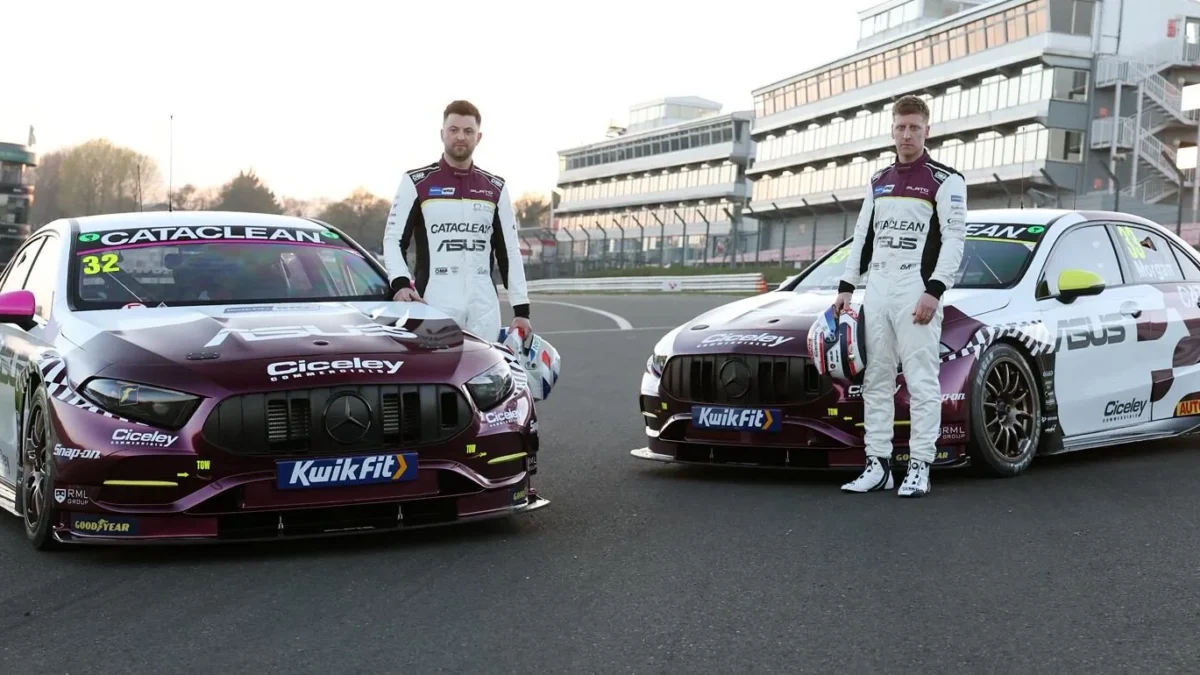
Jason Plato spent the better part of a decade being asked if he would ever start his own British Touring Car Championship team. His response, he cheerfully admits, was consistent and colorful: he would rather, and these are effectively his words, eat his own excrement. He was emphatic. He had no interest. He had watched enough people destroy themselves financially and emotionally on the altar of team ownership to know it was a fool’s errand. He was a driver. Drivers drive.
That was then. This is 2026, and Plato Racing is about to turn its first competitive wheel at Donington Park.
From Retirement to Team Owner
The story of how this happened is, depending on how you look at it, either a tale of a man doing exactly what he said he would never do, or a tale of what happens when the structures that define a professional athlete’s life collapse simultaneously. Plato — two-time BTCC champion, holder of the series’ all-time race wins record with 97 victories, and a man who made punctuality at first corners somewhat optional — retired from competitive driving in 2022. What followed was not the graceful slide into television presenting and occasional demonstration laps. His television work ended. Investments went wrong. His marriage broke down. He has spoken openly, and with considerable courage, about reaching what he describes as a dark place on two separate occasions, and the support he received from friends including Ross Brawn in rebuilding.
What Is Plato Racing?
The road back runs, improbably, through Wellingborough. From a seed of an idea last summer — the team didn’t even have a bank account in August 2025 — Plato has assembled a crack team of experienced BTCC professionals to run a pair of Mercedes-AMG A35 saloons built by RML, the respected British motorsport powerhouse that also guided Plato to his second championship in 2010. The team operates from Unit 2 at RML’s Wellingborough facility — coincidentally the same building where Plato used to come and negotiate sponsorship space on his car with RML’s commercial director, and the same premises where Bay 4 once housed his championship-winning Chevrolet. He now pays rent on the adjacent building. Motorsport is, among other things, a sport of deeply loaded geography.
The Cars: RML-Built Mercedes-AMG A35s
The car selection is characteristic of the level of detail applied to the whole project. The team evaluated in excess of five different cars before settling on the Mercedes-AMG A35 saloon, chosen primarily for its aerodynamic profile — said to have the best drag coefficient of any eligible BTCC body on the current grid. RML reverse-engineered the shells from salvage vehicles — two of the three donor cars came from flood damage, having been written off after river and lake immersions respectively. The road car shells were laser-scanned in their entirety, converted to CAD, and then rebuilt around roll-cages designed using CFD modelling and finite element analysis, with the loading paths through the structure optimised in digital space before a single tube was welded. Billet aluminium intercooler end tanks. Laser-cut stainless steel components. Carbon fibre subframes. The result looks more like an old DTM car than what the BTCC paddock is accustomed to seeing.
Who Drives for Plato Racing?
The drivers are Dan Rowbottom and Adam Morgan — fifth and sixth in the 2025 BTCC standings respectively, so neither is a passenger making up the numbers. And the language Plato uses around the team’s ambitions is not that of a man hoping for a decent midfield finish. He expects to be competitive immediately. He said, on camera, that he would be disappointed if the team was not on pole at its first race weekend. The paddock has heard this kind of thing before, of course. The paddock has also been wrong to dismiss it before.
The RML Question
The RML connection is a source of both strength and controversy. RML is also a key supplier of components to all teams on the BTCC grid, which created a legitimate question about competitive advantage that BTCC boss Alan Gow had to be convinced did not apply. The answer given, and broadly accepted, is that RML built the cars and handed them over; at events, RML personnel will be in RML shirts in the RML truck selling parts to the whole grid, not working on Plato’s cars. The operational separation is absolute in theory, if not entirely in geography, given that the two organisations are separated by a driveway.
Why This Matters
What makes this genuinely compelling as a motorsport story, beyond the politics and the technical ambition, is the personal dimension. Plato is 58. He is responsible for 14 people’s livelihoods. He will be at the circuit watching someone else drive the car he built, which he acknowledges will be a psychologically unusual experience for a man whose entire professional identity was constructed around doing that job himself. He describes the process of choosing his drivers as surreal — selecting the people who will do the thing he used to do. His former rival Matt Neal, now a friend, has received cheques totalling around £40,000 for Team Dynamics wheels. Former worlds are colliding.
The BTCC, as a spectacle, is genuinely excellent and genuinely underappreciated. At Silverstone National, the entire grid is split by just 7/10 of a second in qualifying. That level of competitiveness simply did not exist in the Super Touring era, for all its manufacturer glamour and television audiences. Into this environment, Plato Racing arrives with supercomputer access courtesy of sponsor ASUS, CFD-optimised aerodynamics, and a team owner who built a career on unsettling the establishment.
The cars are purple, white and grey. They look rather good. The shakedown happened three days after filming. By the time you read this, the season has started.
Jason Plato said he would never do this. He was, as it turns out, incorrect. And the BTCC is better for it.
Update, August 2026: The Season That Contained Everything
The debut delivered on the prediction, more or less. Dan Rowbottom won the first-ever Race to Pole at the Donington opener — Plato had said he’d be disappointed if the team wasn’t on pole at its first race weekend, and instead it won the qualifying race outright, by 0.024 seconds. Then came the part nobody scripts: a long midfield summer, a single podium from Rowbottom at Thruxton, a frustrating Oulton Park, and a new team learning in public what every new team learns in public.
Knockhill in August was the breakthrough. Off the back of damper developments, Adam Morgan took his first pole since 2018, won the Race to Pole, and then — in the rain, leading Rowbottom home — delivered the team’s maiden championship race victory as a 1-2, adding second place in Race 3 for good measure. Plato called it a turning point. He was right in a way nobody wanted.
Days after the maiden win, Plato Racing entered administration. Title sponsor Cataclean and TOCA confirmed the team would see out the 2026 season — rebranded CPRL, funded in the interim while administrators seek a buyer — but without Plato himself, who described himself as stunned and unsettled by his departure from the team that carries his name. The line at the top of this article, about people destroying themselves financially on the altar of team ownership, was a joke Plato used to tell about other people. It does not read that way anymore.
The cars, meanwhile, have not noticed. At the very next meeting, on Donington’s GP layout, Morgan led another dominant Saturday 1-2 for the team formerly known as Plato Racing. Whatever happens to the ownership, the project itself — the laser-scanned flood-damage shells, the CFD roll-cages, the best drag coefficient on the grid — has been vindicated on track. The 97 wins still belong to Plato. The team he built is winning without him. Motorsport is, as noted above, a sport of deeply loaded geography. It turns out to be a sport of crueller timing, too.