Lee Iacocca was thirty-eight years old, running Ford Division, and in possession of a conviction that the company was leaving a very large amount of money on the table. The data he had assembled told a specific story: America’s post-war baby boom had produced a generation of young adults who were entering the car-buying market in significant numbers, who had more disposable income than their parents had at the same age, and who were not being offered anything that spoke to them. Ford was selling them the same cars it sold their parents. Chevrolet was doing the same. Everyone was doing the same.
Iacocca wanted to stop doing the same.
The car he had in mind was light, affordable, stylish, and available with enough powertrain options to appeal to everyone from the economy-minded commuter to the performance enthusiast. It would sit on an existing platform to keep costs down. It would be priced to undercut the competition. It would look like nothing Ford had ever made.
He needed Henry Ford II to say yes. Henry Ford II was not initially inclined to.
The Problem With Henry Ford II
Henry Ford II — known within Ford, not always affectionately, as “Hank the Deuce” — was the grandson of the founder and the man who had taken over a company in near-terminal decline in 1945 and restored it to profitability through sheer force of will and a willingness to hire talented people he didn’t necessarily like. He was decisive, commercially shrewd, and deeply sceptical of product proposals that deviated significantly from what Ford’s existing customers were buying.
The Edsel was a recent and painful memory. Ford had launched it in 1957 as a bold new model aimed at a market segment that turned out to be considerably smaller than the research had suggested. The losses were enormous, the embarrassment public, and the lesson — in Ford II’s reading of it — was that chasing demographic fantasies with expensive new platforms was a reliable path to disaster.
Iacocca’s proposal for a sporty youth car was, from Ford II’s perspective, potentially another Edsel. A product designed for a customer who might not materialise in sufficient numbers, on a timeline that required significant investment before a single unit was sold.
Iacocca had anticipated this objection. His entire presentation was designed to answer it.
The Case Iacocca Made
The presentation Iacocca and his team made to Ford’s product planning committee in 1962 was a study in commercial persuasion. Every element of the objection was addressed before it could be raised.
The platform question first: the new car would share its underpinnings with the existing Falcon, which was already in production and fully amortised. The tooling investment would be a fraction of what a ground-up new platform would require. The financial exposure was manageable.
The market question second: the demographic data Iacocca presented was specific and credible. The number of Americans aged eighteen to thirty-four was projected to grow by 50 per cent over the following decade. This was not a forecast or a model — it was an arithmetic consequence of births that had already happened. The customers existed. The question was whether Ford would sell to them.
The price question third: the car would launch at under $2,500. This was a number that put it within reach of exactly the demographic the data identified — young buyers with jobs but not yet with substantial savings. It was also a number that gave the car an almost unfair advantage over the European sports cars it would inevitably be compared to, which cost considerably more and offered considerably less in the way of practicality.
The options question last, and most cleverly: the car would be sold with an enormous range of engine, transmission, and trim options. The base buyer could get an economical straight-six and a modest interior. The enthusiast could spec a V8, a four-speed manual, and a performance package. The same car — the same body, the same platform — served both customers. The range of configurations was not a compromise; it was the point. Ford would sell one car and please everyone.
This last element was the most important. It transformed the question from “will enough young people buy a sports car” to “will enough people in general buy a versatile, attractively priced new model.” Framed that way, the answer was obviously yes.
Ford II approved the programme.
What Happened at Launch
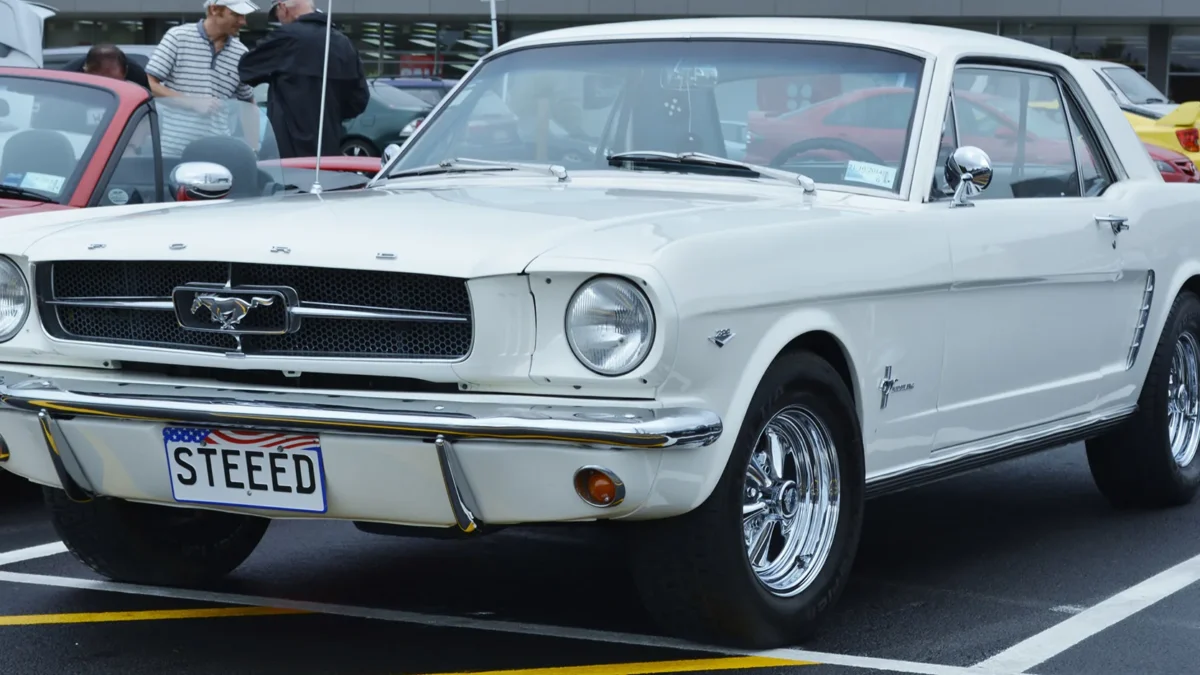
The Mustang was introduced at the 1964 New York World’s Fair on April 17, 1964 — a date Ford’s marketing team had chosen for its proximity to the start of the summer driving season and its guaranteed press coverage from the Fair itself. The launch was coordinated with simultaneous coverage in Time and Newsweek — the first time a car had appeared on the covers of both magazines in the same week.
Ford had projected first-year sales of 100,000 units. They sold 22,000 on the first day. In the first twelve months, 418,812 Mustangs were sold — a record for a new model launch that stood for decades. Iacocca’s demographic forecast had been, if anything, conservative.
The car created a category. “Pony car” — a term coined partly in response to the Mustang’s galloping horse badge — became an automotive classification that Chevrolet, Pontiac, and Plymouth rushed to fill. The Plymouth Barracuda had technically launched two weeks before the Mustang but was so thoroughly overshadowed that it barely registered. The Chevrolet Camaro and Pontiac Firebird arrived in 1966, two years late, explicitly designed to compete with a car that had already established the rules of the segment.
The same Total Performance era that gave Iacocca the commercial runway to make his case — Ford’s broader strategy of using motorsport to reposition the brand as performance-oriented — meant the Mustang arrived into a Ford that was already associated with speed and ambition. The GT40 was being developed simultaneously. Carroll Shelby, who would later give the Mustang its most fearsome variant — the GT350 and GT500 — was already in Ford’s orbit. The Mustang was not a standalone product decision. It was the commercial expression of a coherent performance strategy that Iacocca had assembled, piece by piece, around a single demographic insight.
The Numbers Behind the Legend
The Mustang’s financial performance is worth dwelling on, because it contextualises what Iacocca had actually achieved.
The development cost for the Mustang was approximately $75 million — modest by the standards of a full platform development, exactly because the Falcon underpinnings had absorbed most of the engineering investment. In the first two years alone, Ford sold over 680,000 Mustangs. At an average transaction price of around $2,700 and a margin that the shared platform kept healthy, the car had paid for its development many times over before its first anniversary.
Iacocca later said the Mustang made Ford approximately $1.1 billion in profit in its first two years. The figure has been disputed in its precision, but the order of magnitude is consistent with what the sales numbers support. It was, by any measure, one of the most commercially successful product launches in American corporate history — and it had been approved in a meeting where the primary obstacle was the memory of a previous failure.
What the Edsel Had Actually Taught
The irony of Ford II’s Edsel concern is worth examining directly. The Edsel had failed for specific reasons: it was positioned in a market segment that the 1958 recession eliminated, it was overpriced relative to its competition, and it was styled in a way that generated strong opinions in both directions. It was not a cautionary tale about serving young buyers. It was a cautionary tale about misjudging a market segment, overspending on a platform, and launching into a recession.
The Mustang addressed every one of these failure modes. Shared platform. Competitive price. Timing that coincided with an economic expansion rather than a contraction. Demographic projections based on census data rather than market research guesswork.
Iacocca had not ignored the Edsel lesson. He had read it more carefully than Ford II had.
What It Tells Us
The Mustang story is, at its core, a story about the quality of the argument rather than the authority of the person making it. Iacocca did not have the power to approve the Mustang. He had to persuade someone who did, and that person was sceptical, recently burnt, and institutionally conservative.
He persuaded him by answering every objection before it was raised, by framing the proposal in terms of financial exposure rather than aspiration, and by building a product concept — the configurable pony car — that transformed a niche product into a mass market one.
The result sold 418,812 units in its first year, created a new automotive segment, made Ford somewhere in the region of a billion dollars, and is still in production sixty years later.
Henry Ford II had been right to be sceptical. He had also been right to be persuaded. That combination — the rigorous interrogator and the rigorous case — produced something that neither would have reached alone.
Not every great car begins with a great engineer. Some begin with a great argument in a boardroom, presented by a man who had done the homework and was not going to leave until the answer was yes.