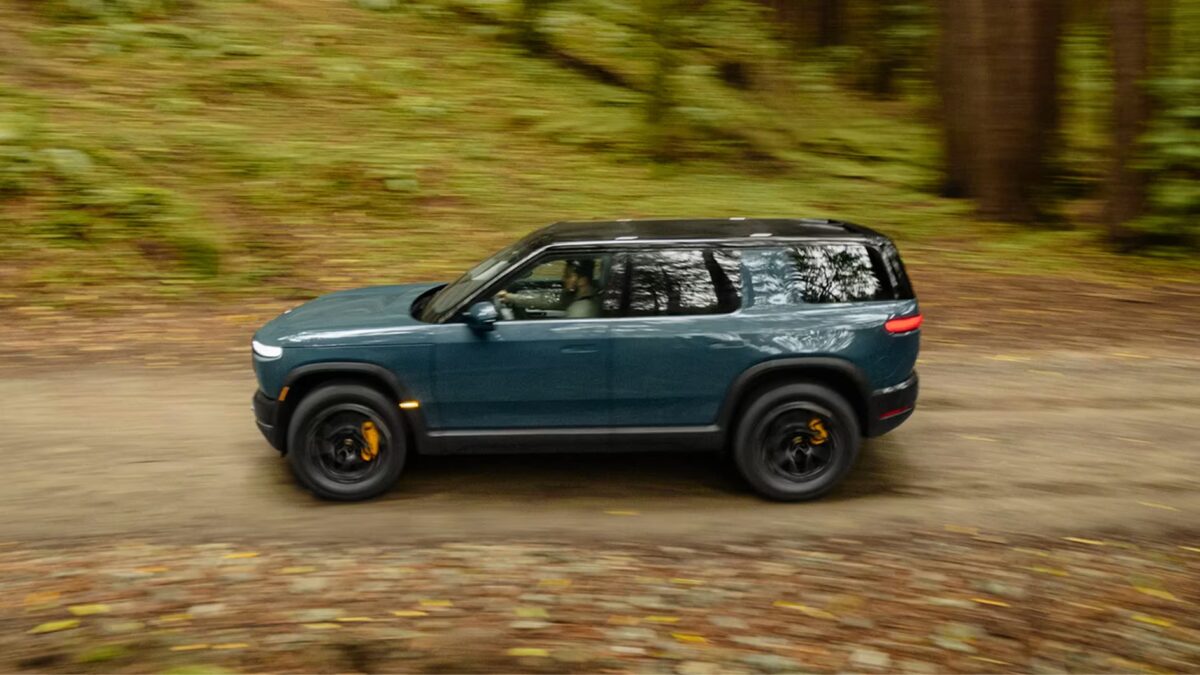
Rivian has been building excellent, expensive trucks that not enough people could afford to buy. The R1S is a genuinely remarkable piece of machinery — capable off-road, refined on it, technically ambitious in ways that make its $75,000-and-climbing starting price feel, if not justified, at least explicable. The problem is that excellent and expensive is not a survival strategy for a company that has never turned a profit and has roughly $7.7 billion in cash left on its balance sheet. What keeps Rivian alive is not the R1. It’s the R2. Which is why the launch of the R2 is, without much exaggeration, the most important product launch in the company’s history.
The good news, based on first drives conducted around Park City, Utah, is that it appears to be very good indeed.
The R2 is Rivian’s midsize electric SUV, built on an entirely new platform — unibody instead of the R1’s body-on-frame construction, structurally integrated battery pack, new front strut and rear multi-link suspension, semi-active dampers on the launch variant, and a torque split revised to 40% front/60% rear to give it the character of a rear-wheel-drive car rather than a truck. It is 2,000 pounds lighter than the R1. The payload is smaller. The ambition is considerably larger.
Pricing is structured in the way that only EV manufacturers seem to consider reasonable. The first R2 to reach customers in Spring 2026 is the Performance with Launch Package, carrying a dual-motor AWD setup and priced at $57,990. The more accessible Premium trim follows in late 2026, with the headline ~$45,000 Standard RWD model not arriving until late 2027. This means the people most likely to read a headline saying “Rivian R2 starts at $45,000” and get excited are the people who will wait the longest to find out whether that’s true. This is a familiar move from EV manufacturers. It does not change the underlying math, but it is worth saying out loud.
What the launch variant delivers is impressive: 656 horsepower, 609 lb-ft of torque, 0-60 mph in 3.6 seconds, and 328 miles of EPA-estimated range on the 21-inch all-season tyre fitment. The chief engineer Max Kauf — who also owns a Porsche GT3 and therefore has opinions about how cars should feel — describes the development philosophy as deliberately neutral: a car that responds to inputs, uses the regen and torque vectoring to manage rotation, and doesn’t need to be babied or fought. The brake-by-wire system keeps regen entirely on the accelerator pedal and uses a hydraulic pump to provide genuine pedal feel during ABS events. These are not small details.
Savage Geese’s Jack drove the launch variant for approximately two hours — one hour on street, one hour on a real off-road course — and came away with impressions that surprised him. The Rivian drives like a unibody SUV rather than a truck, which is what it is, and the suspension calibration strikes the difficult balance between absorbing large impacts on the highway and staying composed through canyon sequences. Steering is slow by sports car standards, which serves the off-road brief and apparently doesn’t feel wrong in context. The autonomous driving system centres itself competently in lanes and handles construction zones without drama.
The technology story is substantive. Rivian has eliminated 2.3 miles of wiring from the R2 versus their previous architecture, consolidated the onboard charger, DC-DC converter, battery management system, and DC-AC converter into a single “powerhouse” unit mounted on top of the battery pack, and enabled bidirectional AC charging — V2H capability — through a software update that will come post-launch. The R2 launches with NACS, giving native access to Tesla’s Supercharger network. No CarPlay or Android Auto, which will annoy some people, but Rivian’s own system is reportedly responsive.
The target buyer is specific: what the Savage Geese team describes as the Patagonia crowd. The person who genuinely wants off-road capability, drives to work every day, picks up children from school, and would currently be buying a 4Runner, a Bronco, or a Subaru Forester. This is not a Model Y conquest strategy. Rivian CEO R.J. Scaringe has cited a target of over 300,000 units annually at full production with 20% per-unit profitability — figures that would require pulling buyers from the lifestyle SUV segment, not just from other EV brands.
Whether it can actually do all of this is, as Savage Geese is careful to note, entirely unverified by two hours of supervised driving in ideal conditions. The history of EVs is full of very good press drives followed by very public software problems, build quality issues, and service centre experiences that make the product seem considerably less appealing. Rivian’s existing customer base is broadly loyal but the company’s production ramp has historically been slower than announced. The R2 needs to be built reliably, in volume, without the kind of initial quality concerns that have damaged its competitors.
If it is, the EV SUV market has a genuinely interesting new entrant. The current EV market dynamics — large manufacturers writing off billions in failed electric projects, subsidy removal in the US flattening demand — suggest that the only cars actually selling in volume are the ones that people want independent of incentives. The Tesla Model Y sells because it is genuinely useful, not because anyone made buyers feel guilty into it. The R2 is attempting something similar: a car that is good at everything, consistently, at a price that doesn’t require an embarrassing rationalisation.
The “if it works” asterisk is large. But the car, on current evidence, is legitimately promising.
Rivian has a habit of making good things slowly. The R2 has to change at least one of those words.