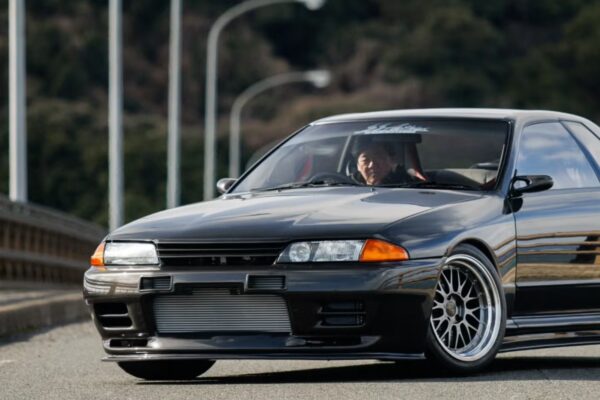
Nismo, to be clear, stands for Nissan Motorsport. It is the performance sub-brand responsible for the GT-R variants that hold lap records, the Z cars that people put on bedroom walls, and the Skyline GT500 race machines that howl around Super GT circuits in Japan. It is a badge with history and meaning and a specific set of expectations attached to it. Nissan has now applied it to a vehicle that weighs 6,000 pounds, has three rows of seats, and uses the same 8,500-pound tow rating as the standard model it is based on. This was always going to require some explanation.
The explanation, it turns out, is not terrible.
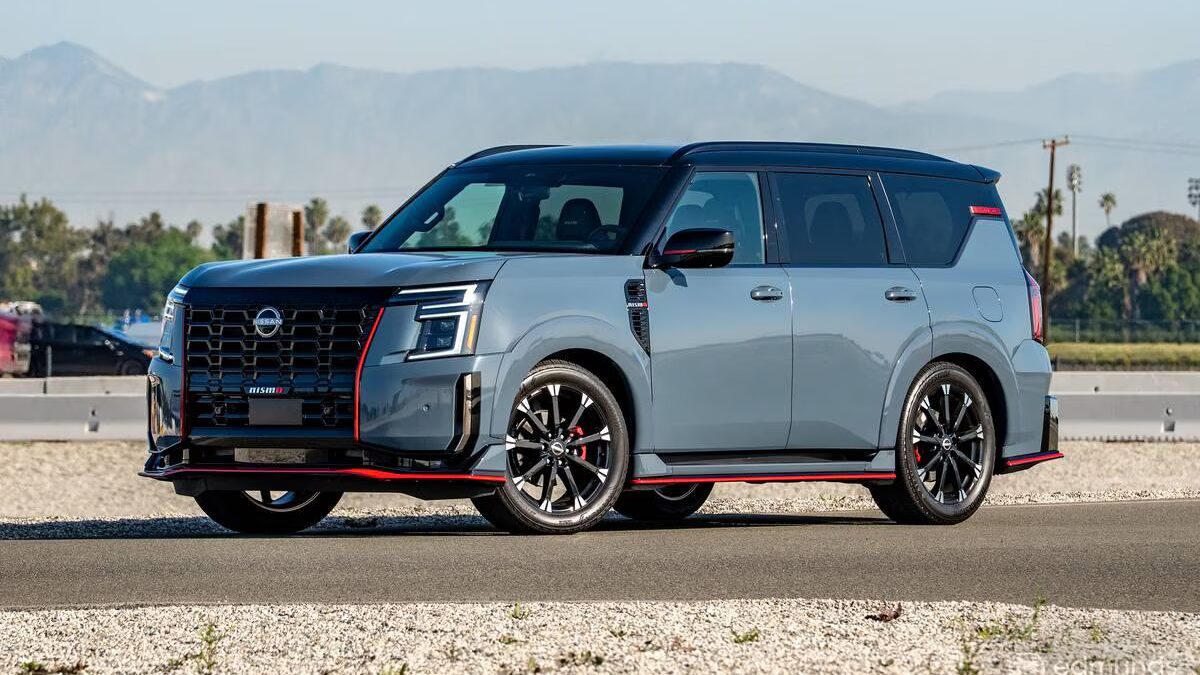
The 2026 Nissan Armada Nismo starts at $79,530 in the United States, or approximately $110,000 Canadian once freight is added in what remains one of currency conversion’s crueller jokes. For that money, you receive a 3.5-litre twin-turbocharged V6 producing 460 horsepower and 516 lb-ft of torque — 35 more horsepower than the standard Armada, courtesy of revised valve timing and a sport exhaust tuned specifically by Nismo. The 22-inch forged wheels are 23% lighter than the standard units, which prompted a chassis retune of the air suspension to account for the reduced unsprung mass. Zero to 60 arrives in 6.1 seconds. Nissan says the steering and handling have been sharpened, and at least some reviewers have come away impressed by how the thing actually drives, which is a more encouraging sentence than you’d expect when describing a vehicle this large.
Throttle House’s Thomas and James tested it in Canada, and their response traced a specific emotional arc: initial visceral revulsion, followed by gradual softening, followed by a grudging acknowledgment that the people honking approvingly in traffic might be onto something. Twenty-nine percent of Thomas’s Instagram followers voted “God’s gift.” The majority voted “kill it with fire.” These numbers feel about right for a car that has a rear spoiler, a multi-layer body kit that takes quite a while to stop, and the word Nismo stencilled on the exterior approximately twelve times.
The honest assessment is that the Nismo Armada is performing a slightly different role than the badge would imply. It is not the Armada equivalent of a GT-R Nismo with track-tuned aero and upgraded cooling. It is the Armada equivalent of putting on a sharper suit: same engine, same bones, more attitude, better-looking wheels, a sound file played through the speakers that is supposed to resemble a Nissan Z. The brakes are unchanged. The towing capacity is unchanged. The nine-speed transmission hunts for gears at low speeds in a way that has been a consistent complaint across the Armada and Infiniti QX80 families, and which suggests Nissan has some ongoing business with its transmission calibration team.
But here is the context that makes this more interesting than it first appears. In the Middle East, this vehicle is sold as the Nissan Patrol Nismo, and it commands a level of cultural passion that the Armada badge in North America doesn’t quite communicate. The Patrol has decades of desert credibility, there is footage of heavily modified versions dispatching sports cars in the Gulf, and the Nismo treatment makes intuitive sense when applied to a vehicle with that kind of heritage. In the US, Nissan is essentially importing that energy into a market that knows the Armada as a solid but largely unloved alternative to the Chevrolet Tahoe. Whether the Nismo badge travels is a reasonable question.
What it does offer, fairly clearly, is value against the specific competition. An Escalade V — which is 500 horsepower, naturally aspirated V8, 0-60 in four seconds, and unambiguously the benchmark in this category — starts north of $165,000. The Armada Nismo is less than half that. You lose roughly two seconds in the 0-60 sprint and a meaningful amount of drama, but you save approximately $85,000 and retain three fully functional rows of seating and a tow rating that the Escalade V either matches or approaches. If Gordian American speed is the specific requirement, a Dodge Durango SRT or Hellcat also presents as a naturally aspirated V8 alternative for less money, though neither can match the Armada’s interior space.
The interior, in Nismo specification, is genuinely quite good. Red stitching, Nismo-branded seats that are described as resembling a big comfortable couch, a 14.3-inch touchscreen running Google built-in, a Klipsch 12-speaker audio system, and a cabin that Thomas and James found difficult to fault on quality grounds. The cooled seats are deleted in the Nismo, which is the kind of trade-off that reveals exactly what the priorities are: someone decided red sport seats were more important than ventilated ones, which tells you something about who is making this decision and who they imagine is buying it.
Nissan as a brand is in a complicated moment. The Infiniti and Nissan performance car conversation includes the forthcoming Nismo Z manual, which has been updated with a revised transmission and which the Throttle House team specifically called out as the vehicle they most want Nissan to get right — because they like Nissan and want it to succeed, and because the Z is one of the few genuinely driver-focused affordable sports cars still in production. The SUV market is where the money is, and the Armada Nismo is Nissan planting a flag in that market with a product that has more flair than a Tahoe, more value than an Escalade V, and more controversy than anyone strictly asked for.
The Nismo badge deserves to be on something that can do the name full justice. Whether a 6,000-pound family hauler is that vehicle is a matter of perspective. The 29% who called it God’s gift are not entirely wrong. The other 71% are not entirely wrong either.
The badge is doing a lot of heavy lifting. Fortunately, so is the suspension.