Today, AMG is one of the most recognised performance sub-brands in the world. The letters appear on everything from compact hatchbacks to GT hypercars. There are dedicated AMG dealerships, a Formula One engine division, and a global community of owners who send birthday cards to the specific engineer who built their engine.
All of that grew from two men working in a former mill, and a car that had absolutely no right to finish second at one of the most demanding endurance races in Europe.
Who Were Aufrecht and Melcher?
Hans Werner Aufrecht and Erhard Melcher met at Daimler-Benz, where both worked in the racing engine development department. In the mid-1960s, Daimler made a decision that would inadvertently change automotive history: the company pulled out of motorsport entirely.
Aufrecht and Melcher were not ready to stop. They continued developing a 300 SE racing engine in their spare time, working at Aufrecht’s house in Großaspach — the G that would eventually complete the AMG name. In 1965, a colleague named Manfred Schiek took their engine to the German Touring Car Championship and won ten races. That result gave Aufrecht the proof of concept he needed.
In late 1966, he left Daimler-Benz. Melcher followed. In 1967, they founded AMG — Aufrecht, Melcher, Großaspach — in a converted mill building in Burgstall, with the stated purpose of designing and testing racing engines. They were a two-man operation with no road car business, no Mercedes affiliation, and no guarantee that anyone would pay them to do what they loved.
What they did have was an idea.
The Car
The Mercedes-Benz 300 SEL 6.3 was a full-size luxury saloon. Four doors, a long wheelbase, leather interior, air suspension. It was the kind of car that senior executives and heads of state were ferried around in. It weighed close to 1,800 kilograms and was designed to deliver its passengers in comfort, not to cover distance quickly.
Aufrecht and Melcher took one of these cars and rebuilt it completely.
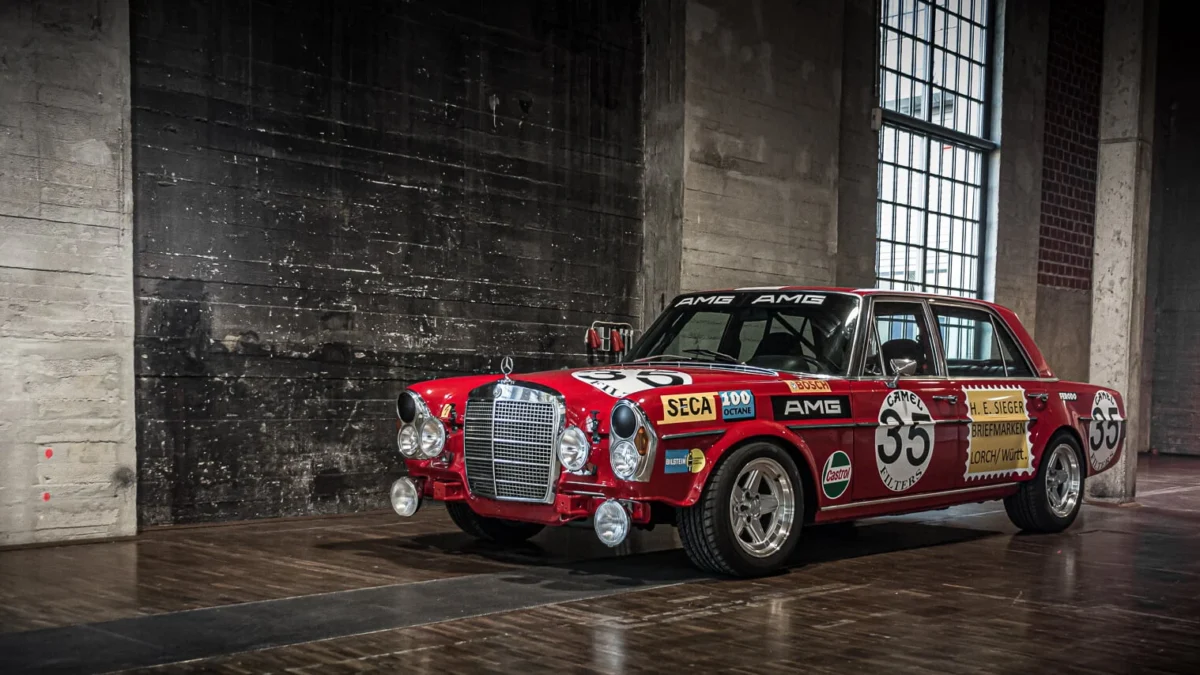
The 6.3-litre V8 engine was bored out to 6.8 litres, bringing power from 247 horsepower to over 420. The car was stripped and lightened as aggressively as its structure would allow. Wider arches were fitted to accommodate racing tyres. The suspension was stiffened. The interior was gutted.
Even with all of that work, the car was still almost certainly the heaviest machine on the grid at the 1971 24 Hours of Spa-Francorchamps. The field included purpose-built racing machines from manufacturers who had spent their entire development budgets on aerodynamics and weight reduction. AMG had a modified taxi.
The car became known as the Red Pig — Rote Sau in German — partly for its colour and partly for its shape. A 300 SEL, however modified, still looks like what it is: a large, comfortable, fundamentally sensible motor car.
What Happened at Spa
The 1971 24 Hours of Spa was a touring car race. The Red Pig was entered in the appropriate class, but the result went well beyond a class win.
Driven by Hans Heyer and Clemens Schickentanz, the 300 SEL 6.8 finished first in class and second overall. It beat cars that had been designed from the ground up to race. It covered the full 24 hours at a circuit that, in 1971, was one of the most demanding and dangerous in Europe — fast, exposed, punishing on machinery.
The result was immediate and significant. The automotive press, which had largely ignored AMG until that point, now had a story it could not ignore. A luxury saloon had finished second overall at Spa. The people behind it were two engineers working out of a converted mill. Mercedes customers, reading about the result, began to wonder what AMG could do to their cars.
That wondering built the business. It is worth noting that the Red Pig sits comfortably alongside the era’s other underdog factory-racing stories — the late 60s and early 70s being a particularly fertile period for cars that had no business winning anything, and yet kept showing up at the front of the grid. The Red Pig is also part of a tradition of German engineers doing things on a racetrack that nobody thought made sense — a tradition Audi would extend a decade later when it took an all-wheel drive system from a military vehicle and used it to dismantle rallying as a sport.
The Aftermath
In the years following Spa, AMG expanded from racing engine development into full vehicle preparation. Customers would bring their Mercedes road cars to Burgstall and have them transformed — engine modifications, suspension work, body kits, bespoke interiors. The modifications cost more than the cars themselves in some cases. AMG earned a reputation, as one history of the company puts it, for doing the impossible: if you wanted it and could pay for it, they would build it.
The formal relationship with Daimler-Benz came later — a cooperation agreement in 1990, a majority acquisition in 1999, full ownership in 2005. But the identity of AMG, the part that makes it distinct from any other manufacturer’s performance division, was established at Spa in 1971.
It was established by a car that weighed almost two tonnes, looked like a government vehicle, and had no reason to be competitive against machines designed for exactly the purpose it was being used for.
The Red Pig did not win. But finishing second when you should not have finished at all is, in many ways, the better story.
What This Tells Us About AMG
The Red Pig is more than a colourful piece of motorsport history. It is a direct expression of AMG’s founding philosophy: that the constraint of starting with a road car is not a disadvantage, but a challenge to be engineered around.
Every subsequent AMG road car — from the Hammer to the C63 to the GT Black Series — is a variation on the same idea. Take something that is already excellent. Make it faster than it has any right to be. Prove that excellence and performance are not in opposition.
The Red Pig proved it first, at Spa, in 1971, in front of everyone who had assumed that a four-door luxury saloon had no business being on the same circuit as a race car.
It had quite a bit of business there, as it turned out.