Every car show in North America, Europe, and Southeast Asia has at least one of them: a Honda Civic with a bold two-tone racing livery, window netting, stripped interior, and a sticker that reads something in Japanese. The owner may or may not know exactly what they are referencing. The cars are clean, considered, expensive to build, and thoroughly documented on Instagram. They look excellent. They bear approximately the same relationship to the thing they are inspired by as a theatrical production of a bank robbery bears to an actual bank robbery.
The thing they are inspired by is kanjo racing, and it is still happening — on the same stretch of elevated Osaka expressway where it started, run by some of the same people who started it. This is what it actually is, where it came from, and why almost everything the wider car world believes about it is slightly wrong.
What Is Kanjo Racing?
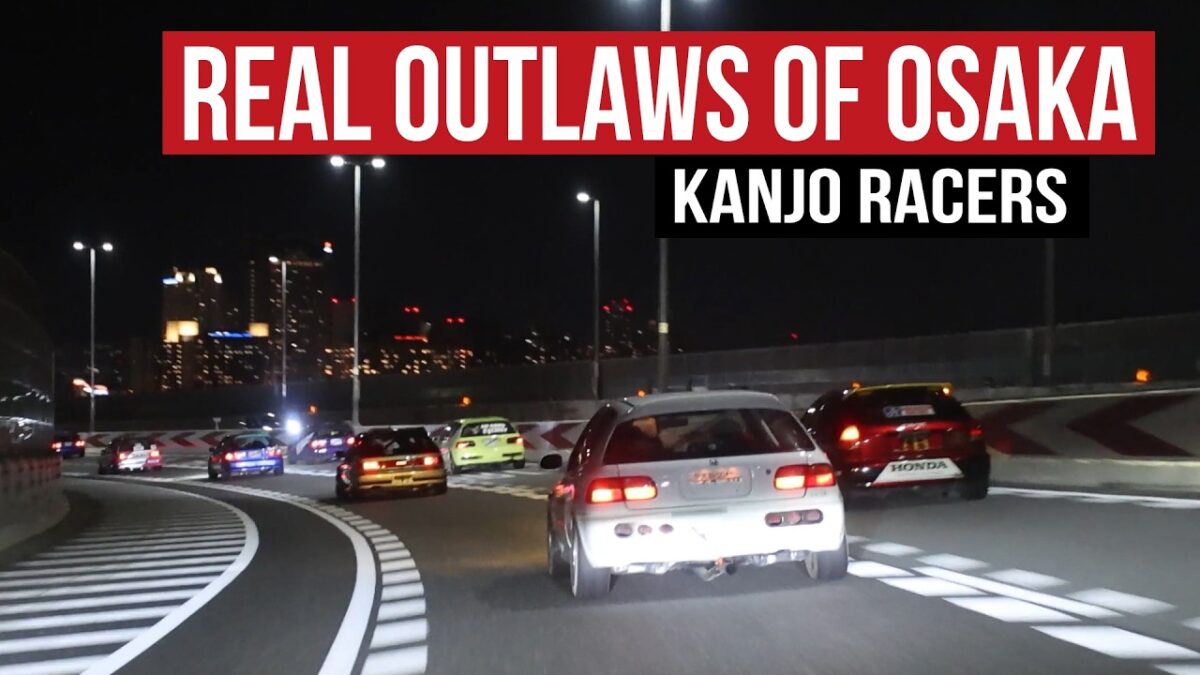
Kanjo means loop. Kanjo racing means loop racing. The route is the Loop Line of the Hanshin Expressway — a 4.77-mile circuit of elevated highway that encircles central Osaka, travelling clockwise through four wards, threading between office towers in a city of 2.7 million people. It is shorter and narrower than the Wangan line in Tokyo, full of tight corners, blind crests and abrupt transitions, and because it is a loop, it can be lapped. Repeatedly. At night. At speed.
That geometry is the entire culture. The cars are not the point. The route is the point. The cars just have to be capable enough to run the loop quickly and cheap enough that losing one — to a crash, a blown engine, or a police impound — is not catastrophic. Everything else that the world associates with kanjo style flows from that single piece of logic.
You will also see the racers called kanjozoku — “loop tribe” — a media label borrowed from the naming convention of Japan’s bosozoku biker gangs. The racers themselves reportedly never use it. They run the loop; the branding was applied from outside.
Why Honda Civics?
The preferred kanjo weapon has always been the Honda Civic — the EF, EG, and EK generations from the late 1980s and 1990s. Lightweight, front-wheel drive, VTEC-equipped, and at the time available for essentially nothing. If you crashed it or blew up the motor, you got another one. A momentum car for a momentum circuit: the loop’s tight geometry rewards a light front-driver that carries speed through corners over anything with big power that has to slow down for them.
Geography did the rest. Suzuka Circuit sits an hour or so east of Osaka, and its one-make Honda races — grids of near-identical racing Civics — were the local motorsport. The kanjo cars are, visually and mechanically, street versions of those one-make racers: gutted interiors, bucket seats, window nets, tow hooks, screaming B-series engines. The look the world now copies was originally just what a racing Civic looked like, an hour down the road.
The Liveries Aren’t Fashion. They’re Camouflage.
Here is the detail that the car-show tribute builds never communicate. The bold liveries were inspired by the Suzuka one-make racers, yes — but they were also changed regularly to make the cars unrecognisable to police. Some crews would come out the following night in an almost entirely different scheme. The original kanjo cars were stripped because weight was the enemy, not because minimalism was fashionable. The liveries changed because the police were looking for them, not because the designs were art.
The cars at those car shows, with their careful liveries and pristine interiors, are interpretations of something that was fundamentally about cheapness, availability, and function. Which does not make them bad cars. It makes them theatre — and the original production is still running nightly.
Who Are No Good Racing?
No Good Racing are the most famous kanjo crew in existence and the closest thing the culture has to an institution: founded in 1985, active for forty consecutive years, slogan “Bye Bye Police,” and about as interested in Instagram as they are in having their faces in any documentation whatsoever.
Which is what made photographer Larry Chen’s recent night with them in Osaka so unusual. Chen was introduced through Yasu of Exceed Japan, a well-known Honda tuner with enough trust built up in that world to make an introduction possible. The conditions for filming were specific: no faces, voice changes where necessary, and an understanding that Chen was an observer, not a participant. None of the cars run plates. Most are not registered. Several have moved plates at best. The team leader arrived in a Rolls-Royce Cullinan. This is not an irony lost on anyone.
What Chen’s footage clarifies is the gap between the mythology and the practice. What he found was not the romanticised version that car culture has been constructing for thirty years. It was a group of people who know a particular section of elevated highway better than they know most other things in their lives, driving stripped Honda Civics as fast as they can around it, in the middle of the night, in a city, while occasionally being chased by police in Toyota Crown undercover cars that do not get close.
The most telling detail: the current-generation FL5 Civic Type R that Yasu brought along — with significantly more horsepower than any of the kanjo cars — struggled to match their pace. Not because the old Civics are faster in a straight line. Because their drivers know every millimetre of that loop and use it accordingly. The police showed up during Chen’s night out; one crew member got chased and circled back a few minutes later, having apparently lost them. Chen’s group parked on the highway until an officer left. Yasu told the officer he had lost his way. The officer appeared to believe this or chose to believe it, which in Japan is sometimes the same thing.
Kanjo vs Wangan vs Touge: The Taxonomy
Japanese street racing culture is routinely flattened into one thing by the outside world, but it has always been three distinct disciplines, defined — like everything in this story — by the road rather than the car.
Wangan is Tokyo’s Bayshore Route: long, wide, fast, and about top speed. Its icons are big-power machines — Skylines, Supras, turbocharged Porsches — because the road rewards horsepower held flat-out. Touge is the mountain pass: narrow, technical, downhill and up, the home of drift culture and lightweight rear-drive cars. Kanjo is the urban loop: short, tight, repeatable, and about intimate route knowledge in a cheap, light front-driver. Three roads, three cultures, three completely different ideal cars. The Civic would be hopeless on the Wangan. A 600-horsepower Wangan machine would be furniture on the loop.
Is Kanjo Racing Still Going — and Is It Legal?
It is still going, and no, it is not remotely legal. It never was. The cars are unregistered, the speeds are indefensible, and the police interest is real, if apparently not very effective. The scene is also older, smaller and more careful than it was at its 1990s peak — the crews that survive are the ones who treat secrecy as a discipline, which is precisely why No Good Racing reaching a fortieth anniversary is remarkable. This is a culture that has outlasted most of the legal racing series that inspired it, run by people who will be out on the loop tonight, same as always, whether anyone is watching or not.
That longevity, and not the liveries, is the thing genuinely worth admiring — from a distance, in the way one admires a documented subculture rather than joins one.
Why the Whole World Copies Kanjo Style
The connection between kanjo culture and the wider JDM car scene is real but frequently misunderstood. The Honda Civic’s cultural importance in the JDM world starts here, on this loop, with these people, who were racing on it forty years ago for reasons that had nothing to do with being photographed. From there it spread the way Japanese car culture always spreads — through games, films and museum retrospectives that render the culture for people who will never see the real thing, and through institutions now canonising the JDM era that kanjo helped define. The tribute builds at every car show on Earth are the visible end of that pipeline.
Chen ended his night wondering what these same people could do if they put their skills on an actual circuit. This is a reasonable question and probably the wrong one. The circuit is not the point. The loop is the point. The loop has always been the point. And the forty-year-old team that runs it every night will be out there tonight, same as always, while someone somewhere is finishing a very clean build inspired by cars that would have been replaced the following week if they got bent.
The stickers are available at the 40th anniversary merchandise table, if you know how to find it.