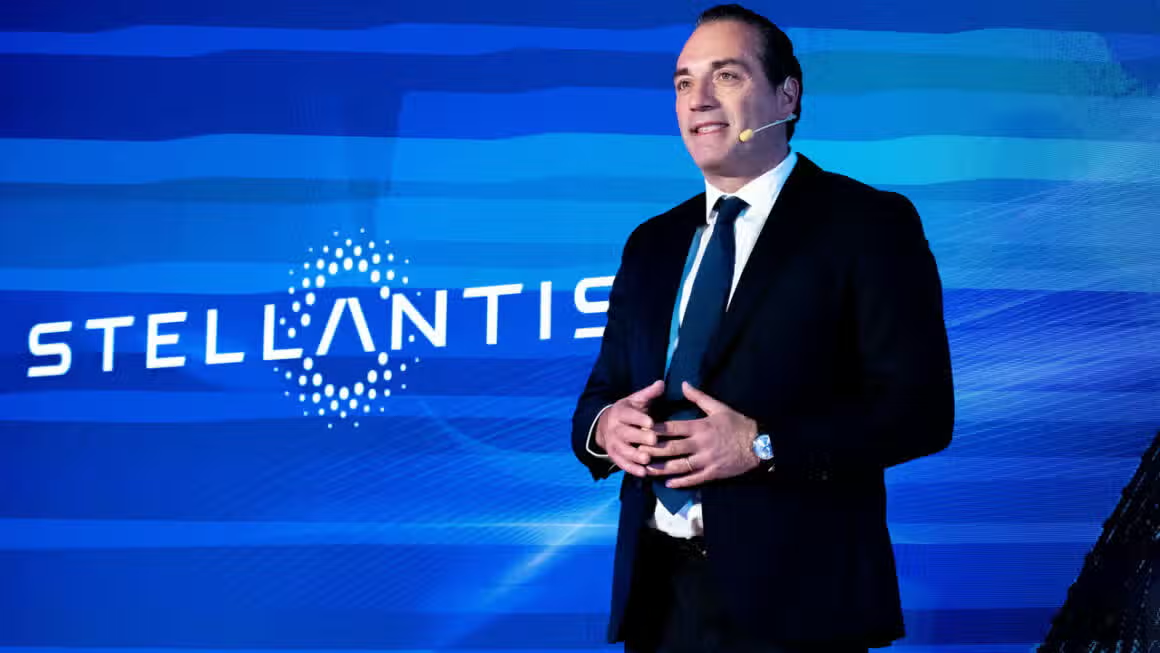
There is a specific kind of corporate Investor Day where the CEO arrives with a slide deck so ambitious that the share price drops six percent before lunch. Stellantis held one yesterday.
Antonio Filosa stood in Auburn Hills, Michigan, and unveiled FaSTLAne 2030 — a €60 billion ($69.6 billion) five-year strategic plan covering more than 60 new vehicle launches and 50 significant refreshes. Within that: 29 new battery-electric vehicles, 15 plug-in or range-extended hybrids, 24 hybrids, and 39 internal combustion or mild-hybrid models. There will be a sub-€15,000 fully electric car built at Pomigliano d’Arco by 2028. There will be seven new North American vehicles priced under $40,000, with two of those under $30,000. There will be a small Ram Dakota pickup, a three-row Ramcharger SUV, three new Chryslers (yes, three — the brand currently sells one minivan), and a Dodge Copperhead SRT performance car. There will, also, be Maserati, which the company promises to detail properly in December.
It is, in short, the most extensive product plan any major automaker has put forward in 2026. Whether all of it actually arrives is a separate question, which the markets are currently asking with appropriate scepticism.
The plan’s logic is built around two admissions. The first is that Stellantis got the EV shift badly wrong. The company booked a $26 billion net loss in 2025, much of it tied to EV-related write-downs and a strategy that assumed European and American consumers would adopt electric cars at a pace they declined to. The second is that the previous CEO’s portfolio approach — 14 brands competing for capital, each diluting the others — has been quietly buried. Four global brands now get 70% of investment: Jeep, Ram, Peugeot, and Fiat. Chrysler, Dodge, Citroën, Opel, and Alfa Romeo are now “regional” players. DS and Lancia have been demoted to “specialty” sub-brands of Citroën and Fiat respectively. This is the kind of organisational tidying that should have happened in 2021, but apparently required a $26 billion loss to make happen.
The affordability piece is where this gets genuinely interesting for the EV market. A sub-€15,000 European electric car, built in Italy, on a new STLA Small platform — that is a direct response to Chinese pricing pressure, and an implicit acknowledgement that European EV competitiveness now requires hitting price points that would have been considered impossible 18 months ago. The two Chrysler crossovers — the Arrow and Arrow Cross — are aimed at the same instinct on the American side: under $30,000, mainstream segments, the kind of car a normal person might actually finance without first selling a kidney. Stellantis is explicitly positioning these against the affordability gap that has hollowed out the American new-car market, where the average new vehicle now costs over $48,000.
The combustion side of the plan is also revealing. Thirty-nine ICE or mild-hybrid models is not a company hedging — it is a company that has looked at the data and concluded that the EV transition is going to take longer than its predecessors assumed. Stellantis’s Q1 Hemi V8 resurgence — which rescued the company’s most recent quarter and lifted the share price into the announcement — is the proof of concept here. The Hemi was supposed to be dead in 2024. It is now selling 40% of Ram 1500s and being expanded back into the Wrangler, Grand Cherokee, and eventually the Charger. The FaSTLAne plan formalises what that quarter already implied: combustion is staying, hybrids are scaling, and EVs are arriving in proportion to actual demand rather than aspirational decks.
The macro context makes the plan look more coherent than it might in isolation. The IEA’s 2026 EV outlook puts global EV share at one in three new cars sold, but the regional variation is enormous — China at over 50%, Europe surging on the back of the Iran-driven oil shock, and America in retreat after the federal tax credit expired. A 29-BEV product plan that quietly includes 39 combustion models is a portfolio designed for that uneven world rather than the all-electric one that 2022’s PowerPoint slides promised.
There are reasons to be sceptical. Stellantis has form for ambitious plans that quietly contract. The 800,000-unit European capacity cut buried in the announcement is the part nobody is celebrating — those are jobs and plants that will not survive the next five years. The Maserati “two new E-segment vehicles, details in December” is a delay dressed as a commitment. And the stock’s 6% drop on the day suggests analysts are not yet convinced that 60 new vehicles, three new platforms, a new software stack, and a complete brand reorganisation can all be delivered on schedule by a company that just posted its worst annual result in living memory.
But the direction is right. Affordability is being taken seriously. The portfolio is being focused rather than expanded. The combustion business is being defended rather than abandoned. And the EV plan is calibrated to the market that exists rather than the one the previous CEO hoped for. Whether Filosa can execute is the question every employee, dealer, and shareholder will be living with for the next five years.
The €15,000 EV from Pomigliano arrives in 2028. Whether anyone is still around to drive it depends on what happens between now and then.