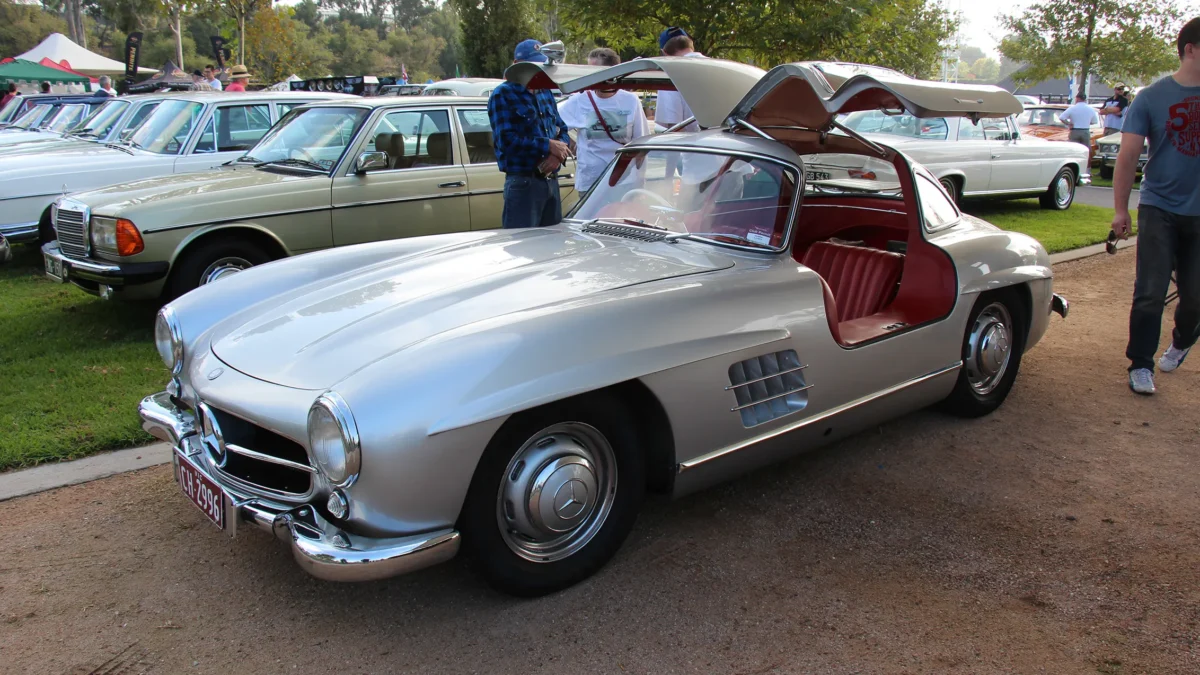
The Mercedes-Benz 300SL is routinely named among the most beautiful cars ever made. Its profile — low, swooping, with those extraordinary upward-opening doors — has influenced automotive design for seven decades. The gullwing doors in particular have become a cultural shorthand for a specific kind of automotive drama. Other manufacturers have chased the same effect. None have quite matched the original.
The doors were not designed. They were engineered. The distinction matters.
The Racing Car That Became a Road Car
The 300SL’s origins are on the racetrack. In 1952, Mercedes-Benz returned to international motorsport with the W194 — a purpose-built racing coupe that won at the 24 Hours of Le Mans and the Carrera Panamericana. The W194 was fast, lightweight, and technically exceptional. It was also never intended for road use.
What changed was a phone call. Max Hoffman, Mercedes-Benz’s American importer and one of the most commercially astute figures in postwar automotive history, convinced Daimler-Benz that the American market would buy a road-going version of the W194. He believed there was a customer who wanted to own a piece of what they had seen winning at Le Mans — and that this customer would pay accordingly.
Mercedes agreed to build it. Chief engineer Rudolf Uhlenhaut was given the task of turning a racing car into something a customer could drive on public roads without requiring a race licence or a co-driver.
The problem was the chassis.
The Spaceframe Problem
The W194 used a tubular spaceframe chassis — a structure made of chrome-molybdenum steel tubes welded together in geometric patterns. The finished frame weighed around 50 kilograms and provided exceptional rigidity for its mass. It was one of the engineering achievements of the car, the reason it could be both light and structurally robust.
It was also, from a door-design perspective, a nightmare.
The spaceframe’s tubes ran the full width of the car at sill height. The side members were necessarily high and deep — deep enough to provide the structural rigidity the car required, high enough to make conventional door openings impossible. The sill, in a normal car, is the threshold you step over when getting in. In the 300SL, the sill was level with the driver’s elbow.
A conventional hinged door — one that swings outward — requires a sill low enough to step over comfortably and a door opening tall enough to accommodate a seated person entering from the side. The 300SL’s spaceframe provided neither.
Uhlenhaut’s team had limited options. They could redesign the chassis, losing the structural advantages of the spaceframe. They could abandon the project. Or they could find a way to open the doors that did not require conventional geometry.
The Solution
The answer was almost absurdly simple in retrospect: hinge the doors at the roof and open them upward. If you cannot step over the sill in the conventional way, you sit on it, swing your legs in, and lower yourself into the seat. The door, opening upward, clears the sill entirely.
Racing regulations at the time required functioning doors — cars had to have proper access points for driver changes and safety purposes. The regulations did not specify how the doors opened.
Uhlenhaut’s engineers pointed them at the sky.
The first time the doors opened, they looked like a bird spreading its wings. A journalist coined the nickname. Mercedes-Benz itself has never officially used the term — the company refers to them as upward-opening doors — but the name gullwing has defined the car ever since.
A Design Accident With Engineering Precision
The 300SL launched at the New York International Automobile Show in February 1954 — notably the first Mercedes-Benz to debut outside Europe, a choice driven by Hoffman’s belief in the American market. It was received as a sensation.
The doors were the focal point. What nobody in that showroom knew — what very few people outside the engineering team fully understood — was that the doors were not a stylistic choice. They were the least-bad solution to a structural problem that had no obviously elegant answer.
This is worth sitting with. The feature that defined the car’s visual identity, that made it instantly recognisable, that other manufacturers have spent decades trying to recreate for effect — was the product of an engineer being boxed in by his own chassis design and finding the only exit available.
The car also introduced direct fuel injection to production vehicles for the first time — another engineering innovation driven by the desire to extract maximum performance from the 3.0-litre straight-six. The 300SL was the fastest production car of its era, capable of 260 km/h. But it is the doors that people remember.
The Practical Consequences
The gullwing design, for all its beauty, created real inconveniences that Mercedes engineers acknowledged but could not fully resolve.
The windows could not be wound down in the conventional sense. They had to be removed entirely when stationary — the opening aperture was too small for a roll-down mechanism. In warm weather, ventilation in the cabin was limited. Getting in and out required a specific technique that became part of 300SL ownership lore: sit on the wide sill, swing both legs in together, lower yourself onto the seat.
When Mercedes introduced the 300SL Roadster in 1957 — an open-top variant designed partly to address the ventilation complaints of American customers — the conversion required a complete chassis redesign. Without the roof structure, the spaceframe had to be reinforced differently to maintain rigidity. The roadster was heavier and slightly less pure than the coupe, though arguably more practical.
The roadster had conventional doors. They were less famous in every way.
Legacy
Only 1,400 300SL Gullwing coupes were built between 1954 and 1957. Pristine examples now sell for upwards of €1 million at auction. The design has been acknowledged as a direct ancestor of the Mercedes-AMG SLS AMG — a modern homage that, unlike the original, was given gullwing doors deliberately, for effect.
The difference between the two cars is instructive. The SLS’s doors open upward because someone in a design studio decided they should. The 300SL’s doors open upward because Rudolf Uhlenhaut had no viable alternative.
One is a tribute. The other is an accident that became a masterpiece.