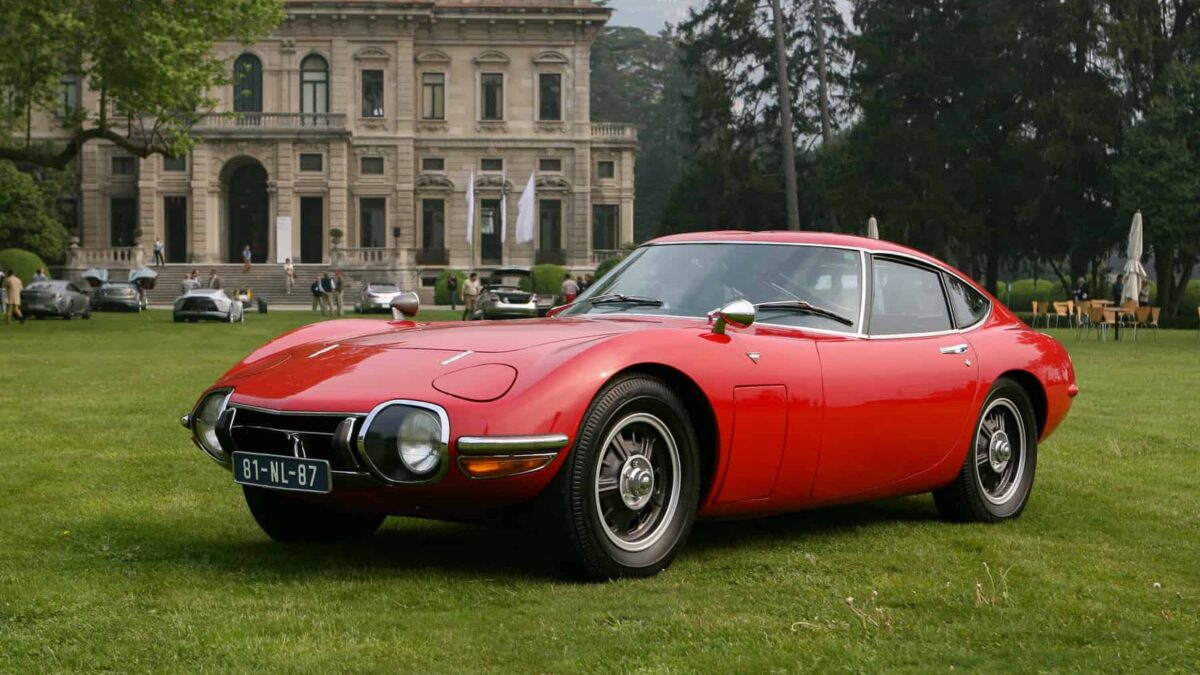
The Toyota 2000GT is the car that proved Japan could build a world-class sports car. Launched in 1967, it was elegant, fast, and technically accomplished — a match for the best of what Europe was producing at the time. Only 351 examples were built, making it among the rarest and most collectible Japanese cars in existence. A pristine example sells for well over two million dollars today.
Almost every element of its origin story is more complicated than the nameplate suggests.
Where It Actually Started
In October 1962, Yamaha Motor Company and Nissan began a joint development project. Yamaha’s president, Genichi Kawakami, wanted to prove that his company — better known for motorcycles and musical instruments — could build a sophisticated sports car chassis. Nissan would provide the powertrain and the commercial platform.
Yamaha developed a prototype designated the A550X. It was a lightweight sports coupe with double wishbone suspension all around, a design that was aerodynamically considered and mechanically thoughtful. The collaboration produced a finished vehicle that, by the account of those who worked on it, showed genuine promise.
Then Nissan walked away. The reasons have never been fully clarified, but Nissan’s priorities shifted and the A550X was left without a manufacturer partner. The car existed, fully documented, with no home.
Yamaha went looking for another partner.
Toyota’s Involvement
In May 1964, Toyota launched an internal project designated 280A, exploring the idea of a flagship sports car. Meanwhile, Yamaha’s president had heard about Toyota’s interest and moved quickly. By September 1964, Kawakami had presented the A550X to Toyota’s management.
The meeting was, by the accounts of Toyota engineers who attended it, initially underwhelming. The engine was not in the car. It could not be driven. The documentation was comprehensive, but documentation is not a running vehicle. Toyota’s team left without commitments.
Yamaha followed up. A contract for joint development was signed in December 1964. What followed was not Toyota acquiring Yamaha’s work but a genuine collaboration: Yamaha retained significant engineering responsibility, while Toyota provided the broader platform, manufacturing capability, and — crucially — the powertrain.
The A550X’s original engine was rejected. In its place, Toyota’s M-series inline-six — the same unit used in the conventional Toyota Crown saloon — was selected as the base. Yamaha’s engineers were then tasked with transforming a family car engine into something worthy of a sports car. They added a twin-cam head, triple carburettors, and extracted 150 horsepower from 2.0 litres. The result shared a basic architecture with a Crown engine and had almost nothing else in common with it.
The Body Without a Wind Tunnel
The 2000GT’s styling was finalised by late 1964, overseen by designer Satoru Nozaki — a detail rarely mentioned, since Japanese manufacturers of the era tended not to personalise design credits. The car drew obvious visual inspiration from the Jaguar E-Type, which was then widely considered the most beautiful car in the world.
What Nozaki and the team did not have was a wind tunnel. Aerodynamic testing for road cars was not yet standard practice in Japan, and the budget and timeline did not accommodate it. The body was shaped by intuition, by eye, and by the considered judgement of engineers who understood aerodynamic principles even if they could not test them directly.
Decades later, when the 2000GT was finally subjected to aerodynamic analysis, it produced a drag coefficient of 0.28 — a figure that is impressive by modern standards and was extraordinary for 1967. The Lamborghini Miura, launched the previous year and considered the defining supercar of its era, is commonly cited around 0.37. Toyota’s intuition-built body was measurably more aerodynamically efficient than Italy’s most glamorous rival.
The Details
The production 2000GT was a meticulous machine. The dashboard was finished in rosewood crafted by Yamaha’s piano division — the same hands that built musical instruments shaping the fascia of a sports car, which may be the most complete expression of what this partnership was. The interior featured a wooden steering wheel, a full set of Smiths instruments, and a level of fit and finish that Japanese manufacturers had not previously attempted in a sports car. The retractable headlights were elegant. The pop-up mechanism for the hardtop was ingeniously engineered.
Some of the detail touches were less glamorous in origin. The round rear light clusters, for instance, were production units lifted directly from Toyota buses. The solution was pragmatic; nobody looking at the car from the outside would have known.
Of the 351 cars built, two were specially modified with open-top bodies for the James Bond film You Only Live Twice in 1967 — the standard roof being too low for Sean Connery to fit inside comfortably. Those two roadster conversions are among the most sought-after variants of an already rare car.
Why It Matters
The 2000GT established the template for Toyota’s relationship with Yamaha that persisted for decades — Yamaha would go on to develop engines for the Lexus LFA, among other projects. It also established something larger about how Toyota builds sports cars at all: when the company needs what it doesn’t have, it partners for it. It is the same partnership pattern that produced the modern Supra — and the enthusiasts outraged that a Supra could share its hardware with BMW might note that Toyota’s very first world-class sports car was a Yamaha-engineered rescue of an abandoned Nissan project, with a Crown engine and bus tail lights. The 2000GT also established, in the most direct possible terms, that Japanese engineering was capable of matching European sports car manufacturers on their own ground.
But the car’s origin story complicates any simple reading of it as a Toyota achievement. It began as a Yamaha-Nissan project. It was developed in collaboration with Yamaha. Its engine was a transformed Crown unit. Its body was designed by a man who trusted his instincts more than instruments.
The 2000GT is, in other words, a car built by people who were working around constraints and making it up as they went, guided by talent and judgement rather than process and budget. The result was perfect. The process was improvised.
That is, arguably, the most Japanese story in the history of Japanese sports cars.