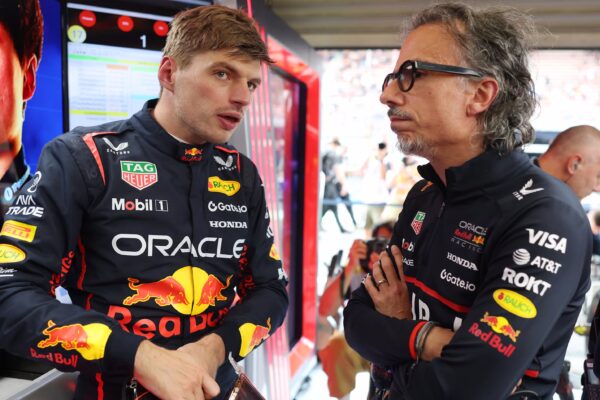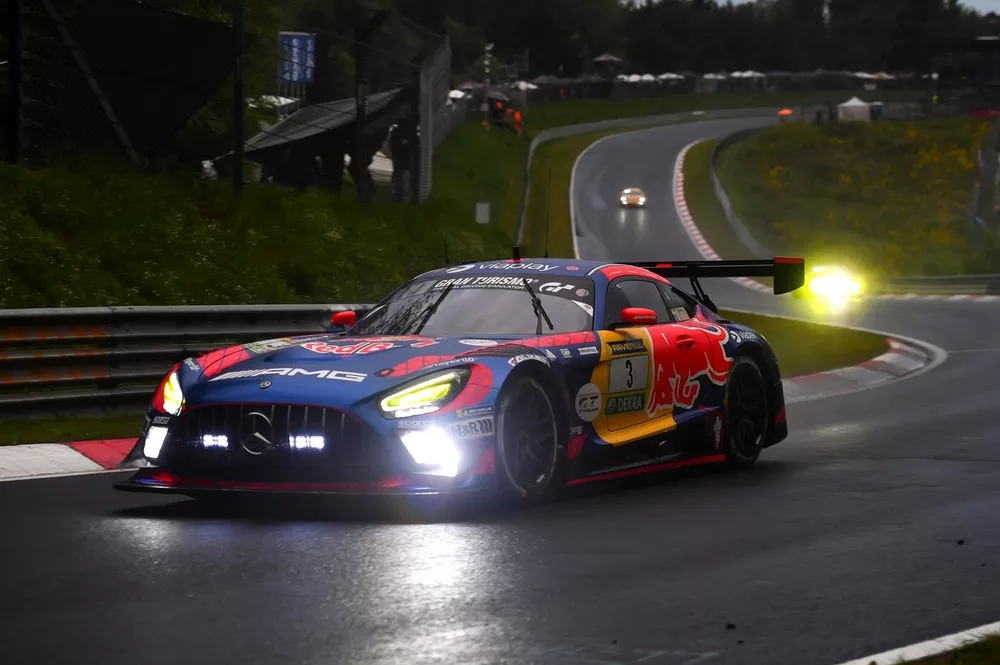
With three and a half hours left at the Nürburgring on Sunday afternoon, Dani Juncadella was two laps into his stint when the driveshaft in the #3 Verstappen Racing Mercedes-AMG GT3 gave up. The car had been leading the race for the better part of 20 hours. Max Verstappen, who had personally hauled it from tenth on the opening stint into first place during a mixed-conditions masterclass that left even his fellow GT drivers fumbling for superlatives, was no longer going to win his first ever Nürburgring 24. “The word heartbroken probably doesn’t even come close to what we feel right now,” he said afterwards. Then he announced he’d be back next year.
Did Max Verstappen win the Nürburgring 24 Hours?
No — and he lost it in the cruellest way available. The race went, eventually, to the sister #80 Mercedes-AMG of Maro Engel, Maxime Martin, Fabian Schiller and Luca Stolz. Mercedes’ first overall Nürburgring 24 win since 2016. A Lamborghini was second. An Aston Martin was third. There is a neat, painful symmetry in the winner: Schiller’s #80 was the same car that had pipped Verstappen in Thursday qualifying, beating his 8m18.539s by 3.6 seconds to take the session ahead of Raffaele Marciello’s ROWE Racing BMW. The car that out-qualified him finished the job from the same garage.
None of which is the story. The story is the 352,000 people who turned up to watch.
That’s a record crowd for the 56-year-old event. Tickets had sold out for the first time in its history before the green flag fell. The Eifel region of Germany, briefly, became the centre of motorsport. None of this was happening for Maro Engel, brilliant as he is. It was happening for a 28-year-old four-time F1 world champion who had decided, in the middle of his own miserable Formula 1 season, that the best way to spend a weekend was to drive a 25.378-kilometre circuit 154 corners at a time, for fun. His entry was the most-anticipated non-F1 race of the year. The actual race lived up to the billing.
How Verstappen’s race unfolded
The context makes the performance more remarkable, not less. Verstappen arrived with, by his own admission, about ten in-anger laps in this car on this circuit. His lineup — Juncadella, Jules Gounon and Lucas Auer — included a former DTM champion, a Bathurst winner and a two-time Nürburgring 24 winner, and he qualified third among them all on Thursday looking entirely at home.
Here are the relevant figures. 161 cars entered, the largest field since 2014. The race opened in light rain, and Verstappen — starting his first stint in the wet on the Nordschleife, having taken over from Juncadella in tenth place — carved his way to the lead with what Naomi Schiff politely called “a degree of commitment GT drivers don’t usually employ.” He survived two near-disasters, including a 270km/h side-by-side with Engel in the #80 that briefly looked likely to end both their afternoons. By the time he handed over to Gounon, the #3 had a 30-second lead and was managing the race rather than racing it.
Then the driveshaft. With four hours left. In a race where 48 of the starters didn’t make the classification anyway. The variance was always going to find someone.
Why was the F1 world champion racing at the Nürburgring at all?
Because, on the available evidence, he’d rather be there. Verstappen went into the weekend winless in 2026. Kimi Antonelli had taken three of the season’s first four rounds, Mercedes led both championships, and Ferrari’s eleven-part Miami upgrade package had looked — in former Ferrari race engineer Rob Smedley’s word — “soul-destroying.” The Red Bull–Ford partnership is in its first season together, the Ford-branded power unit is not winning races, and Verstappen spent the spring complaining about the new F1 hybrid regulations with such consistent vehemence that he warned he might walk away from the sport entirely. For this weekend in mid-May, he was away from the sport entirely. Apparently because he wanted to be.
The 2026 F1 regulations have produced cars that the drivers, by and large, do not enjoy driving. The 50:50 hybrid split forces them into long stretches of “super clipping” — lifting off in order to harvest energy — that turns the cars into expensive moving battery management exercises. Oliver Bearman’s 50G crash at Suzuka was the most visible symptom, and the FIA has spent the spring rewriting the rulebook in response: the mid-season 2026 rule scramble, followed by confirmation that the 50:50 ICE/ERS split will be scrapped for 2027 in favour of a 60:40 weighting. Translation: the FIA has admitted, on the record, that the cars need to be more about engines and less about batteries.
The Nordschleife is the opposite of all of this. What does Verstappen get out of it that he doesn’t get from F1? Several things. He gets to actually overtake. He gets a 6.2-litre Mercedes-AMG V8 rather than a deployment map. He gets weather, traffic, night driving, and 154 corners of the most technically demanding circuit ever built. He gets to lose a race because of a driveshaft rather than because of an MGU-K deployment table. And he gets, by the look of his face when he was being interviewed in the early hours of Sunday morning, the kind of grin that has been absent from his F1 weekends since round one in Australia.
The grin matters: with his Red Bull exit clause now five weeks from activation at the Austrian Grand Prix, every minute he spends visibly enjoying a Mercedes-AMG GT3 on the Nordschleife is a minute Red Bull’s senior management spends checking their phones. Side projects are one thing. Side projects when your driver’s contract has a five-week window to walk are something else entirely.
The rest of the grid wants in
For F1, the awkward part isn’t that Verstappen didn’t win. It’s that its other stars spent the weekend sounding envious. Lando Norris — who called his Nordschleife tyre test in a McLaren 750S “the most fun I’ve had all year” — spent yesterday telling McLaren’s own YouTube channel that he wants to do Le Mans. “You know, I still feel like I want to go and try other things,” the reigning F1 world champion said. “Do Le Mans, now McLaren are doing Le Mans, so maybe go and do that at some point.” McLaren are indeed doing Le Mans. The MCL-HY hypercar is currently in its 2026 test programme with Mikkel Jensen, Gregoire Saucy, Richard Verschoor and Ben Hanley, with a 2027 WEC debut confirmed. Zak Brown told media last year he had spoken to both Norris and Oscar Piastri about Le Mans drives: “They would like to be at Le Mans in one of [our cars].”
File this alongside the FIA’s V8 announcement two weeks ago, Kimi Antonelli’s stated plan to take a Nordschleife A-permit — “I would love to do an endurance race with Max together,” said the man currently leading the championship — George Russell’s request to attempt the all-time Nordschleife lap record in an F1 car (denied by Toto Wolff), and Oliver Bearman’s confirmation he was watching. The pattern is not subtle. The drivers who actually have to drive the new F1 cars are, with increasing frequency, choosing to drive other things. The fans, by 352,000 of them at a single race, are watching what the drivers are watching.
Will Verstappen race the Nürburgring 24 Hours again?
He says yes. Mercedes has now reportedly banned him from doing it again — take that with whatever salt you like; he’ll likely race something on the Nordschleife next year regardless. And the bigger prize is already in open negotiation: Ford has formally confirmed it is in active talks with Verstappen about a Le Mans 24 Hours entry, potentially as soon as 2027. “Discussions go back three-plus years,” Ford global motorsport boss Mark Rushbrook said before the race. “Depending on the schedules, it could be during [Verstappen’s F1 career] or both [during and after his F1 stint].” Verstappen, contracted to Red Bull until the end of 2028, has long publicly wanted Le Mans — the original plan involved sharing a car with his father Jos and Fernando Alonso. The Ford partnership makes it considerably more likely to actually happen.
F1 is not in danger of being eclipsed by the WEC. The money is too lopsided, the global audience too large, the commercial machinery too entrenched. But it is now in the unusual position of having its biggest stars publicly enjoying their side projects more than their main one. The Canadian Grand Prix is in five days. It will draw a good crowd. It will not draw 352,000 people. The 24 Hours of Le Mans in June — scheduled the same weekend as the Spanish Grand Prix, just to make the comparison painful — gets to test which way the wind is blowing.
A sport whose biggest star is also a fan of his own sport’s biggest competitor is a sport with an interesting problem. Verstappen will be back at the Nürburgring next year. He said so himself. The question is whether F1 will give him a reason to be enthusiastic about Bahrain.