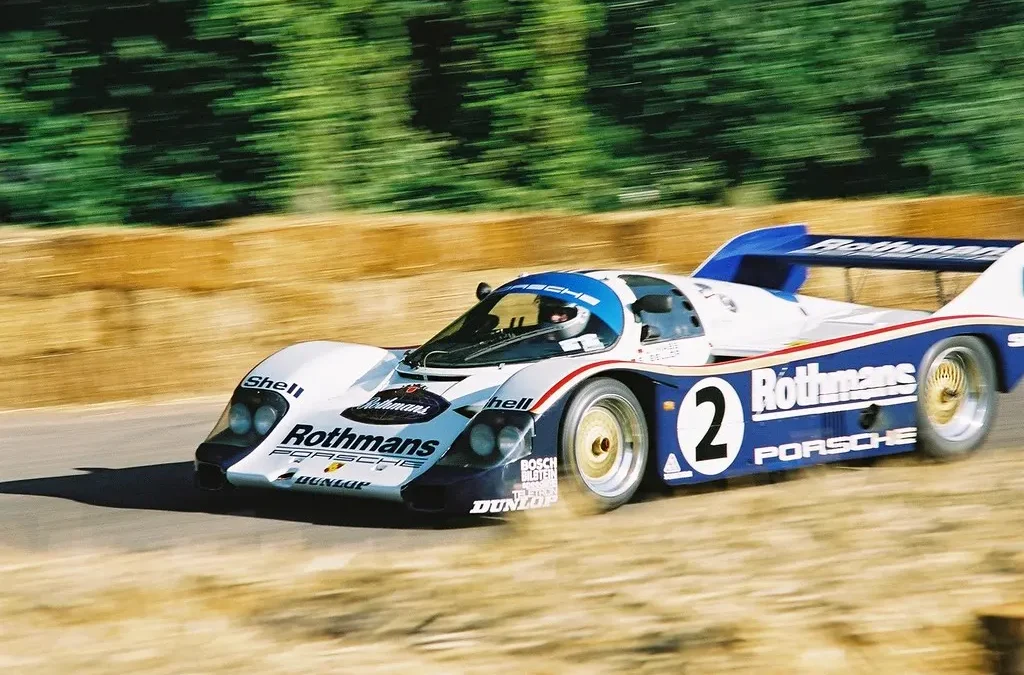
The Porsche 956 is one of the most successful racing cars ever built. It won Le Mans outright in 1982, 1983, 1984, and 1985. It dominated the World Endurance Championship. It was faster than anything the competition could produce for most of its competitive life.
It was also, in the precise engineering sense, unforgiving to a degree that cost lives. The same technology that made it so extraordinarily fast made it almost unrecoverable when it failed.
The 956 is one of the clearest examples in motorsport history of a car that was simultaneously a masterpiece and a problem.
The Engineering
The 956 was designed by Norbert Singer, Porsche’s head of motorsport engineering, as a response to the FIA’s Group C regulations introduced in 1982. Group C restricted fuel consumption rather than engine output — manufacturers could build as much power as they wanted, provided the car could complete the race within a fuel allocation. This framework rewarded efficiency alongside outright performance.
Singer’s response was to build a car that extracted maximum aerodynamic downforce from minimum drag. The 956 used an almost flat underbody with carefully designed venturi tunnels — curved channels that accelerated airflow beneath the car, creating a low-pressure zone. The result was ground effect: the car was effectively sucked toward the road surface, increasing grip without the penalty of aerodynamic drag that conventional wings created.
Colin Chapman had pioneered ground effect at Lotus in the late 1970s. Singer refined and extended the concept at Porsche in a car designed for 24-hour endurance racing, where the balance of performance, reliability, and fuel consumption mattered as much as outright speed.
The 956 produced more downforce than its weight at racing speeds. At full pace on a long straight, the car was generating enough aerodynamic load to theoretically drive upside-down on the ceiling.
The Problem
Ground effect, as both Chapman and Singer understood, is an unstable phenomenon. The downforce it generates is proportional to speed: faster means more grip. Slower, or any disruption to the airflow beneath the car, means a sudden and non-linear loss of downforce.
In a car with conventional aerodynamic downforce — generated by wings and bodywork above the car — a loss of grip is gradual and recoverable. The driver can feel it coming and make corrections. In a ground effect car, the loss can be almost instantaneous. One moment the car is glued to the road. The next, it is not. The transition between the two states can happen in fractions of a second.
At the speeds the 956 was capable of — over 350 km/h on the Mulsanne Straight at Le Mans — a sudden loss of downforce was, in practical terms, unrecoverable. Drivers reported that incidents in ground effect cars felt qualitatively different from conventional accidents: there was no warning, no period of increasing instability, no opportunity for correction. The car simply departed.
Several serious accidents in 956s and its successor, the 962, were attributed to exactly this characteristic. The cars were not badly built. The aerodynamic philosophy was the issue.
The Le Mans Straight and What Changed
The Mulsanne Straight at Le Mans, in the early 1980s, was a 6-kilometre stretch of public road on which racing cars reached speeds that today seem almost incomprehensible for a venue shared, for the other 51 weeks of the year, with French traffic. The 956 was among the fastest cars ever to travel that straight.
In 1988, the Mercedes-Benz CLR — a later successor to the ground effect concept — flew at Le Mans after a loss of front downforce, confirming what critics had been arguing for years: that ground effect cars at extreme speed were fundamentally difficult to manage when aerodynamic balance broke down.
The governing bodies progressively restricted and then effectively eliminated full ground effect aerodynamics in prototype racing through a series of regulation changes across the late 1980s and 1990s. Flat floors replaced venturi tunnels. The era of the 956 and its descendants ended not because the cars were too slow, but because the safety implications of their performance were ultimately considered unacceptable.
The Legacy
The 956 won Le Mans four consecutive times. It also won in the hands of customer teams after the factory retired it, the design proving robust enough for private operators to campaign competitively for years. The car defined the Group C era and established Porsche as the dominant force in endurance racing for much of the 1980s.
Norbert Singer’s engineering on the 956 directly informed the 962, the car that replaced it, and through both vehicles influenced how Porsche approached aerodynamic development for decades afterward. The 956 is studied in engineering programmes as an example of how optimising for a single performance variable — downforce — can create emergent risks that the original design brief did not account for.
It won four times at Le Mans. It was eventually sidelined not by a faster competitor but by the recognition that what it could do, and what happened when it stopped doing it, were two sides of the same engineering coin.
Few cars have demonstrated more clearly that the line between dominant and dangerous is sometimes narrower than it appears from the podium.