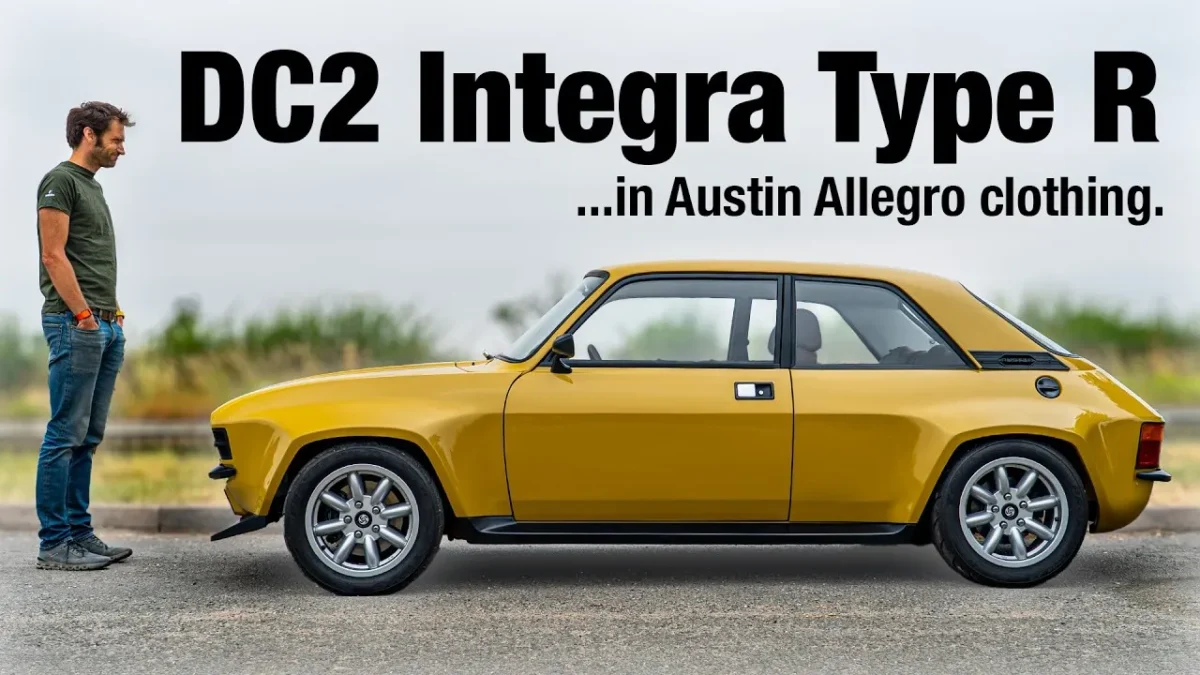
Somewhere in Leicestershire, a small workshop has committed what purists on two continents will consider an act of vandalism, and the rest of us should consider a minor miracle. Retropower has taken an Austin Allegro — the car so beleaguered it was nicknamed “All-Agro,” the rolling punchline of British Leyland’s 1970s — and rebuilt it on the bones of a Honda Integra Type R. The result, revealed in Henry Catchpole’s film for Hagerty, is called Project Lucky Strike. And it might be the most interesting restomod of 2026.
Yes, more interesting than another air-cooled Porsche with a six-figure invoice. Because anyone can make a great car great again. Making a bad car great? That takes nerve.
The Worst Possible Starting Point (On Purpose)
The Allegro needs no introduction, but it’s getting one anyway. Launched in 1973 to replace the genuinely successful Austin 1100, it arrived just in time to be made to look ancient by the Volkswagen Golf. Spen King — the engineer behind the Range Rover — reportedly compared the production car’s bloated proportions to a caricature of Henry VIII, and he was on the same side.
That reputation is precisely the point. Retropower’s client didn’t ask for a great car to be preserved; he asked whether one of Britain’s most ridiculed cars could be turned into a genuinely brilliant driver’s machine. As co-founder Callum Seviour puts it, the whole premise is that it started as a terrible car. Could they make it something good?
How Do You Fit an Integra Type R Under an Allegro?
The engineering answer was to stop trying to fix the Allegro and start replacing it. Retropower borrowed a DC2 Integra Type R and an Allegro, 3D-scanned both bare shells, and overlaid them in CAD. The two cars — separated by 25 years, 6,000 miles, and roughly infinite competence — lined up almost eerily well. The team joked that it was as if some Honda engineer had secretly designed the DC2 to accept an Allegro body. Even the B18C VTEC engine slots perfectly under the stubby bonnet.
So the finished car uses the Integra’s floorpan, inner wings, chassis legs, and bulkhead — shortened about 120mm at the rear footwell — while the Allegro contributes its roof, glass, apertures, and doorframes, all wrapped in a custom widebody. The historical irony is even better than it first appears: British Leyland was already building rebadged Hondas — the Triumph Acclaim arrived in 1981 — while the Allegro was still limping out of showrooms. This is less sacrilege and more an alternate timeline where that collaboration started earlier and went really, really well. Fittingly, it’s painted in period-correct Harvest Gold, a name Seviour politely declines to improve upon.
The Quartic Wheel Gets the Last Laugh
Inside, the infamous quartic steering wheel returns — the squared-off design the 1970s press dismissed as a gimmick and police fleets binned outright. Catchpole, who has driven the McLaren W1, points out that the hypercar’s wheel is an extremely similar shape. The Allegro was apparently just fifty years early. Somewhere, a British Leyland product planner is owed an apology, though presumably not for anything else.
The rest of the cabin blends Recaro front seats with original split-folding Allegro rears, chocolate-brown trim, Harris Tweed inserts, bespoke billet aluminium controls, and a discreet MoTeC display. It is, by all accounts, so refined that it deserves the badge of the Vanden Plas 1500 — the Allegro’s improbable luxury variant — rather than plain Austin.
The Shop That Gordon Murray Cold-Called
Retropower itself is half the story. Brothers Callum and Nathan Seviour started in a rented workshop in 2009 — one a degree-qualified engineer, the other a hotel bar manager — and their reputation grew to the point that Gordon Murray, designer of the McLaren F1, simply rang them up and asked them to build him a Mk1 Escort as a daily driver. His brief arrived as a handwritten spec on two sheets of graph paper. (For more on what happens when Murray gets properly obsessive, see our piece on why the McLaren F1 has a gold-lined engine bay.)
Today the workshop hosts a 392 Hemi-swapped Jensen, a Saab 900 hiding Audi S4 quattro underpinnings and a 600hp five-cylinder, and an E-Type with electric doors and a reversing camera concealed behind a flip-up number plate. Refreshingly, they turn work away: if you want an Alfaholics-style 105, they’ll send you to Alfaholics. If you want a Singer, go to Singer. Retropower exists for the cars nobody else would touch.
Why This Matters Beyond One Gold Hatchback
Lucky Strike lands in a booming market. The global classic car restoration and restomod services market is projected to hit USD 7.9 billion in 2026 and expand to USD 14.4 billion by 2036, with restomod builds expected to lead the sector with a 39.5% share this year as owners chase vintage design with modern drivability — and the UK’s heritage-vehicle culture keeping it growing at an assessed 6.4% annually (source: Future Market Insights, May 2026). The obvious donors — Porsches, Broncos, Defenders — are increasingly picked over and priced accordingly. On the other side of the world, Japan’s specialists are charging $375,000 for carbon-bodied Skylines. The next frontier is exactly this: unloved cars with loved-car engineering underneath.
It’s a very British solution to a very British problem, executed with Honda hardware — and it echoes a national talent for improbable comebacks we’ve chronicled before, most recently in TVR’s thirty-second resurrection.
If an Allegro can be made desirable, the entire back catalogue of automotive failure is suddenly in play. Trendy Trabants and attractive Aztecs get floated as candidates, and honestly, why not? The restomod industry has spent a decade perfecting nostalgia for cars people already loved. The clever money may now be on redemption arcs.
The Allegro spent fifty years as the answer to “what’s the worst British car ever?” It only took a Honda heart transplant, two obsessive brothers, and a coat of Harvest Gold to change the question.