In 1989, Ayrton Senna was the best racing driver in the world and everyone knew it. He had won two Formula One World Championships. He would win a third. He was at McLaren, the dominant team of the era, and his understanding of what a racing car should feel like was as sophisticated as any driver’s has ever been.
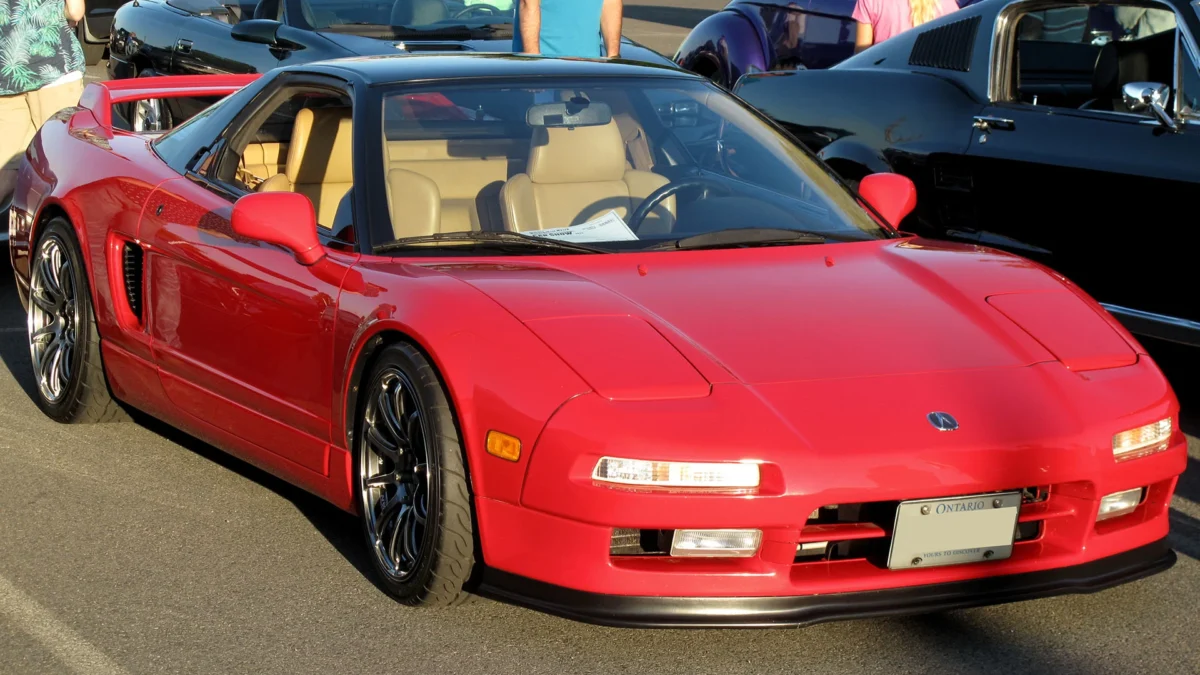
Honda, who supplied McLaren’s engines and had therefore watched Senna operate at close quarters for several years, invited him to Suzuka to drive a prototype of their forthcoming supercar. The car was, by any reasonable measure, already excellent. It was mid-engined, aluminium-structured, naturally aspirated, and designed to challenge Ferrari on their own terms. The engineers who had built it were proud of it, and they had reason to be.
Senna drove it and told them it was nervous at the limit. Not undriveable. Not dangerous. Nervous — meaning it didn’t communicate clearly enough, didn’t give the driver the feedback they needed to place it precisely and confidently at speed. In a road car aimed at wealthy enthusiasts, this might have been considered acceptable. Honda didn’t consider it acceptable. They went back and rebuilt the suspension.
That decision — to take the word of a three-time world champion seriously enough to rework a nearly-finished car — is why the NSX is not merely remembered but revered.
What Honda Was Trying to Do
The NSX project, which began in earnest in the mid-1980s under chief engineer Shigeru Uehara, had an explicit target: Ferrari. Specifically, the Ferrari 328, which was then the benchmark for accessible, mid-engined, naturally aspirated sports cars in the market Honda was aiming at.
This was, by the standards of Japanese automotive ambition of the era, a significant statement. Honda had won Formula One championships. They had built the S800 and S2000 as credible sports cars. But nobody had built a Japanese car that genuinely competed with Ferrari in the supercar segment — a car that an informed buyer would weigh seriously against a Maranello product and might, on reflection, prefer.
Honda’s approach to closing that gap was characteristically methodical. Uehara’s team spent considerable time at Ferrari dealers in Europe and America, interviewing owners and potential customers about what they valued and what frustrated them. The consistent findings were illuminating: Ferrari owners loved the performance and the emotional charge of their cars, but found them physically demanding, sometimes unreliable, and difficult to drive at everyday speeds without feeling that they were wrestling the car rather than working with it.
The NSX’s brief, as it crystallised, was to deliver Ferrari performance with Honda engineering quality and, crucially, Honda usability. A car that a skilled driver could exploit fully and an ordinary one could live with daily. This was not a compromise position. It was a direct attack on Ferrari’s most persistent weakness.
The Aluminium Decision
Before Senna entered the story, Uehara’s team had already made one decision that set the NSX apart from almost everything else in its class: the body and chassis would be aluminium.
In 1984, when this decision was effectively made, aluminium monocoque construction was the preserve of Formula One and exotic racing machinery. Ferrari used steel. Lamborghini used steel. The manufacturing complexity and cost of working in aluminium at production scale were considered prohibitive for a road car programme.
Honda built the tooling anyway. The resulting NSX chassis was lighter and stiffer than steel equivalents, which gave Uehara’s engineers a platform that could deliver the handling balance they were targeting without the weight penalties that had compromised rival cars. The decision cost more than the conventional approach. It also produced a car that weighed 1,370 kilograms in a class where 1,500 was considered acceptable — and whose chassis stiffness allowed the suspension to be tuned with a precision that heavier, less rigid structures couldn’t support.
This is the context in which Senna’s feedback arrived. The NSX was already a more sophisticated piece of engineering than most of its rivals. His criticism was not that it was badly built. It was that it wasn’t quite right.
What Senna Said
The accounts of Senna’s test session at Suzuka in 1989 vary in detail but are consistent on the substance. He drove the car, he lapped it, he pushed it toward its limits, and he reported that the handling felt nervous at high cornering loads. The car, he said, didn’t tell the driver what it was about to do before it did it. A racing driver — or a serious enthusiast driving hard on a mountain road — needed that communication. Without it, the car was being driven reactively rather than proactively, and that gap in information was both less satisfying and less safe than it should be.
The specific mechanical issue was identified in the suspension geometry. The rear toe characteristics under load were inducing instability that manifested as the nervousness Senna had described. The fix required changes to the rear suspension pickup points — not a minor revision, in a car that was approaching production readiness, but a significant rework of geometry that had already been validated through thousands of test kilometres.
Uehara authorised the changes.
The revised suspension geometry that resulted from Senna’s feedback became the production specification. Every NSX that left the Takanezawa factory from 1990 onward was built around rear suspension tuned in response to a test session conducted by the best racing driver in the world.
What the NSX Became
The production NSX, launched in 1990, was received as something that the automotive press hadn’t quite experienced before: a mid-engined supercar that was genuinely easy to drive at everyday speeds and genuinely rewarding to drive at the limit. These two qualities had previously been assumed to be in tension — you could have one or the other. The McLaren F1, the other supercar of its era that was defined by a single engineer’s uncompromising vision, was extraordinary but demanded enormous commitment from its driver. The NSX asked less of you on the way to work and rewarded everything you had on a circuit.
Ferrari’s response is instructive. The 348, which was supposed to be the NSX’s direct rival, was publicly compared to it in every major road test and found wanting in almost every dynamic metric. Ferrari subsequently developed the F355, widely credited as a direct response to the NSX’s benchmark-setting. In other words, a Japanese car improved the quality of Italian cars by shaming them into doing better. This is not a small thing.
Ayrton Senna continued his association with the NSX throughout his life. He drove one on public roads in Japan. He used it, by various accounts, as a reference point for what a road car’s communication with its driver should feel like — the lightweight, driver-focused philosophy that he had absorbed racing Lotus-built cars in Formula One, translated into something a customer could buy and use.
He died at Imola in May 1994. Honda suspended NSX production briefly in tribute. The car continued until 2005, a fifteen-year run that is remarkable for a mid-engined supercar in any era.
The Second NSX and What It Confirmed
The second-generation NSX, launched in 2016, was a fundamentally different machine — hybrid, turbocharged, heavier, and considerably more complex. It was also, critically, developed without the input of anyone quite like Senna. It was an excellent car in many technical respects and was received with polite appreciation rather than the genuine awe that greeted its predecessor.
The contrast is instructive. The original NSX was better than its specification suggested it should be, in ways that were difficult to quantify on paper. The second NSX was about as good as its specification suggested, and no better. The difference between those two descriptions is, in large part, the difference between having a single exceptional voice shaping a car’s character and having a development process that is thorough, professional, and entirely committee-led.
This is not a criticism of the engineers who built the second car. It is an observation about the nature of the decision Honda made in 1989: to listen to someone who knew, at a cellular level, what it felt like when a car was telling you the truth, and to change the car until it did.
What It Tells Us
The NSX story is a case study in the value of the right consultant at the right moment. Honda had excellent engineers, a clear brief, and a nearly-finished car. What they lacked was the perspective of someone who had spent their career at the absolute edge of what a car could do — someone who could detect, at speeds and cornering loads that most test drivers never approached, the precise character of a suspension’s misbehaviour.
They had access to that person. They invited him to drive the car. They listened to what he said. They changed the car.
The decision cost time and money. It produced one of the most admired driver’s cars of the twentieth century, prompted Ferrari to raise their standards, and gave Honda a supercar legacy that a company of their size and conservatism had no business owning.
Nervousness, it turns out, was the most valuable feedback they ever received.#