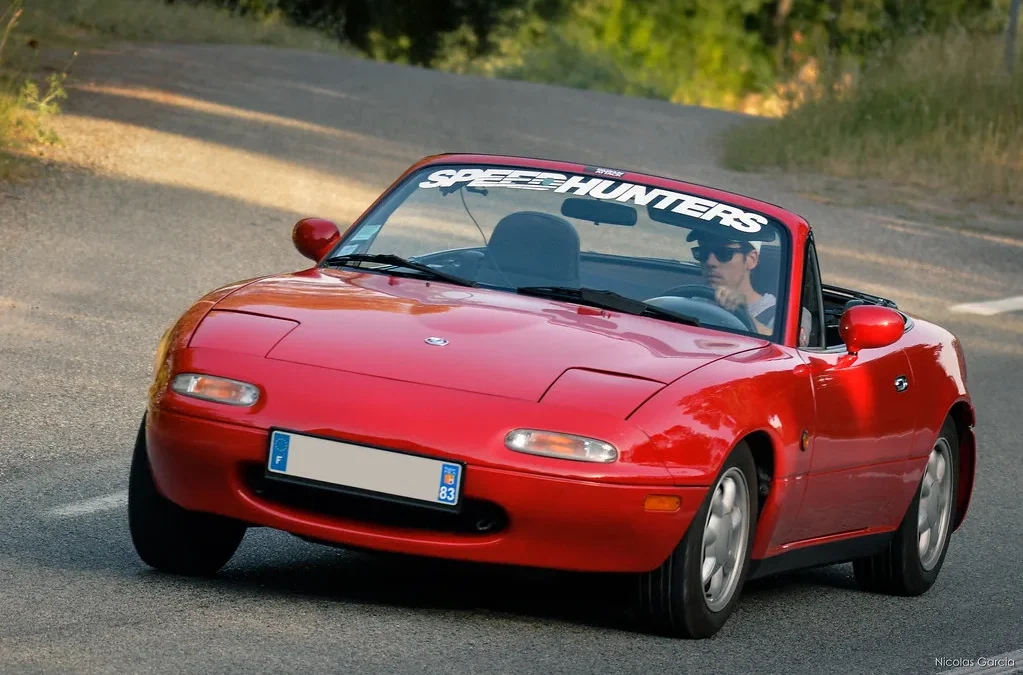
At some point in the mid-1980s, a group of Mazda engineers in a room in California got into an argument about where to put the engine. This was not a minor technical discussion. It was a philosophical dispute about what kind of car they were building, what it was for, and who, precisely, was supposed to drive it. The argument lasted, in various forms, for the better part of two years. It produced a car that has been in continuous production for thirty-six years, accumulated over a million examples, and is by most serious assessments the best-selling sports car in history.
The argument, in its simplest form, was this: mid-engine or front-engine?
The engineer who won the argument was Shigenori Fukuda. His reasoning has become something of a legend in automotive engineering circles, and it deserves to be more widely known than it is.
The Problem Mazda Was Trying to Solve
The Miata’s origins lie in a specific commercial observation. By the mid-1980s, the traditional British sports car — the MG, the Triumph, the Austin-Healey — had effectively ceased to exist. Emissions regulations, safety requirements, and the commercial difficulties of the manufacturers involved had between them eliminated the affordable, lightweight, open-top sports car from the market. The cars that had defined a generation of enthusiast motoring in Britain and America through the 1960s and 1970s were gone, and nothing had replaced them.
Mazda, whose rotary-engined sports car programme had given the company a genuine performance identity, noticed the gap. The brief that emerged from internal discussions in 1983 and 1984 was to build something that filled it — a small, lightweight, affordable roadster that recaptured the spirit of the cars that had disappeared. Not a supercar. Not a track weapon. A car for enjoying a road on a Sunday morning, with the roof off, at speeds that would not require a racing licence to manage.
The reference points Mazda’s engineers established were telling. The Toyota 2000GT represented the Japanese sports car tradition the Miata was consciously trying to revive, but the more direct benchmarks were European: the Lotus Elan, the Alfa Romeo Spider, the MGB. Lightweight. Communicative. Simple. Cars that made their drivers feel clever rather than terrified.
The Mid-Engine Argument
The case for a mid-engined Miata was, on paper, compelling. Mid-engine layouts offer near-perfect weight distribution, lower polar moments of inertia, and handling characteristics that, in a sports car, translate directly to agility and balance. Every serious sports car of the era — the Fiero, the MR2, the Lotus Esprit — was moving toward mid-engine configurations. The physics were unambiguous. If you wanted the best-handling small sports car possible, you put the engine behind the driver.
A faction within Mazda’s engineering team, based in Japan, pushed hard for exactly this. Their prototype work suggested a mid-engined Miata would be dynamically superior. They were not wrong.
Fukuda, leading the California-based team that had originated the project, disagreed — not about the physics, but about the question being asked.
The Argument Fukuda Won
Fukuda’s position, as documented in multiple accounts of the Miata’s development, was essentially this: a mid-engine layout optimises a car for the limit of its performance envelope. It makes the car as fast and as balanced as possible at high speeds and high cornering loads. But the Miata was not being designed for the limit of its performance envelope. It was being designed to be enjoyed by ordinary drivers, on ordinary roads, at ordinary speeds — and at those speeds, the mid-engine layout’s advantages are largely irrelevant, while its disadvantages are not.
A mid-engine car requires careful packaging. The engine behind the driver means a shorter wheelbase is harder to achieve, or a longer rear overhang, or compromises in cabin space that make a small car feel cramped rather than intimate. More importantly, the mid-engine layout removes something that Fukuda considered essential to the car’s character: the sense of mechanical connection that a front-engine, rear-drive layout provides.
In a front-engine, rear-drive car, the driver sits between the engine and the driven wheels. The forces of acceleration and the forces of steering work through the driver’s body in a way that is intuitively readable — you can feel the rear working, feel the front loading and unloading, feel the whole car communicating its grip and balance through the seat and the wheel. Colin Chapman had built the Lotus Elan — Mazda’s primary handling benchmark — around exactly this principle. The Elan was not mid-engined. It was front-engined, rear-driven, light, and perfectly balanced, and it communicated with its driver in a way that faster, more sophisticated cars could not replicate.
Fukuda wanted to replicate that. The mid-engine layout, whatever its dynamic advantages at the limit, would not give him the same result.
What Front-Engine, Rear-Drive Actually Required
Having won the layout argument, Fukuda’s team then had to deliver on the promise of it. A front-engine, rear-drive layout is not automatically communicative or balanced. It requires careful attention to weight distribution — the engine as far back as possible, the gearbox as close to the centre as possible, the fuel tank and spare tyre positioned to maintain near-50/50 front-to-rear balance.
Mazda achieved a front-to-rear weight distribution of 50.5/49.5 in the finished NA Miata — as close to perfect as the layout allows. The engine was mounted low and set back toward the firewall. The battery was relocated to the boot to balance the weight of the spare tyre. Every component’s position was evaluated against its effect on the car’s overall balance.
The result was a car that weighed under 950 kilograms and handled with a precision and transparency that its price point — around $14,000 at launch in the United States in 1989 — made almost incomprehensible. Road testers who drove it back-to-back with mid-engined alternatives at similar price points consistently reported that the Miata felt more communicative, more predictable, and more rewarding at everyday speeds. Not faster. More connected.
The Decision’s Legacy
The Miata has been in production through four generations — NA, NB, NC, ND — and in every one of them, the front-engine, rear-drive layout has remained non-negotiable. The ND, launched in 2015, is lighter than the original NA and handles better by every objective measure. It is still front-engined. It is still rear-driven. The layout Fukuda insisted upon in a California argument in the mid-1980s has been re-validated by four engineering teams across four decades.
More than a million Miatas have been built. It is the most-raced car in North American motorsport, the foundation of Spec Miata — one of the largest and most competitive single-make racing series in the world — and the car that a significant proportion of professional racing drivers cite as the one that taught them the most. Not because it is fast. Because it communicates.
The mid-engine advocates were not wrong about the physics. Fukuda was right about the car.
What It Tells Us
The Miata’s layout decision is one of the clearest illustrations in modern automotive history of the difference between optimising for performance and optimising for experience. The two are not the same thing, and confusing them produces cars that are technically impressive and emotionally inert.
Fukuda’s argument — that the question was not “what layout makes this car fastest” but “what layout makes this car feel the way it should feel” — is one that every engineer working on a driver’s car should be required to read. It is also, notably, the argument that the mid-engine advocates could not answer. They had better physics. He had a better question.
The Miata is not the fastest car in any class it has ever competed in. It has never needed to be. It is the car that people who care about driving buy when they want to remember why they care about driving, and that distinction — earned by a layout decision made in an argument in California forty years ago — is worth more than any lap time.